
The following guide covers:
Levels of training needs assessment
Components of training needs analysis
4 steps to assess employee training needs
Example of the training needs assessment process
A well-done role-level training needs assessment can help you pinpoint the exact skill gaps holding people and your organization back. While training is not always the solution to reach the organization's goals in this regard, assessment helps you decide what your next steps shall be.
In this article, we will guide you through the key steps: setting organizational goals, analyzing job roles, assessing current skills, identifying gaps, and selecting the right training solutions. Along the way, you will find practical insights and real tips from HR leaders, L&D professionals, and career specialists who’ve done it all before.
Levels of training needs assessment
As the HR Guide defines, training needs assessment is
“The process of identifying training needs in an organization for the purpose of improving employee job performance”.
Let us imagine your sales numbers are dropping, customer complaints are rising, or a new system is rolling out soon. Do your employees need more product knowledge? Better communication skills? Or is the issue something else entirely? Without a proper analysis, the experience would be like pinning the tail on the donkey while blindfolded.
As Sean McKesson, specialist at Career Development Solutions, explains:
“First, it (training needs analysis) defines and prioritizes the greatest areas of need. It allows you to identify the performance and skill gaps that you may know or not know about. It’s also integral to determine the costs and benefits of the training”.
Sean McKesson
Solutions architect at Career Development Solutions
After such analysis, you may discover that you do or do NOT need the training. To understand whether the training is the solution for the organization’s goals, companies usually conduct a training needs assessment on the organizational level, role level, and individual level.
- Organizational level
The organizational level focuses on the big picture. It helps you understand whether training is aligned with your business strategy and whether it supports the goals leadership actually cares about.
“This level looks at the company as a whole, and you’ll need to look at your current strategies, goals, and future direction. You then need to establish a gap between where you currently are and where your organization wants to be”.
Juliette Denny
Founder of Iridescent Technology
For example, if the company plans to enter a new market or launch a new product line, you need to assess whether the workforce has the capabilities to deliver. Maybe you are investing in digital transformation. Do your teams have the tech skills to handle it, or is there a reskilling gap?
Here are three key tasks a specialist typically does at the organizational level:
- Review strategic documents and business plans. This includes goals, KPIs, financial reports, or market expansion strategies.
- Interview leadership and department heads. The aim is to understand priorities, challenges, and expectations.
- Identify performance gaps linked to strategic objectives. You compare where the company is now versus where it wants to be, and determine whether skill or knowledge gaps are part of the problem.
- Role level
The role level focuses on what specific job functions are needed in order to perform effectively. While the organizational level looks at the company’s direction, the role level zooms in on what each position requires to help move in that direction.
To run a training needs assessment at the role level, here are three key tasks
- Define the competencies for each role. This includes technical skills, soft skills, tools used, and expected outputs.
- Interview or survey role experts and team leads.
- Compare actual performance with role expectations. Review KPIs, project results, error logs, customer feedback, or any metrics tied to the role. Identify if the issues are skill-based or if they stem from other factors like unclear processes or a lack of tools.
- Individual level
The individual level focuses on each employee’s specific strengths, weaknesses, and growth areas in that role. So to speak, you define what this person needs to be better at that job.
In this case, the assessment process involves the following key steps.
- Review performance data and feedback. This includes performance appraisals, manager reviews, 360-degree feedback, or even peer evaluations.
- Hold one-on-one conversations.
- Set development goals tied to the role.
Components of training needs analysis
As we have already mentioned, analysis is an integral part of your employee training needs assessment process. And as such, the HR Guide advises conducting an analysis on a few important components, such as
- Person analysis
This is where you identify who needs the training. Not every employee in the same role performs at the same level. Person analysis helps you pinpoint individuals or groups that require support. For example, your newly hired customer service reps may need training on call-handling techniques. But for some others, it may be the conflict resolution skills that need attention.
- Task analysis
Here, you break down what tasks need to be performed and what skills they require. This step also means looking at how work is currently done versus how you want it to be done.
- Document analysis
This involves reviewing job descriptions, SOPs, performance expectations, and compliance guidelines to ensure that what you train people on matches what the role demands.
- Skill gap analysis
Once you know what the role demands and what the employee currently does, you run a skill gap analysis. This identifies the difference between current and required capabilities.
Now, let’s put all of these steps into a practical checklist and see where and how you can start the employee training needs assessment.
4 steps to assess employee training needs
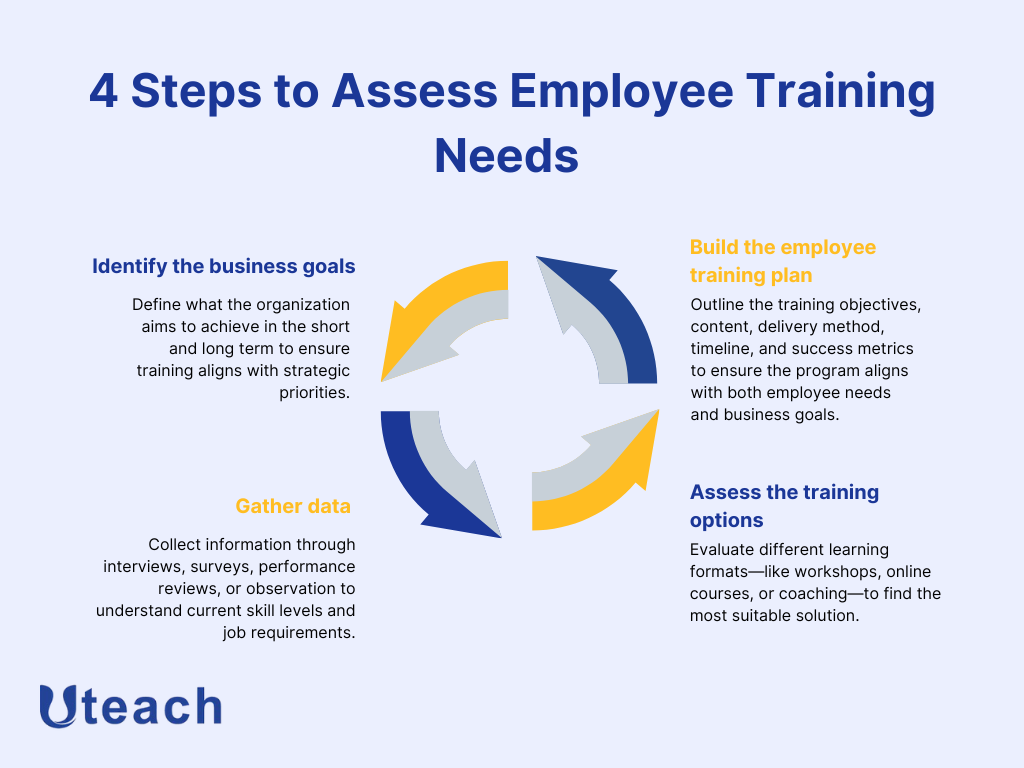
If we look through the whole process of assessing the employee training needs from the top, it will look like this
- Identify the business goals
- Gather data
- Assess the training options
- Build the employee training plan
Reflect back on your business goals
Companies aligning performance management with business strategy see employees become up to 35% more efficient and productive. According to the State of Performance Enablement Report conducted last year, 70% of the employees also feel a sense of belonging when the company's goals align with the training objectives.
Some of the examples companies mention as their business goals include:
- Improve customer satisfaction by x%
- Reduce employee turnover by x%
- Increase productivity by x%
- Strengthen technical capabilities, etc.
Such goals become apparent when you discuss the direction the company is moving to with the leadership team. After you have clearance on the topic, your next task is to understand how the departments and employees themselves can contribute to achieving those goals.
To identify that on a role level, a job analysis will come to help.
Conduct a job analysis
Job analysis is breaking down the role into its core tasks and responsibilities. One of the methods is when you identify all the tasks someone in this role performs regularly, how often they do them, how important each task is, and how difficult they are.
For example, for a customer service representative, the key tasks analysis can look like this.
Task | Daily Frequency | Importance (1–5) | Difficulty (1–5) |
| Answer incoming calls | High | 5 | 3 |
| Resolve customer complaints | Medium | 5 | 4 |
| Enter data into the CRM system | High | 4 | 2 |
| Escalate unresolved issues | Low | 4 | 4 |
| Prepare daily reports | Low | 3 | 4 |
Once the tasks are clear, you then pinpoint the knowledge and skills needed to perform them effectively. Using this example, the role requires strong communication skills, product knowledge, problem-solving abilities, and CRM software proficiency.
Based on our task example above, the skills and knowledge will look like this.
Skills
Required Knowledge
|
For this list to be accurate and reflect the true competencies the employees need, discuss it with the employees themselves and the team managers.
Now that you have all the skills listed, you shall conduct skill gap analysis, which will reveal the area of training for a specific role.
Assess current skill levels
Once you know what knowledge and skills are required for the role, the next step is to assess where employees currently stand. This is what skill gap analysis is all about, comparing what employees can do now versus what they need to be able to do to meet job expectations and business goals.
There are several effective ways to assess current skill levels:
- Manager evaluations – Team leads and supervisors can provide grounded feedback based on daily performance.
- Tests or assessments – Use quizzes, technical tasks, or practical tests to measure knowledge and application.
- Peer feedback – Especially useful in collaborative roles, peer feedback can reveal strengths or blind spots.
- Interviews and focus groups – Talk directly to employees to understand how confident they feel about specific tasks and where they struggle.
Sean McKesson, Solutions Architect at Career Development Solutions, outlines some best practices their team takes into consideration while doing employee skill assessments.
“There are some ground rules that I like to set. Begin with the end in mind and think about those goals, and build your interviews around that. Set a timeline and make sure that everybody stays on task so that you can get the most data. And then diversify the data sets. When you’re asking questions, make sure you have open-ended questions as well as closed-ended questions”.
Sean McKesson
Solutions architect at Career Development Solutions
As you analyse all the data about the current skills levels the employees have, create a table and mark the level for each skill as
- Low
- Medium
- High
In the same way, rate the urgency to acquire the skill in that table.
Find the gaps to be filled
Now that you know what skills are required and where your employees currently stand, it is time to compare the two and spot the real gaps.
To do this, many teams use a simple spreadsheet. You list the business goal, each key skill, assess the current skill supply (how present or strong it is across the team), and compare it to the degree of demand (how critical the skill is for current or future business needs). Both are rated as Low, Medium, or High.
Here is an example layout:
Skill | Current Skill Supply | Degree of Demand | Gap Type |
| Handling customer objections | Low | High | Shortage |
| Report writing | High | Medium | Surplus |
| CRM software navigation | Medium | Medium | Maintain |
| Data interpretation | Low | Low | Low Priority |
“The most effective companies take a deliberate, systematic approach to capability assessment. At the heart of this process is a comprehensive competency or capability model, which is based on the organization’s strategic direction.
Kevin Rutherford
Chief human resources manager
This is the method shared by Kevin Rutherford, Chief Human Resources Officer, who recommends a competency gap worksheet that follows this same logic. Their team uses the following way to identify if the employee needs training on that specific skill.
- Low supply, high demand = shortage. This is a critical gap and should be prioritized for training.
- High supply, low demand = surplus. No training needed here. You might even consider reallocating resources.
- Medium supply, medium demand = maintain. Keep existing capabilities sharp through occasional refreshers or coaching.
- Low supply, low demand = low priority. Can be monitored, but does not require immediate action.
Create the training plan
The skill gap analysis shows exactly what training the role or the particular employee needs.
But before you start with the training and learning, you need to create the employee training plan.
This is where you plan the learning goals, timeline, budget, key tasks, resources, and the format for the training. And if the data you have already gathered is not enough to decide on the specific format and training delivery, you can ask your employees again.
“I always ask the team supervisors whose employees are delivering the projects or the products. This, for me, is the best way to find information about what kind of training they actually need. This can be done in a survey or by asking them one by one”.
Jason Schroeder
President of Elevate Construction and Leantakt
To make planning the training even more effective, ask yourself the following questions
- What training resources do we already have
- What is the best format of training for the employees
- How much time should an employee spend on training, and when should they train
- Do we use internal or external resources to train the employees
- What platforms or tools do we use to deliver the training
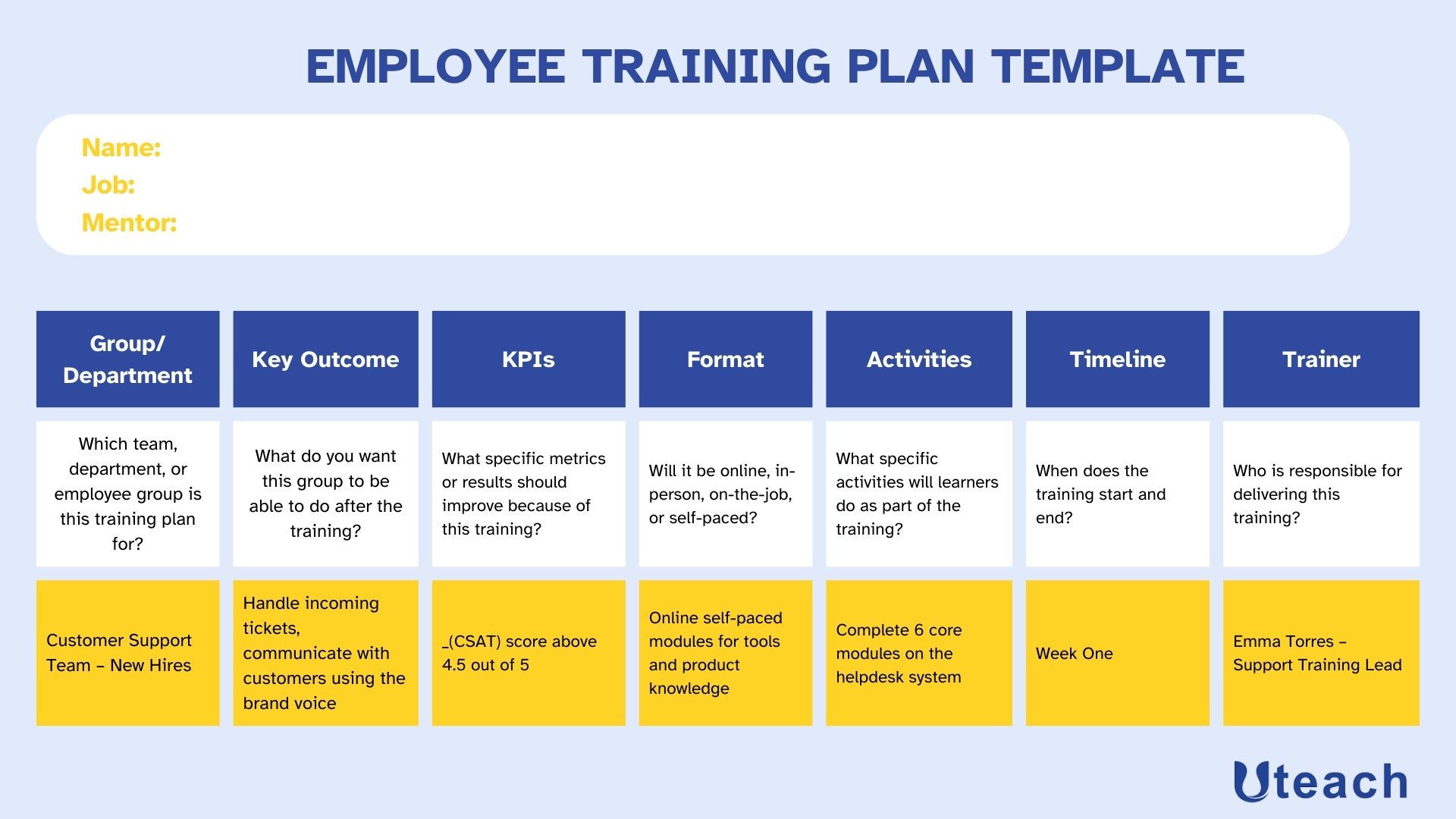
The template below includes the key components your employee training plan should include, which you can customize depending on your organization’s needs.
Example of the training needs assessment process
If you found yourself lost in the process of gathering, analyzing the data, and planning the solution, the simple example below will clear the doubts.
Let us say we are a fictional company named BrightNest Tech. It is a mid-sized software company specializing in customer experience tools for online retailers. The company is rapidly scaling and wants to ensure its teams are prepared to support growth.
Organization goals
- Improve customer retention by 20% over the next year
- Expand into a new market of retailers in Spanish-speaking countries
Job analysis
Target Role: Customer Support Specialist
Task | Frequency | Importance | Difficulty |
| Responding to support tickets | Daily | High | Medium |
| Handling customer objections | Daily | High | High |
| Using internal CRM and helpdesk tools | Daily | Medium | Medium |
| Escalating technical issues | Weekly | Medium | Low |
| Gathering product feedback | Weekly | High | Medium |
Knowledge and skills required:
- Clear written communication
- De-escalation and objection handling
- Product knowledge
- CRM software navigation
- Active listening and empathy
Current skill levels
Skill | Assessment Method | Average Rating |
| Written communication | Writing test + review | Medium |
| Objection handling | Manager interviews + survey | Low |
| CRM navigation | Platform test | High |
| Product knowledge | Quiz + self-rating | Medium |
| Active listening | Peer review + simulation | Medium |
Skill gaps
Skill | Skill Supply | Demand | Gap Type |
| Objection handling | Low | High | Shortage |
| Written communication | Medium | High | Maintain |
| CRM navigation | High | Medium | Surplus |
| Product knowledge | Medium | High | Maintain |
| Active listening | Medium | Medium | Maintain |
Key Training Priority: Objection Handling
Training objective: Improve objection-handling skills in the customer support team to increase customer satisfaction and retention
Training format: Blended learning, live role-play sessions, short on-demand videos, peer coaching
Training Timeline:
- Week 1: Video modules on communication and conflict resolution
- Week 2: Live practice sessions with feedback
- Week 3: Peer shadowing + manager-led feedback
- Week 4: Final simulation assessment and reflection
FAQ
- What are the 5 steps of training needs assessment?
The five steps of training needs assessment help organizations figure out exactly who needs training, what they need to learn, and why. Here is how it flows:
- Identify organizational goals. Start by understanding what your company is trying to achieve. Training should align with these business objectives.
- Conduct a job analysis. Look at specific roles and identify the tasks, required skills, and knowledge for each one. This gives a clear picture of what “good performance” looks like.
- Assess current performance. Collect data (via surveys, interviews, performance reviews, etc.) to understand where employees currently stand in terms of skills and knowledge.
- Identify skill gaps. Compare the current skill levels with what’s needed. This reveals the gaps that training should aim to close.
- Plan the training strategy. Design a targeted training solution that addresses those gaps. Choose the format, set clear objectives, and define how success will be measured.
- What is a TNA questionnaire?
A TNA questionnaire (Training Needs Assessment questionnaire) is a structured set of questions used to gather insights about employees’ current skills, knowledge, and training needs. It helps organizations understand what kind of training they actually need.
These questionnaires often include a mix of closed-ended questions (e.g., rating your confidence in a specific skill from 1–5) and open-ended questions (e.g., “What challenges are you facing in your current role?”). You can have them for different roles, departments, or levels of experience.
- Is training needs assessment the same as training needs analysis?
Often, you see the terms training needs assessment and training needs analysis used interchangeably.
Training Needs Assessment (TNA) is the broader process of identifying if and where training is needed. It looks at why training is required, who needs it, and what the training should cover. It often includes gathering data through surveys, interviews, performance reviews, and job analysis.
Training Needs Analysis is a step within the assessment. It focuses more specifically on analyzing the necessary data to complete the assessment process.