
The following guide covers:
How does learning retention work?
“In the end, we retain from our studies only that which we practically apply.”
— Johann Wolfgang Von Goethe
Your employees can attend all the workshops in the world, read a hundred how-to guides, and collect digital certificates like trading cards. But if nothing gets applied, most of that knowledge quietly evaporates.
Retention is not about how much information we can stuff into our heads in a single sitting; it is about how much of it stays useful, accessible, and ready when the job demands it. So, if you want your employees to retain the information, you want to make learning more useful and accessible.
In this article, we will look at six initiatives that improve learning retention in a very practical way. You will see how continuous learning prevents knowledge from fading, how aligning training with daily work makes recall easier, how internal knowledge hubs keep memory fresh, how managers, recognition, and peer-to-peer sharing all contribute to making retention more natural.
How does learning retention work?
Learning retention is essentially about how much of what we learn stays in our memory and can be recalled when needed. The science behind it is not overly complicated: our brains are built to filter information. We remember what feels useful, relevant, and repeatedly reinforced, and we forget what seems unimportant or is never applied.
Psychologist Hermann Ebbinghaus explained this over a century ago with the “forgetting curve,” showing that people forget most new information within days if there is no reinforcement.
Several factors influence retention.
- how meaningful the material feels to the learner.
- how often it is repeated or practiced.
- whether it is connected to real-life tasks. T
- the level of engagement and interaction during learning.
- the support system around it.
At first, information enters short-term memory. If it is practiced, discussed, or connected to something practical, it moves into working memory. With further repetition, application, or teaching others, it makes the shift into long-term memory.
So to speak, the more cues and contexts are linked to that knowledge, the stronger the memory trace becomes.
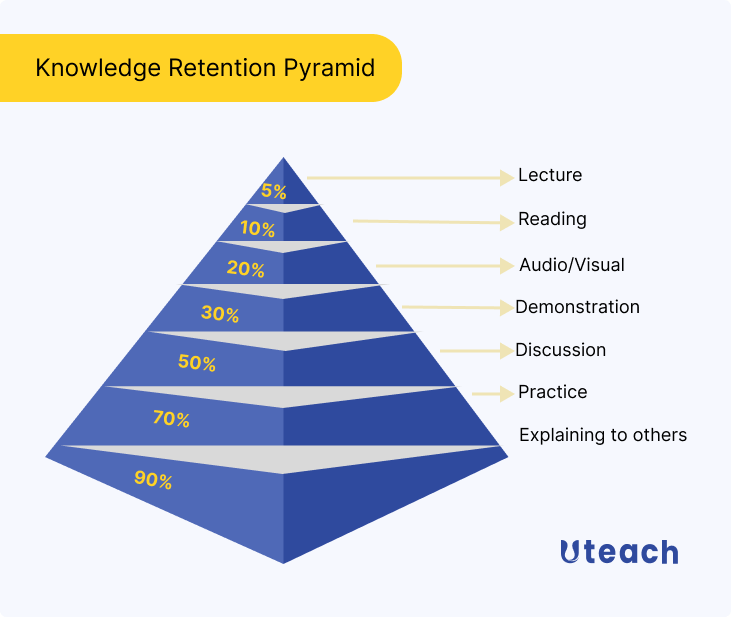
A useful way to visualize this is through the “learning pyramid of retention,” which illustrates how different activities lead to different levels of retention.
At the top are passive methods like lectures or reading, where people tend to remember only a small portion of what they hear or read. As you move down the pyramid, retention rates improve: discussing the material, practicing by doing, and especially teaching others can push retention levels above 70–80 percent.
The percentages vary, based on which studies we consider. But the idea is the more active and participatory the learning experience, the better the retention.
L&D best practices to improve learning retention
Improving learning retention is not just about clever slide decks or polished instructional design. The key is also creating a learning environment that truly sticks. The following practices go beyond course creation.
We will discuss strategic L&D initiatives designed to foster long-term knowledge retention across your organization.
Build a culture of continuous learning
As discussed above, retention only strengthens when learners start applying that knowledge. So, when you run workshops once in a while, you only provide the opportunity to learn. And that knowledge quickly fades away.
But the challenge here is not just the forgetting curve but the lack of opportunities to bring that learning into everyday work. That is why you want to make the efforts continuous with continuous learning.
In this case, employees get frequent touchpoints with knowledge, which significantly improves retention. In fact, research from Deloitte has shown that organizations with a strong learning culture are 92% more likely to develop new products and processes successfully. Meaning the learning culture fosters people remembering, applying, and expanding what they know.
So, how do you make continuous learning more than just a slogan on a wall? To implement it, you can:
- Give employees ownership of their own learning, with self-directed learning opportunities and mentorship.
- Make learning more engaging with microlearning, mobile learning, and game-based learning opportunities.
- Promote the mindset of continuous learning, explaining the key purpose of learning
A good example of this in practice is Google. The company is widely recognized for how it integrates learning into work rather than treating it as an add-on.
Employees have access to “Googler-to-Googler” programs, where staff teach each other specialized skills, and internal platforms where microlearning resources are constantly available.
What makes this effective is not just the scale but their philosophy. Learning is expected, not optional. As a result, people can test, fail, relearn, and share again.
Related: Continuous Learning at Work: 4 Steps to Start
Align training with daily work
The human brain is very selective. It keeps what it finds useful and discards what it cannot apply. That is why aligning training with everyday work is such a practical way to improve learning retention.
To make the training even more efficient, most companies adapt the learning in the flow of work approach. Here, the learning happens just in time and when the employee actually needs it. You can implement such an approach by
- Breaking down training content into smaller chunks that fit naturally into daily routines, such as short guides or process checklists.
- Embedding training into the very tools employees already use, like CRM systems or project management software, so the learning appears exactly when it is needed.
- Encouraging managers to bring training discussions into regular one-on-one meetings, connecting lessons to immediate goals.
With this approach, employees do not attend training sessions separately. Instead, they get learning materials and insights relevant to the tasks they are currently performing.
One of the best examples of learning in the flow of work is Microsoft.
They integrate learning into existing workflows (search, in-app, Teams), ensure broad content (both formal training and informal tips), and maintain it. Because employees see, for example, Viva Learning and other content inside their daily tools and can search for knowledge through Microsoft Search or topics via Yammer, the hub is not “extra work” but part of how they do work.
In their blog, Microsoft shared the following:
“Our subject matter experts follow the channels that host the content, so they get notified when someone asks a question in the chat about a session days, weeks, or months after the session is complete”.
Jeff Bogdan, director of learning, Windows Engineering
Use internal knowledge hubs or wikis
Another challenging part about just offering training? It is often the case that the information stays within the walls of the offline training or is buried somewhere in the online course modules.
And because there is no quick place for employees to check the information they need at the moment of work, learning retention weakens.
You can address this gap with internal knowledge hubs, employee handbooks, or wikis. In this case, wikis become the go-to resource for exact information that is accessible, searchable, and reliable. Besides, wikis make sharing tacit knowledge practical. You can capture tips, lessons, and updates, so learning is not lost when someone leaves or moves roles.
If you want to organize your corporate learning wikis:
- Use tools your people already use daily. If your teams work in Microsoft Teams, SharePoint, or something similar, embed the knowledge hub there
- Ask your employees to organize by topic, role, or project so people can find what they need. Use tags, metadata, and good naming.
- Give teams or individuals responsibility for updating specific sections.
- Promote micro-contributions. If someone discovers a quicker method or updated process, let them write a short note
Make manager accountability partners
As the learning pyramid we discussed shows, the knowledge retention rates are higher when the learners actually reinforce learning.
And one of the ways to reinforce the knowledge is to have the employees get a follow-up after the training with their managers. This practice is especially true when you are training your new hires.
Without that ongoing accountability, what they learn declines. To improve learning retention in this regard, you can implement the following practices.
- Give managers responsibility for following up on team members’ training. For example, schedule brief check-ins where employees report what they tried from training, what worked, and what did not.
- Train managers in coaching skills. They must know how to ask good questions, give constructive feedback, and help map learning to performance.
- Set metrics tied to the retention and learning application. For example, track how many learning goals are set and achieved in teams, or how direct reports report manager support in applying training.
- Make manager development continuous. Managers should also have their own learning and coaching so that they model accountability.
The question now is, how can you encourage your managers to take the initiative? Performance reviews are one way to achieve this, but Adobe, for example, implements a different approach.
Adobe famously abolished the traditional annual performance review in 2012 and replaced it with the "Check-in" system. This system is built on regular, ongoing feedback between managers and employees.
In this model, the managers are expected to be coaches and are held accountable for the growth and success of their team members.
In a podcast interview, Jeff Jacobs, the Senior Director at Adobe, mentioned
“We have mandated quarterly check-ins where we have somewhere upwards of 94% of employees report successful check-in meetings with their managers around alignment and how they’re doing, which just boggles my mind.”
Jeff Jacobs
Recognize and reward knowledge application
You are right. Rewards are not a direct way to increase learning retention. However, the recognition systems you implement encourage employees to put their knowledge into practice, which results in better retention.
Here are some ways you can use employee rewards during the training.
- Award badges or digital credentials when learners apply the training knowledge via assignments on the LMS platform.
- Introduce a points system or “learning currency” that employees earn when they demonstrate application of training
- Publicly recognize their efforts during the all-hands meetings and give shout-out
The currency system is what Zapos adapts to encourage its employees. People then redeem those for swag, charity donations or other small perks. For example, for them, it is even a parking spot, which is a challenge in the morning hours.
Encourage peer-to-peer knowledge sharing
According to multiple models of retention, when one teaches or shares knowledge, one organizes thoughts, identifies gaps, and reinforces what was known. That act of teaching others improves understanding and recall.
So retention improves not only because of repetition but because, according to the Feynman Technique, explaining helps remember information more effectively.
When people hear from peers, not just experts, the material is often more relatable, more directly applicable, and easier to internalize.
The core idea behind peer-to-peer learning is that you use the internal expertise of your employees who already do the work well to teach others. You can encourage such practice in the following ways:
- Organize peer review or peer feedback sessions. For instance, after someone applies something from training, peers review each other’s work or processes and suggest improvements.
- Use internal forums, Slack / Teams channels, and wikis where peers post tips, short how-tos, and lessons learned.
- Run learning circles, where you have the facilitator and the presenters. The facilitator, in this case, your employee mentor, formulates the presenter group. And the group prepares a presentation on the solution to the current problem the team is facing. And the other groups listen to each other.
For this purpose, Amazon launched Circles. Due to this initiative, employees focus on career development, skill-building, and building meaningful professional relationships. Karl Viedge, who led the mentoring program in the UK, mentions:
“Helping a colleague get to the heart of a personal or professional challenge helps you to assess and reflect on your own challenges. It’s an invaluable way to practice how you respond to hard times or big decisions”.
Karl Viedge
Senior Manager in Finance Operations at Amazon
Related: Peer-to-Peer Learning | How Does It Work, Examples
Provide the best learning experience with Uteach
People do not remember training simply because it was well-designed or nicely delivered. They remember when learning is continuous, directly tied to their work, supported by systems, reinforced by managers, rewarded for application, and shared among peers. In other words, retention thrives when organizations treat learning as part of daily culture, not as a one-time event.
If you want to make learning in your organization not only memorable but also engaging, organized, and easy to access, you need the right system in place. A learning management system like Uteach helps you build that structure. With Uteach, you can:
- Centralize all training resources in one place.
- Attach quizzes, guides, and knowledge checks directly to live sessions.
- Track progress and see who is applying what they learned.
- Encourage collaboration through peer-to-peer activities.
- Keep learning accessible on demand, so no knowledge is ever out of reach.
To see how Uteach can make your training experience smoother and far more effective, book a demo with our team. We will walk you through the platform and show you how it can help your organization not only deliver training, but actually make it stick.