The following guide covers:
When to build a personal brand
Should you build a niche brand or a personal brand?
Should you build your brand around yourself or your niche?
The choice between a personal brand and a niche brand indeed affects everything, such as how quickly you build trust and how easily you scale. A personal brand helps people connect with you instantly. A niche brand gives your business a focused identity that feels bigger than one person.
In this guide, we will break down when to choose which path, explore the pros and cons of both options, and examine real-world examples to help you make an informed decision that aligns with your business goals.
When to build a personal brand
A personal brand is how you present yourself to the world as a creator or expert. It is built around your name, your voice, and your unique point of view. This means that people follow you because they trust you, like how you teach, and want to learn from you because of you.
As Tim Ferriss describes, it is hard to imagine someone wanting to succeed without personal branding in this Google era.
Personal branding is about managing your name, even if you don’t own a business, in a world of misinformation, disinformation, and semi-permanent Google records. Going on a date? Chances are that your “blind” date has Googled your name. Going to a job interview? Ditto.
Tim Ferris
Author, entrepreneur
I will share a checklist for you to decide if you need to build your creation business around niche branding or personal branding. But before that, here are three cases when personal branding is better:
- You are selling coaching, services, or content based on your personality, experience, or story.
- You plan to be the instructor in most of your courses.
- You do not know the direction you want to niche down yet
Let’s get into the details of all these points.
Advantages | Disadvantages |
| Easier to build trust | Hard to scale and sell |
| More flexible | Tied to your energy, reputation, and presence |
| More human storytelling | Different audience perceptions of professionalism |
Advantage #1: Easier to build trust
With personal branding, people usually perceive you as more authentic, relatable, and empathetic. Why?
- People connect with people
Sure, there is still no research that directly proves consumers are more likely to trust a personal brand over a niche brand. I am not insisting on that. But if we look at it from the psychological point of view, people connect with people, not the business or the company itself. That is because mirror neurons, facial expressions, and voice tone all help people feel safe and connected.
To build that trust and connection with consumers, even companies started creating content around the personality of their employees. Not long ago, we used to think that if you were building a business brand, you had to stick to being formal with your brand messaging, especially in B2B. But so many companies (like Semrush and Hubspot, my personal favorites) proved that wrong.
- People remember you more easily, which brings familiarity
When you make your personality and identity the core of the branding, it brings a sense of familiarity. In fact, 36% of marketers believe influencer content outperforms brand-created social media content, due to higher trust and authenticity perceived by consumers. And that applies to personal branding as well.
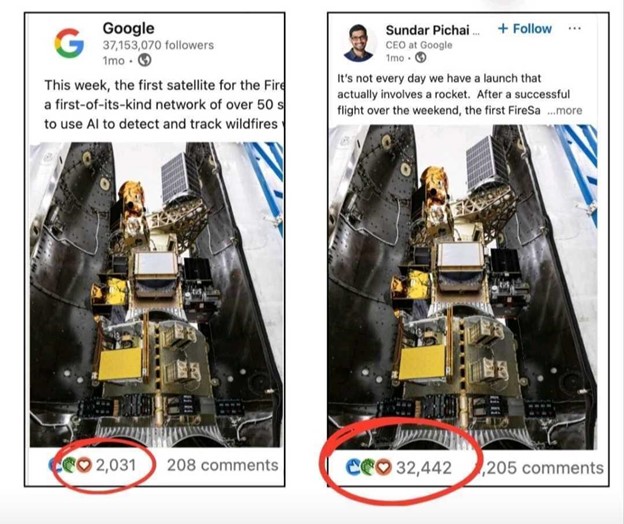
If you have both a personal account and a business account, you know that the audience is more likely to show more engagement on your personal account than the brand account.
In the example below, you can see the exact same announcement, one posted on Google’s page, and another on Sundar Pichai’s, who is the CEO at Google. The difference in engagement is huge.
Advantage #2: More human storytelling
It is true that you can put storytelling on the basis of your niche brand, too. But in the case of personal branding, you have more flexibility to show
- what you think
- how you feel
- what the journey was like
Your own experiences, failures, and lessons resonate in ways that a niche brand’s copy does not match. That is because you do not just position yourself as an expert in that niche when talking about your own struggles, growth, and behind-the-scenes process.
Advantage #3: Easier to create and maintain a community
You would agree that human connection drives community. We already established that audiences are more likely to engage, comment, and stay loyal to someone they feel emotionally connected to, which is far easier with a face and a story than with a brand name.
A Sprout Social study found that 72% of consumers feel more connected to a brand when its CEO is active on social media․ This is an important factor for community loyalty․
An excellent example of that is Kit (formerly ConvertKit). Nathan Barry, founder of ConvertKit, indeed started with personal branding. He began his career as a freelancer, then created iPhone apps, and built an audience through blogging and writing books on design.
The personal journey helped him gain early followers who felt connected to his growth. Nathan himself has acknowledged that his personal brand accelerated his career significantly.
Another great benefit of personal branding is that even if you lose access to that community, people will still remember and connect with you.
In an interview with me, Angelica Norton, an author and writing coach, shared how she lost her community of 30,000 people when her pages were hacked.
Security incidents like these can sometimes escalate into identity-related risks. For example, situations where someone has opened an account using stolen personal information.
But like Angelica, you will only be able to win them back easily because of your personal branding and influence.
“In 2023, someone hacked my email and deleted both my LinkedIn and my Facebook, and it was just gone. And I had over 30,000. So, all of my intellectual property on self-publishing —everything — was just gone. My entire career was erased from both Facebook and LinkedIn. So I restarted my LinkedIn page. And the process of rebuilding has been very quick because people knew who I was. And they were happy that I was back”.
Angelica Norton
Author, writing coach
Disadvantage #1: Hard to scale
The reasons why a personal brand is harder to scale are that it depends too heavily on you, and when you want to collaborate with someone, you have to be cautious.
- The business depends on you too much
In a personal brand, you are the product, so to speak. Which means if you are not always there teaching, promoting your business stalls. That makes it hard to grow beyond your time and energy.
The problem is that scaling requires delegation. But your personal brand limits how much you can hand off without diluting your identity.
But this does not mean that you cannot scale. For example, Ramit Sethi, who you most likely know as the author of “I Will Teach You How To Become Rich”, started as a personal brand. But soon, he needed to transition to a business (niche) brand. After that transition, Sethi is now the face of the IWT brand, but the brand has its own unique voice, message, and core story.
Disadvantage #2: Harder to sell
If you plan to sell your business in the future, better start with a niche brand. Even if you know that you will not sell the business, with personal branding collaborating with other instructors and teams on your project becomes harder. Your brand promise is too tied to your personality and delivery style, and you need to work hard on your brand and marketing if you decide to have a larger team of other instructors.
Disadvantage #3: Different audience perceptions of professionalism
In some niches (for example, if you plan to work in B2B or other educational businesses), it is better to collaborate with a niche brand, rather than just your personal brand. Niche brands seem more credible and sustainable to some people. Yet, this is just a matter of perception from your audience and depends on who you work with and your business model.
Related: How to Build Your Personal Brand as an Educator Using Social Media
When to build a niche brand
A niche brand is a business built around one specific topic, audience, or transformation, not your personal name. It is focused, targeted, and clear about who it helps and what it helps them achieve. The strength of a niche brand lies in its clarity: people know what they are getting and who it is for.
“A niche brand is necessary for someone who specializes in one single area of interest. And sometimes the niche brands are easy to grow because you have that specific targeted audience who is interested in just that one niche”.
Monica Freeman
Brand strategist
Here are three cases when niche branding is better:
- You are creating content, courses, or products focused on a single, specific topic or problem.
- You want the brand to grow beyond yourself (maybe hire others, sell it, or expand it later).
- You already know the niche you want to focus on and are ready to commit to that audience.
Starting with a niche brand has its advantages and disadvantages, including the following.
Advantages | Disadvantages |
Better positioning in a crowded market | Vulnerable to market shifts |
More attractive to partners and affiliates | You may grow out of the niche |
Easier to grow a team | Slower to build emotional trust |
Advantage #1: Easier positioning in a crowded market
As a niche brand, you focus on a specific customer segment. This means that your products, services, and brand messaging are for that particular segment of people. Such personalization helps you achieve higher customer engagement, loyalty, and conversion rates.
- Niche brands convert better because they speak the customer’s language directly.
- Ad targeting and SEO are easier, as you can use main keywords in your brand niche name (not just your personal name) and landing pages.
On average, niche-focused landing pages can see conversion rates jump 10–15%. But there are cases when you can convert even more. For example, coach and lead generation strategist Jennie Wright managed to achieve conversion rates ranging from an impressive 44% to 90% with targeted niche landing pages.
The thing is that when you focus on the personal brand, you compete with all the other individual creators who offer online courses in a particular field. Yet, with niche branding become a leader in your small category.
Advantage #2: More attractive to partners and affiliates
A brand built around a single, specific topic or audience looks more like a long-term and less of a passion-based project. I’m not saying that personal branding is unprofessional. Not by any means.
Yet, according to statistics, affiliate partnerships generate significantly higher click-to-purchase conversion rates. That usually makes the affiliate partner more interested in your business.
- Niche-specific affiliates typically see conversion rates 40% higher than general affiliates.
- Top-performing affiliates in specialized niches achieve conversion rates of 5–10%, while the industry average is 0.5–1% for most general affiliate programs.
One of the reasons is that you build the whole marketing messaging and branding around a solution, and not yourself, and affiliate marketing becomes easier.
Advantage #2: Easier to grow a team
Niche brands are a type of business brand, so you can have clear roles and distribute work across your team. In a personal brand, you often wear all the hats as the founder from the point of view of branding and marketing, because it all revolves around your voice, even when you have a team. With a niche brand, you can even hire someone for the CEO and keep your personal life and values separate from the business.
Disadvantage #1: Difficult to expand later
One of the biggest risks with niche branding is how rigid it can become over time. When your brand is built entirely around a specific audience or topic, you gain clarity, but you also lose flexibility.
When you grow out of your niche or decide to expand, both come with a cost. That’s why, when choosing the business niche, make sure you have offers you can lean into, and one does not work. For example, offering coaching/consultation, having a YouTube channel, creating and selling digital products, etc.
Disadvantage #2: Vulnerable to market shifts and new trends
When you build your entire brand around one platform, format, or trend, you tie your business to something you do not control, which is the market. And markets move fast. For example, a niche around a tool, tactic, or trend loses popularity when
- The algorithm changes
- The tool loses popularity
- The audience moves on to something new
And when that happens, your brand becomes irrelevant, even if your expertise is still valid.
Should you build a niche brand or a personal brand?
As we have already seen, starting with a niche brand and personal brand comes with unique opportunities and disadvantages.
- To help you decide which fits your business model better, here is a simple checklist.
- Do you want to teach based on your experience, story, or unique point of view?
- Are you planning to be the main instructor in your courses for the foreseeable future?
- Do you want to build trust fast by showing your face, voice, and personality?
- Are you still exploring your niche or want the freedom to shift topics later?
- Do you prefer growing a loyal audience or community that connects directly with you?
If your answer to all these questions was yes, then start with personal branding.
- Are you focused on solving one specific problem for one specific audience?
- Do you want to build a business that runs beyond you, with team members or co-instructors?
- Is your goal to sell, license, or scale the brand in the future?
- Are you targeting professional buyers, institutions, or businesses that expect formal branding?
- Do you want your offer to be easy to explain, refer, or rank for in search?
- Do you already have a clear niche direction and are ready to commit?
In that case, start with niche branding. But if you are just starting and want to test your idea fast, my personal recommendation would be personal branding.