
The following guide covers:
Are podcasts still a popular marketing channel?
Best practices to build an audience for your online course with podcasts
Should you start your own podcast as a creator?
The podcasting world is now more crowded than it used to be, but it continues to be one of the strongest mediums for content marketing. This means that if you want to succeed, you need to find ways to genuinely stand out.
As someone who is an avid podcast listener and has been part of this journey, I outlined a few observations for you to consider. This is not a blueprint that everyone must follow step by step. Just patterns I observed across different creators that can help you build an online course audience with podcasting.
Feel free to apply the ones that fit your style and your niche, and turn your podcast into a consistent and reliable growth channel for your course business.
Are podcasts still a popular marketing channel?
Podcasts started gaining serious popularity more than a decade ago, and over the years, they have become a major content medium. But are they still in the spotlight now?
From what I have seen, and the data backs me up: yes, and if you use them wisely, they can absolutely be one of your key growth channels in a course business. More than 584 million people listened to podcasts in 2025, and this is projected to reach 619 million by 2026.
But why should you focus on podcasts?
- Better audience engagement
Unlike social media, where content is skimmed by a fast scroll, podcast listeners make a deliberate choice. They listen on their own time, often regularly, which creates a higher level of engagement than you might get from a quick post or video scroll.
Meaning, it is most likely your audience gets your message through your podcast, rather than social media, per se.
- Better targeting and trust-building opportunities
When listeners dedicate time to your show, it becomes part of their routine. Over time, as you consistently deliver value, you become a trusted voice. In fact, 54% of listeners are more likely to purchase from brands they hear about on podcasts.
On the other hand, here you have the opportunity to speak to a very specific audience that shows interest in your topic. If you compare it to social media, you will see how many segments we should actually speak to to get that level of engagement.
Best practices to build an audience for your online course with podcasts
If you are thinking, “I’m probably already late on the trend, everyone has a podcast now”, you are definitely not too late. Yes, there ARE podcasts on almost every topic. But much like with your course topics, if someone is already speaking about it, it does not mean you cannot bring in your own approach, experience, knowledge, and skills to the matter.
All you need to start your podcast is a few key considerations for building and engaging your audience. Let’s get into each one and see some examples.
#1 Mention your lead magnets and free resources
This first one seems like the most obvious one. Considering that your podcast is there to add additional value to your courses, you are always encouraged to list all your free resources. So you can refer to that list and see which shall go into which funnel to get you leads.
To naturally include the lead magnet in the podcast script, think of it from the point of view of the AIDA copywriting framework. Which means that you first get your listener’s attention by raising a pressing question or something that your audience finds challenging to cope with. Then you generate interest and curiosity, as you speak about your own experience with the matter, or any new insights you managed to gather while preparing the episode.
And when you have the listeners agree to what you shared, you are ready to mention your ebooks, free guides, webinars, or any other lead magnet that will help your audience put into practice whatever they hear on your podcast.
If you have resources prepared for your listeners, make sure you mention them at the beginning of the episode, where you give them an overview of what to expect and what they will gain.
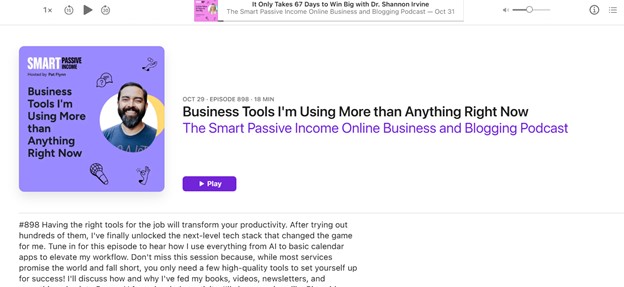
Or you can arrange it like Pat Flynn with his podcast “The Smart Passive Income Online Business and Blogging”.
All his recent episodes (episode 901 being the most recent one currently) present his free guide on demystifying AI. Which, in its turn, is included in the funnel of promoting their new software product.
But to make the most out of this strategy, make sure you have already built a funnel on that lead magnet and know where to lead your listeners next.
How should you mention the resource?
- mention it once during your intro, when you preview what they will learn
- mention it midway through the episode, where it naturally supports the insight you’re sharing
- add it in the episode description with a link
- add it as a pinned comment if you publish episodes on YouTube
- mention it again during the outro as a natural next step
#2 Highlight your own experience
One key indicator for me, whether I stick with listening to niche podcast episodes and research what else the host has to offer, is when they keep it practical. Because most of the time, we can find the general information online. But we can never know what you personally experimented with and the results that brought you.
I noticed that the podcasts that attract the most loyal audiences are the ones where the host openly, confidently, and consistently talks about what they have actually done, not what they think should work.
You may now think, “Why would I share all that for free, if I want my listeners to enroll in my paid program?”. It may sound paradoxical, but sharing your own experience for free does not weaken your paid offers. If anything, it strengthens them. Your stories become proof that you have been where your listeners are now. Your lessons become signals that you have actually done the work.
And when people hear that, they are far more comfortable paying to learn the structured version inside your course.
Whatever you share in audio form only increases the perceived value of your paid service because it shows two things:
- You are generous enough to help, and
- You are competent enough to guide.
And it does not always have to be your own experience. Bring in the experience of your guests. Ask the exact questions your listeners would ask if they had a chance to talk to your guest-expert.
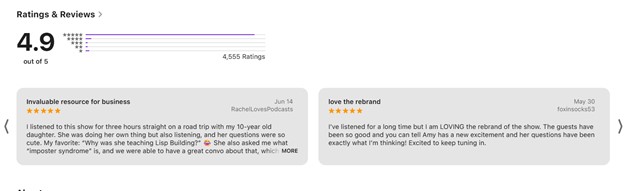
Amy Porterfield is one of the best examples of this approach done right. On her show, she is transparent about what worked and what did not. She does not hide the behind-the-scenes of building digital courses, and her listeners love her for it.
Amy interviews guests with that same lens: asking them the questions her audience is already thinking. And judging from her reviews, her listeners love Amy for it.
#3 Use the sneak-peak style
If we take the business niche for podcasts, not everyone is really opening the curtain into their plans, actual revenue, taking people into their decision-making processes, or strategy.
But those who do come across as more genuine, transparent, and are able to instantly gain the trust of their audience. So, as long as that adds depth to your topic, share the strategy you are testing, that copy you are working on, that next course launch you are planning, the amount you managed to gain with that marketing hack, etc. You get the idea.
When you bring listeners into your process, you create anticipation. They begin to look forward to what you will update them on next and what they can learn from you.
This can be a special series where you document your own journey and make your listeners part of the success. Because, honestly, we do not have all the answers all the time, as the learners expect. You can walk the path with them and share what you discovered.
For example, if you follow Jenna Kutcher's “The Goal Digger Podcast,” you know how often she shares topics like
- Ways I’m prioritizing my health in my business season
- My evolution is happening behind the scenes
- Why I cut the chapter from my book, etc
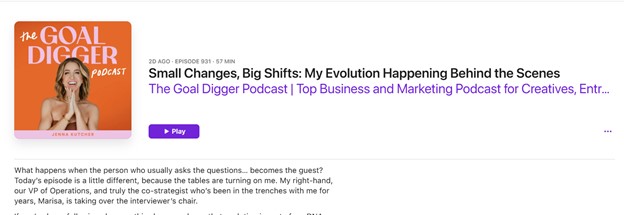
Those are great ways to make your listeners relate, stick with your podcast, and browse your additional offers.
#4 Mention your offers and tie them to the topic
Though you have every right, you do not have to promote your programs in a pushy way. Instead, you can weave them into the conversation as examples. It feels natural, relevant, and helps your listeners understand how the concepts in the episode look in real life.
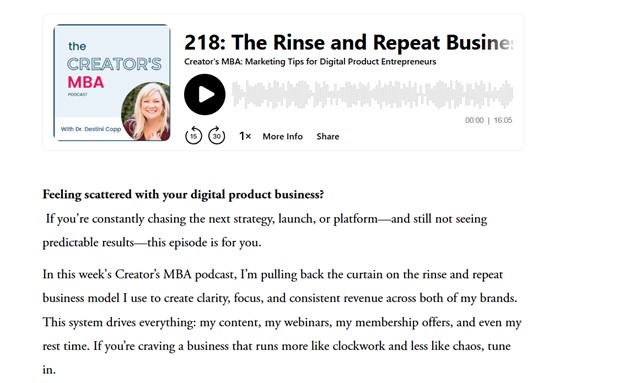
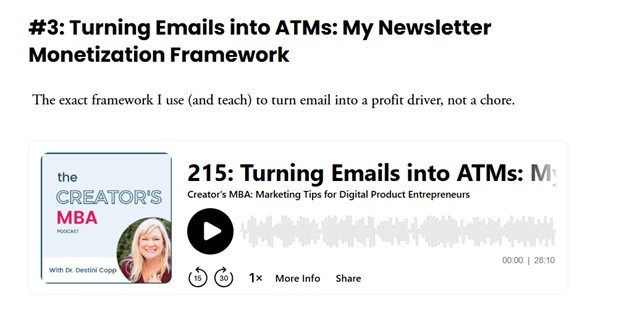
Though there are thousands of examples, I would like to bring your attention to Destini Copp’s Creator’s MBA Podcast.
In her episode called “The Rinse and Repeat Business Model,” she talks about the framework she uses to make her revenue predictable. While she explains the model, she naturally brings up her membership program as an example. She also mentions her upcoming webinars as part of her own funnel.
#5 Own a specific niche and speak directly to that audience
If we compare podcasts to social media for a second, you will notice that on social media, we just scroll for content. While with podcasts, most of the time we intentionally choose to engage with that podcast.
And for your future learners to actively choose your podcast, you need to give them a reason. One of the reasons is that you speak to a very specific audience. Only in this case do your examples and stories relate to the listeners, and they easily find value in your content.
Be the essential podcast for someone.
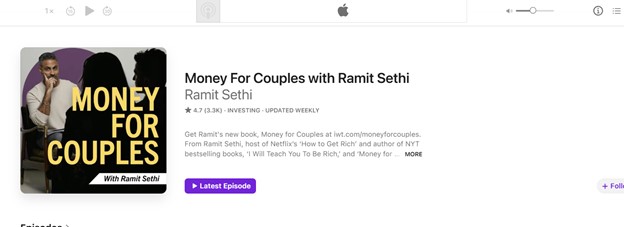
For example, Ramit Sethi’s show “Money for Couples” focuses only on couples and the money decisions they must navigate together. He does not try to cover every finance topic for every type of person. He speaks directly to partners who are trying to make joint financial choices.
#6 Show the transformation you offer instead of just telling
“Better see once than hear a thousand times” is relevant to podcast marketing as well. You can make your show not only about what kind of an expert you are and what transformation you can offer, but also about how you actually make that transformation happen.
And the easiest way to do that is by inviting past students or potential students to have honest conversations about their challenges, their journey, and the results they reached.
But I do not mean to say the podcast should communicate how amazing your program is. Instead, it will show your listeners how well you understand their struggles. So to speak, when you guide someone through a problem live on your podcast, people hear the way you think. Your potential students observe how you structure a solution. And that gives them a clear picture of what it feels like to work with you.
Let’s go back to Ramit’s podcast again. His format does not tell people how to manage money as a couple.
He brings real couples onto the show and coaches them through their financial conflicts. Listeners appreciate that he validates emotions, frames difficult conversations, and offers clear action plans. That is one of the key reasons why they choose to listen to him.
#7 Show personality for emotional connection
Like with social media, I have seen podcaster-course-creators who are trying to build a perfect, professional, full of knowledge and insights image. And then there are the creators who do not rely on strict scripts, who are not afraid to speak the way they truly speak, who share their flaws, mistakes, and learning moments. They show their personality, they stay approachable, and they let listeners see the real person behind the lessons.
People buy from people who feel genuine. If your podcast creates that feeling, they will naturally move closer to your paid offers. It is also one of the first things listeners notice. They can tell in a few minutes if the host is authentic or performing. And this matters a lot because I believe podcasting is an intimate format.
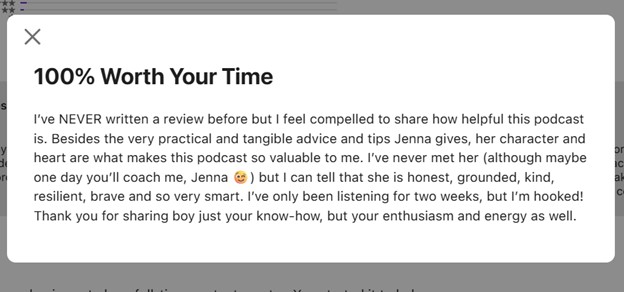
I also saw this reflected in reviews. Someone wrote that it was the host’s “character and heart” that made the podcast valuable. People remember your tone, your warmth, your honesty, even more than the tips you share. And when your personality resonates with them, they will stay for the long run.
#8 Tell listeners what to do next
The next practice I outlined might seem simple, but it is extremely important if your podcast is part of your business strategy. At the end of each episode, your listeners need to know exactly what the next step is.
And when that next step leads to a lead magnet, a webinar, a waitlist, or a program page, you create a clear path from listener to subscriber to customer.
This is why having a funnel matters. You know what they will receive, what email sequence will follow, and how they will move closer to your paid offer.
Destini Copp does this consistently. At the end of her episodes, she tells listeners to reach out to her via email or send her a direct message if they want to learn more about a specific topic she mentioned. It feels conversational, not promotional. And it opens the door for deeper engagement.
If you want to apply this in your own podcast, here are a few places you can lead people to:
- a free guide or toolkit that supports the episode topic
- a webinar or workshop where you teach the next step
- a waitlist for an upcoming launch
- a short questionnaire that leads into a discovery call
- your email newsletter so you can continue the relationship
#9 Encourage people to interact with you
I heard many hosts use phrases like, “I’d love to hear your question about what you will do if…” or “Tell me how you would approach this situation.” These prompts do two things at once.
First, they make the listener feel included in the conversation. Second, they open the door for more engagement, which then strengthens the show’s visibility in the podcast. You can even directly tell them to leave a review.
Reviews give you insight into what people value, what episodes resonated, and what topics they want more of. This feedback helps you create better content. It also helps you understand what your audience is thinking.
Everything we discussed in the points serves as small interactions to build community. And when your listeners feel connected to you, they are more likely to join your programs, trust your guidance, and stay with you long term.
Should you start your own podcast as a creator?
If you want to build trust, speak directly to a specific audience, and create content that stays relevant long after you publish it, then yes, podcasting can be a very effective channel for you.
It gives you space to teach, share stories, highlight your expertise, and guide people toward the next steps in their learning journey. And if you already love helping people through your knowledge, a podcast becomes a natural extension of your voice.
If you run your online school with Uteach, you can take it one step further. You can upload your podcast episodes as audio lessons and make them part of your courses, or simply publish them on your website to add more value for your audience. Book a demo with our specialist to learn more about how Uteach can help you make the most out of your content marketing.