

The following guide covers:
6 Tips from pro trainers to become a better professional
Key skills and qualities you need to become a good trainer
To be a better trainer, you should first remember what it felt like to be a learner. But there is more to it than just remembering your student days. Being a good trainer takes skill, practice, and knowing what actually works in real classrooms and sessions.
In this article, I collected the best tips from real professional trainers and coaches. Some of them I interviewed, and many of their insights come straight from years of experience. Each tip includes practical, simple steps you can try today.
So grab a pen, your favorite cup of something, and let’s discuss what skills you need to work on to become a better trainer.
6 Tips from pro trainers to become a better professional
You can be a great expert in the topic you train people on. But the deep knowledge of the content is not enough to be a good trainer as well. What should you pay attention to more specifically?
Here is a quick list of what professional trainers think every trainer should do to become better.

As someone who leads people toward learning more and growing on a regular basis, you cannot be the one who does not expand their knowledge on the topic.
And yes, that applies to the cases when you have had the exact same training hundreds of times, and you know the topic exceptionally well. Your delivery might still be smooth, but your content becomes stale. And if you do not put in consistent effort, you may even lose the sense that you are growing.
Mac Lake, who is a leadership development trainer, mentions that you need to share something new every time you haven’t mentioned during your previous sessions.
“I was doing a full-day, 8-hour session on leadership development. At the end of the training, I was driving home, and it hit me. I didn’t say anything today that I had never said before. That was an indicator that I was not growing in my knowledge and awareness of this topic”.
Mac Lake
Leadership development trainer
What steps can you take?
- Challenge yourself to learn something new about the topic. Look through books, newsletters, podcasts, training, and communities you have with other trainers.
- Keep a private Notion or Google Doc with things you find interesting or something you learned about the topic. Fresh frameworks, podcast snippets, screenshots, or metaphors. And when you need to refresh the session, go through the notes to see what new you could include for this time.
Always stay curious
If you walk in thinking your role is to teach and only teach, you are closing the door to the most valuable asset in the room. That is, your trainee’s experience. The biggest trap you can fall into is thinking that you are the smartest person in the room when it comes to your topic, just because you are the trainer.
What we sometimes forget is that each trainee knows something that you do not know about the topic you train on 24/7. That is why another essential skill for a trainer is to stay curious. A study by Harvard Business Review found that curiosity boosts creativity and improves the way we approach tough situations.
Curiosity is also what makes you human in front of your audience. Ask your trainees how they would handle a tricky situation. Because when you invite them into the conversation, they will invite you into their learning.
When I interviewed Linda Haddad, the founder and executive director of Yeghsa, she put it perfectly:
“Don't come from an egotistical place where I'm the trainer and the know-it-all all. Be open to feedback. Be engaging, flexible, and adaptable. Be open to change. And also listen, listen. Maybe a lot more than you speak. Sometimes that happens a lot in my. And my classes are where they're talking 90% of the time. And I'm listening”.
Linda Haddad
Founder and executive director of Yeghsa
What steps can you take?
- Sow enthusiasm. It makes you human in front of your audience. Ask your trainees how they would handle a tricky situation. Because when you invite them into the conversation, they will invite you into their learning.
- Leave each session with the question of what you learned from your trainees or whether you shared something that inspired or challenged them.
- Listen more than you speak.
Reflect on the process before each training
You know the saying that goes like the best-laid plans of mice and men often go awry? That applies to training as well. You map out the session, but suddenly, when it comes to the execution part, there are still a few little details you have not calculated. Or a trainee decides today is the day to challenge everything you say.
Your job as a trainer is to also anticipate derailers. For example, to teach a class, I used to visualize how I would execute all the exercises, games, and activities I prepared for the learners. Or even what questions and difficulties they might have during a specific practical task.
Mac Lake, who is a leadership development trainer, takes this a step further and even thinks of all the follow-up questions and anticipates the answers.
“I’m going to even think about my follow-up questions so that I can be fully prepared for whatever scenario might come my way”.
Mac Lake
Leadership development trainer
You are right to think that you cannot script every twist. But a detailed visualization helps you be more prepared and smooth with the training.
What steps can you take?
- Based on your experience, write down a few what-if scenarios that you think usually happen and plan how you will handle the situation. For example, what if no one answers your question? What if something takes longer than planned, and you are running out of time?
- Go through all the practical exercises and tasks and visualize how you will conduct them.
Ask for feedback
Feedback is something I have seen trainers usually ask at the end of the whole training. As participants, we would answer some cliche questions, and the feedback was more like a check-the-box activity.
But that would not really tell you anything. So, if you want to use such surveys as a way to become a better trainer, make sure you ask the right questions.
In an interview with me, Angel Rodriguez, who offers certification training for unarmed security guards, even referred to feedback as “golden nuggets”.
“The five-star reviews are nice to hear. But how can I get better for the next session? How can I get better for the next class? I'm asking them to really look at it, look for minutiae, mistakes. That's the things I really call those golden nuggets. Listen to those golden nuggets. Don't take them as insults. Take those as ways to improve”.
Angel Rodriguez
Founder of Alliance Training and Testing
What steps can you take?
- Send a short feedback form after the first two sessions, and do not wait for the training to be complete. Because each group or individual you train has different preferences and you want to make sure your training fits that box.
- Revisit the golden nuggets after every session. Collect the feedback in an organized way for you to refer to anytime you need.
- Communicate the idea that your trainee’s feedback is important to you and make sure they understand it truly means something.
Do not be dependent on your slides
There are cases when you cover everything you planned to share, hit all the bullet points, and wrap the session on time. Yet, even in that case, the training falls flat.
The thing is, when you follow the script too tightly, you stop noticing the people in front of you. You start delivering content, not a training experience. And nobody remembers a beautifully narrated PowerPoint. Instead, your trainees remember how much it spoke to them.
When I spoke to Linda Tilson, leadership development coach and consultant, she explained why sticking to the plan can backfire:
“Get rid of the script. Preparing a script helps us create that perfect image everybody wants to achieve. The thing is, people are not there to see just how perfect you are. It works quite the other way around. They want to see the genuine you, and they want to find something they can relate to”.
Linda Tilson
Career and leadership development coach
What steps can you take?
- Don’t obsess too much over what you want to share. Instead, do research on what your trainees already know and what they want to learn about. This way, you will be able to deliver something real, not perfectly scripted.
- Use your slides as support, but be flexible enough to discuss additional points depending on how the session goes.
Know your learners better than your content
In the stage when we develop the content, we spend hours including the best examples, frameworks, color coding the materials, etc. But none of that matters if we are not tuned in to who is in the room.
Because you can wing content anytime if you know your audience. The reverse is rarely true. Every group is a little different. Some are fast thinkers who want to dive in and debate. Others need more structure and examples to feel confident. Some learners might already know half of what you planned to teach.
So, knowing your audience is what makes your training more engaging, relevant, and personal.
What steps can you take?
- Keep a “learner log” after each session. Keep records of what worked with this group. Or what surprised you?
- Be flexible enough to ask for the trainee’s opinion on the way you could execute a certain activity, and ask direct questions on what they already know about the session’s topic. Afterward, you will be able to plan better and personalize your training for them.
Key skills and qualities you need to become a good trainer
Each of the tips we discussed requires you to have certain skills and qualities as a trainer. If you are looking to develop the key competencies every trainer needs, here is where you can start.
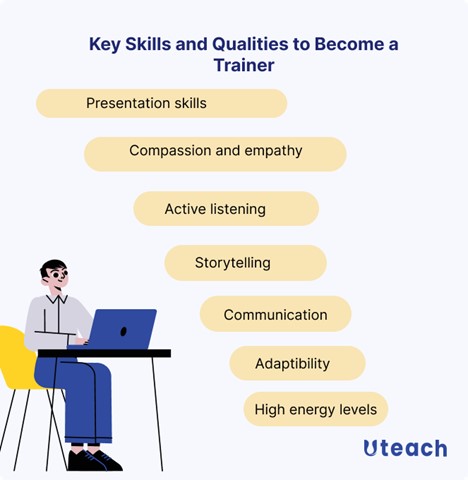
The presentation and speaking skills are probably among the most mentioned ones. As a trainer, you need to be able to hold the audience's attention and be comfortable with speaking to them. It includes a variety of subskills, such as holding a presence and keeping your audience engaged.
- Compassion and empathy
One of the key challenges trainers and facilitators face all the time is what we call the difficult participants. Some groups challenge every point, or stay silent the whole time.
It is easy to label them as difficult, but the real work is in understanding what is underneath that behavior. Maybe what you train them on does not align with something the management team has set for them. And now they have concerns. But if you keep pushing your agenda without acknowledging that disconnect, they will shut down. Compassion and empathy help you see things from their side and adjust in a way that brings them back into the learning experience.
- Active listening
Most trainers are great at talking. They know how to explain, present, and deliver with confidence. But, as we discussed earlier, some of the best learning happens when you step back and let your participants speak. Active listening is what helps you catch the insights behind their words, spot confusion early, and respond to what they actually need instead of what you assumed they needed. The more you listen, the more useful your words become when you finally speak.
- Storytelling
Stories make abstract ideas real, bring dry content to life, and help learners emotionally connect to what you are teaching. But it can also be real-life examples, not necessarily stories.
“A story can be a literal story, but you can also tell a story from case studies and examples. That’s what I do. The stories I used to make that class interesting to myself and to the class were court cases that illustrated the issues I had to train about. Then I made a game out of those”.
Jeff
Founder of Your Learning Career
- Communication
Good communication helps you explain ideas clearly, guide discussions, and adjust your delivery․ Also, there are cases when a question pops up, and you do not know the exact answer. The way you communicate and navigate it makes a great difference. For example, you may decide to find the answer together with the learner, or tell them you need to do some more research and present the answer later.
- Adaptibility
As we have mentioned earlier, no matter how carefully you plan, training sessions have a way of throwing surprises at you. A good trainer will not cling to the original plan. They read the situation, adapt if needed, and keep the session moving in a way that still delivers value.
- High energy levels
You set the tone the moment you walk into the room, virtual or physical. And if you cannot show the same level of enthusiasm for each training session, you cannot expect engagement from your learners.
“None of the programs great trainers conduct are low on energy. They have to have the highest amount of energy right from the start to the end of the program”.
Solomon Salvis
CEO of SimuRise
FAQ
- How do I handle unexpected challenges during training?
Challenges during training are not a sign that something has gone wrong. In fact, they are a part of every training.
For example, it can be a technical glitch, an activity falling flat, or a participant asking a question you did not plan for. To handle such challenges, you should respond, not react.
Let’s say a slide is not working; keep talking. If a participant is confused, pause and explain again in a different way. The trick is not to push through as if nothing happened, but to stay flexible and adjust. Sometimes you even need to switch up the activity, open a discussion, or involve the group in finding a solution.
- Should I use humor in training?
Yes, you can use humour during the training and keep it real. Humor breaks the ice, makes your training more memorable, and helps learners feel more relaxed.
For example, it can be a simple personal story or a comment on a situation if it creates the right mood and connection with your learners. Just make sure your humor never targets anyone in the room.
Of course, a lot depends on your personality and how you choose to promote your personal brand.
- Is it okay to repeat a story or example I’ve used before?
Absolutely. If the story fits the topic and helps this new group understand the point better, use it. What matters is not whether it is new to you, but whether it adds value to them. If you tell it with energy and connect it to their learning, it will still land well.
- What is the best platform to run online training?
If you are looking for a platform that helps you deliver powerful training experiences, whether online, hybrid, or offline, consider Uteach. It gives you everything you need to create structured programs with videos, live sessions, and quizzes, all in one place. Your training becomes more engaging through learner communities and mobile learning features that keep participants connected and involved even between sessions.
Plus, you save hours by automating scheduling, attendance, calendar invites, and notifications. Over 6,000 trainers trust Uteach to deliver their best work. Book a free demo with our specialist to learn more about how Uteach helps you deliver the training experience you need.