
Every new hire needs both direction and development. In other words, they need onboarding and training at the same time. Training is only one part of the onboarding journey, while onboarding itself is a much broader process that shapes how employees connect, adapt, and start contributing effectively.
In this article, we will look at what employee training and onboarding are, what the examples of these practices are, and how you can tell one from the other.
What is employee onboarding?
Before new hires start doing their best work, they first need to understand how things work.
“Onboarding is a process through which employees gain the knowledge and skills they need to become effective members of the organization. Suitable onboarding will boost the employee’s confidence and help them build a healthy business relationship”.
Josh Fetcher
Founder of HR University
Josh Fetcher put this well while explaining what employee onboarding is. The purpose behind employee onboarding is to help new hires adapt to the new environment. In a sense, onboarding connects employees with the company’s mission, culture, and expectations.
Onboarding begins the moment an offer is accepted and continues through the first months of employment.
When looking at many sources, you will find that onboarding refers to the first three months of employment at the company. However, I agree with the Gallup researchers that it takes about a year for employees to understand their role perfectly and start performing at high-level tasks.
Regardless of how long it takes, onboarding brings focus to aligning personal strengths with company goals and helps employees see how their contribution fits into the bigger picture.
- What does a successful employee onboarding look like?
As you know, organizations differ by size, culture, structure, industry, etc. So, there would not possibly be a single checklist that every company can simply copy and run their onboarding.
With that being said, there are still core components of onboarding, including:
- Pre-start preparation (equipment, access, introductions)
- Clear first-day schedule and welcome plan
- Role clarity: what the person is supposed to do, and how success will be measured
- Structured ramp-up: tasks and learning built over weeks, not dumped on day one
- Mentorship or buddy support, like someone to guide and answer questions
- Cultural orientation: norms, values, informal rules
- Scheduled check-ins and feedback loops (30-day, 60-day, etc.)
- Two-way feedback: letting the new hire rate the experience
- Documentation hub: a go-to resource for links, processes, tools
I know this sounds a little generic, so let us see how it works with an example of Buffer’s onboarding process.
At Buffer, they document core tasks (equipment, logins, meeting scheduling, cultural norms) and break information into manageable boards in project management tools.
They assign three roles to support the new hire: the hiring manager (who sets 30/60/90 goals), a role buddy (peer in a similar function), and a culture buddy (someone from another team to explain norms and company history).
They also build feedback into early stages (after 30, 60, 90 days) and ask the new person to rate the onboarding itself so they can improve continually.
Related: 17 Onboarding Activities to Help New Hires Stay
A few best practices we can see in their onboarding approach include:
- Use multiple “buddies” (role + culture) to cover both how to do the job and how to fit in socially.
- Define clear 30 / 60 / 90 goals so the new hire and manager stay aligned
- Build formal feedback loops early.
- Collect feedback from new hires about the onboarding itself and adjust for next time.
- Centralize all onboarding tasks and resources (checklists, documentation, tool links) so nothing is scattered.
- Break large information dumps into small, timed chunks (e.g. pre-start emails, phased docs).
“Avoid overloading your hires with irrelevant information by deciding at the start which areas your onboarding program should focus on. Your onboarding program could include your organization’s history, structure, and culture, a brief overview of your customers, and the team’s responsibilities with their workflows and goals”.
AIHR Acedemy
Why is efficient onboarding important for you?
A study by Gallup found that only 1 in 10 employees strongly agree that their organization does a good job of onboarding. But poor onboarding costs you more than that. In fact,
- Employees who undergo efficient onboarding are 58% more likely to stay in your organization for the next 3 years.
- Employees with an exceptional onboarding experience are 2.6x more likely to be satisfied at work.
- 89% of employees agree that efficient onboarding helps them be more engaged at work.
Yet, one of the key reasons why efficient onboarding and training matter is that you do not deal with high turnover rates.
What is employee training?
Employee training is a structured process designed to increase an individual’s skills, knowledge, and competence in specific areas related to their job role. The purpose behind training is to bridge the gap between current performance and the performance required to meet business goals.
It helps employees stay updated with new technologies, methods, and best practices that make their work more efficient and valuable to the organization.
So to speak, employee training is a continuous investment in professional growth, and not a one-time event after hiring.
In this sense, onboarding connects employees to the company, and training connects them to their potential.
It focuses on role mastery, performance improvement, and career advancement. A well-designed training program gives employees clarity on how to do their work better and why their development matters. Over time, this creates a workforce that is not only capable but confident and motivated to take on more complex challenges.
- What does a successful employee training look like?
The success of the employee training first depends on what type of training it is. For example, you can offer upskilling, reskilling, technical, compliance, soft skill training, etc.
But no matter what your case is, the process of running employee training includes:
- setting goals first, like clear business-aligned outcomes (for example: reduce support ticket resolution time, increase code quality, or improve sales conversion)
- needs assessment to identify gaps: where people are now versus where they need to be
- choosing appropriate methods (workshops, e-learning, hands-on labs, shadowing) that suit the audience, timeline, and complexity.
- including real work or simulations so people apply what they learn right away
- attaching mentors, peer-partners, or follow-up sessions to reinforce learning and handle questions.
- testing knowledge or skills
- getting feedback from learners on what worked and what did not
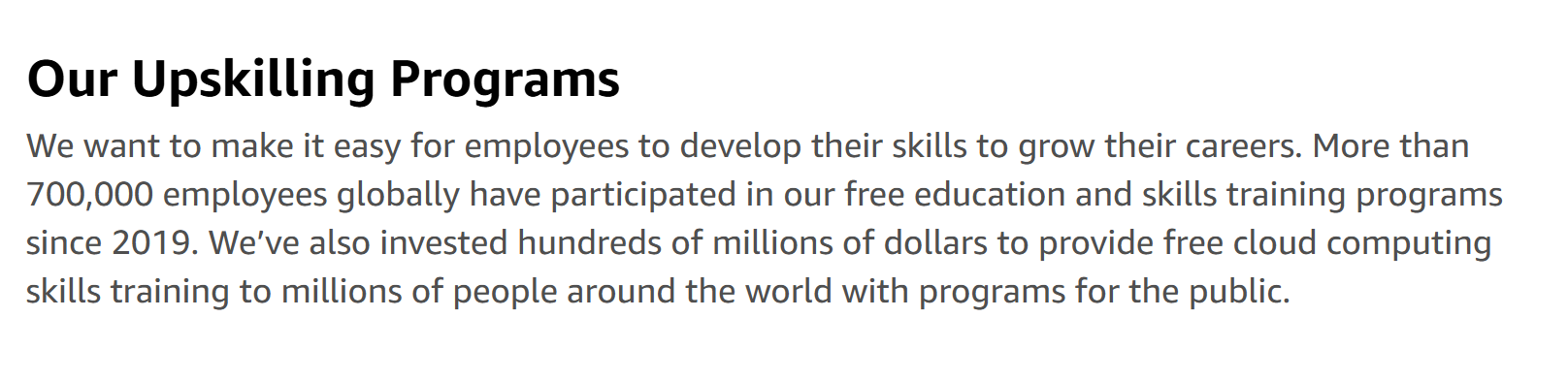
One of the best employee training academies is that of Amazon’s. To upskill their workforce, Amazon set up Amazon Technical Academy. With their upskilling program, On completion, nearly all graduates transitioned into software engineering roles.
Statistically speaking, nearly 98% of graduates were placed into software development engineer roles at Amazon, with average compensation gains of about 93%.
Related: 10 Essential Corporate Training Programs for Your Organization
- Why is efficient employee training important for you?
According to the American Society for Training and Development, companies that invest in training have a 24% higher profit margin. One of the reasons is that employee training increases satisfaction and engagement, which leads to higher retention rates and a more positive company culture.
ASTD also studied 575 U.S. publicly traded firms and found that firms that spent about US$680 more per employee on training than average saw their total shareholder return (TSR) increase by 6% points the following year. Also, the companies doing more training also had much higher net sales per employee.
If we leave the numbers aside and translate them into text, efficient employee training means more discretionary effort, better collaboration, and increased productivity.
What makes onboarding and training different?
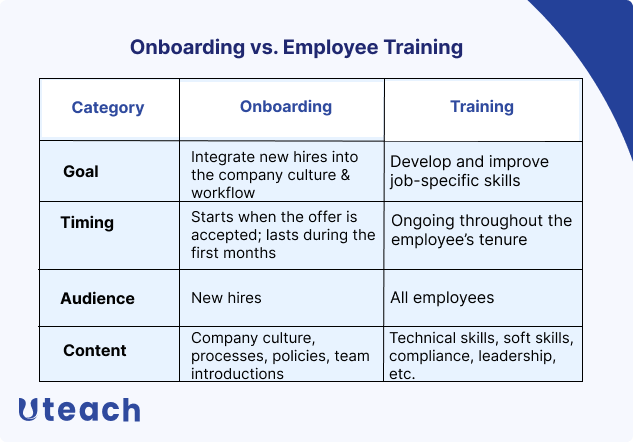
As you have already guessed from what we discussed above, employee training is part of the onboarding process. Yet, onboarding and training are not the same, and they cannot be used interchangeably.
So, let’s summarize the key differences between the two in terms of their purpose, duration, training methodology, and KPIs you measure.
- Goal
The goal of onboarding is integration, while the goal of training is improvement. Onboarding helps new hires settle in, understand the organization’s values, and see where they fit in the larger picture. Training, on the other hand, focuses on sharpening the skills that allow them to perform specific tasks better.
For example, during onboarding, a marketing hire learns how the team collaborates, what tools they use, and how the brand voice sounds. During training, that same employee takes detailed training in campaign analytics, A/B testing, or advanced content strategy techniques, etc.
- Duration
Onboarding happens during the early phase of employment. From the day the offer is accepted until the employee is fully comfortable in their role. It might last a few weeks or several months, depending on the organization.
Training, however, continues throughout the entire employee lifecycle. A person who has been with the company for five years still attends regular training to update skills or prepare for leadership responsibilities.
“Onboarding is essentially integrating a new person into your environment. It is a series of short steps and processes that happen at the beginning of an employee’s tenure. Training is ongoing; it doesn’t even stop. You just may be doing a lot more training in the beginning with a new employee”.
Winston Davis
CEO of Moveup Consulting
- Training methodology
When it comes to methodology, onboarding usually follows a structured sequence including orientation, introductions, shadowing, and basic process familiarization. It involves HR, managers, and mentors working together to create a cohesive start.
Training methods are much more diverse. They include workshops, e-learning modules, simulations, mentoring sessions, and hands-on projects. The approach depends on the skill to be developed and the learning outcome expected.
- KPIs and ways to measure
For onboarding, success is reflected in retention rates, new hire productivity, and time-to-proficiency. Training success, however, is tracked through performance improvement metrics, skill assessment scores, and how well employees apply new knowledge to their jobs.
To put it simply, onboarding measures adaptation, while training measures growth.
Conclusion
In other words, onboarding helps new employees adapt, connect with the company culture, and understand their role within the organization. Training, on the other hand, focuses on skill development and performance improvement throughout the employee’s journey.
Both create a continuous learning environment that drives engagement, productivity, and long-term retention.
If you are looking for a platform to automate your employee training and onboarding, consider Uteach. With Uteach, you can build structured onboarding programs, create interactive training modules, track employee progress, and even attach quizzes and certificates to measure learning outcomes. You can host all your learning materials, live sessions, and internal knowledge hubs in one place, saving hours of manual coordination.
Book a demo with our team to see how Uteach automates your training and onboarding and turns them into smooth, measurable, and efficient experiences for both your HR team and employees.