
The following guide covers:
Constructivist learning approach
Connectivist learning approach
Experiential learning approach
Learning theories have been developed for decades, and new ones are still emerging. Sometimes they overlap, sharing similar approaches and ideas, which can make it tricky to figure out where one ends and another begins. These theories help us choose the right methods to engage students, support their growth, and improve learning outcomes.
In this article, we will cover the main theoretical approaches to learning, explore their key concepts, outline their benefits, and share practical examples of how you can bring each one into your classroom. Whether you prefer structure, creativity, collaboration, or technology, you will leave with ideas you can use right away.
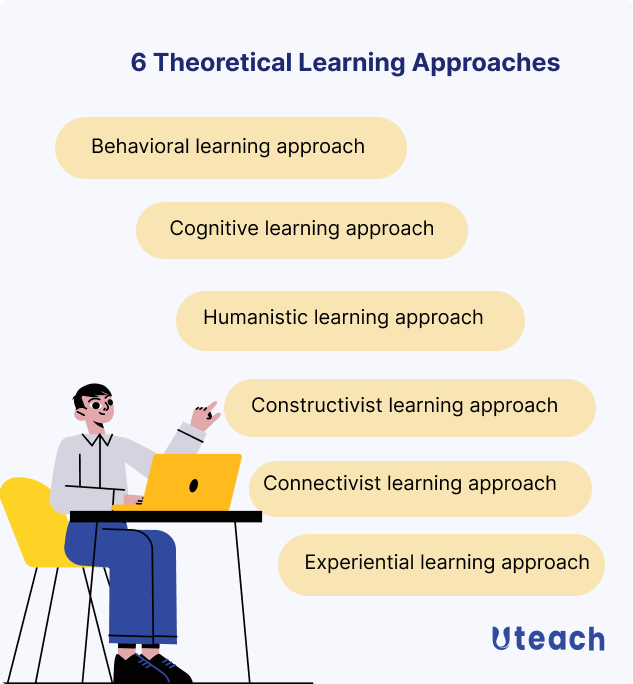
Behavioral learning approach
Behavioral learning is all about what you can see and measure, like real, observable changes in student behavior driven by what happens in their environment. It focuses on how students respond to stimuli and how those responses are shaped over time through reinforcement or consequences.
The roots of this idea go way back to Pavlov, Watson, Thorndike, and Skinner, who laid the foundation with experiments on associations and consequences. The big idea is simple: good behavior gets rewarded, so it happens more.
Key concepts
The main idea behind this learning approach revolves around ideas like learning through associations, consequences, the relationship between stimulus and response, and negative and positive punishment.
What does this all mean?
- Classical conditioning (Learning through association)
Classical conditioning is when a learner connects two things together because they repeatedly happen side by side. The most famous example is Pavlov’s dogs learning to salivate when they heard a bell, because that sound was always followed by food.
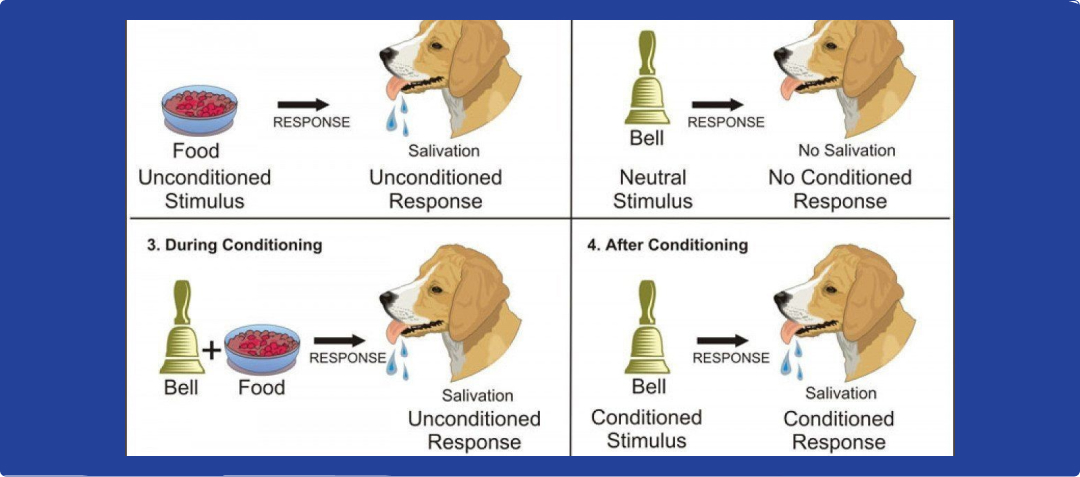
If we take this to the online classroom, this can be as simple as playing soft background music before running a group activity. Over time, students might start to settle down as soon as they hear that music, because they link it with the idea that you will be running a group activity.
- Operant conditioning (Learning through consequences)
Here, the focus is on what happens after a behavior. If a behavior is followed by something positive, the student is more likely to repeat it. If it is followed by something unpleasant, the student is less likely to do it again.
- Stimulus–response
Behavioral learning sees every action as a response to something. In classical conditioning, the “something” is another event (like the bell and the food). In operant conditioning, it is the result of the action (like the praise after the homework). Your role as the educator is to spot these patterns and make sure the “something” leads to the behavior you want.
- Measurable outcomes
In the behavioral learning approach, learning has to be seen and counted. For example, if you introduce a new rule, you measure its success by looking at how often the desired behavior happens after the change. For example, if you want students to start lessons on time, you track how many start on time before and after you introduce a reward system
Benefits
- Clear, measurable outcomes
- Predictable results
- Easy to replicate strategies
- Works well for building specific skills or habits
- Encourages consistent behavior
- Provides structured learning environments
- Supports data-driven decision making
How is it used in learning
One of the well-known ways we use behavioral learning in everyday online classes is when we reward students with gamification elements. For example, every time they complete the learning activity the right way, they receive a certain badge for it. So, the students understand that to collect all the rewards and badges, they need to complete certain tasks in the way required.
As teachers, we achieve positive behaviour by
- Setting clear behavioral expectations
- Using rewards to increase desired behaviors
- Applying consequences to reduce unwanted behaviors
- Reinforcing skills through repetition and practice
- Tracking and measuring progress over time
- Structuring activities to create positive associations
- Using consistent cues to signal specific actions
Cognitive learning approach
Cognitive learning focuses on what is happening inside the learner’s mind, such as how they think, understand, remember, and make sense of new information. So to speak, the mind is like a computer. It takes in information, processes it, stores it, and retrieves it later when needed.
During this approach, learning happens when we help students organize ideas, understand deep meanings, and build mental structures that last beyond simple memorization. As you can guess, it also focuses on how the students learn, not just what they learn.
Key concepts
The key idea behind the cognitive learning approach is understanding the cognitive load, metacognition, assimilation, and accommodation.
- Metacognition
From the point of view of psychology, metacognition is the process of when we are aware of how we think and process the information. According to Perkins, on the level of metacognition, we have 4 types of learners. They are tacit, aware, strategic, and reflective. Tacit are the ones who are not aware of their metacognitive processes. And the reflective learners are the complete opposite.
- Cognitive load theory
Our brain can only handle so much at once. If something is complicated or presented badly, students get overwhelmed. Good design lightens that mental load, so important ideas stick more easily.
- Assimilation and accommodation
Assimilation is when students fit new things into what they already know. Accommodation is when they must change what they know to handle something new. Learning happens when these balance out.
- Discover-based learning
Discovery learning encourages students to dig in and construct their own understanding. Bruner also suggested revisiting big ideas over time, each time with a deeper layer of complexity.
Benefits
- Encourages deeper understanding
- Promotes critical thinking
- Builds problem-solving skills
- Improves memory retention
- Supports independent learning
- Enhances the ability to transfer knowledge
- Develops metacognitive skills
How is it used in learning
Some of the methods we use when applying the cognitive learning approach are implementing activities that support discussion-based learning, problem-based learning, hands-on activities, and inquiry-based learning.
A common way of applying cognitive learning strategies is when, as teachers, we use visualization techniques to explain complex concepts. For example, doing so via a mind map, a table, etc.
Other practices include:
- Using timelines to help students see cause-and-effect relationships
- Breaking down a complex math problem into a sequence of smaller, labeled steps
- Providing graphic organizers before reading helps students identify main ideas and supporting details
- Using storytelling to link new information to familiar scenarios
- Applying retrieval practice quizzes at the end of each lesson to reinforce long-term memory
Humanistic learning approach
Humanist learning puts the individual learner at the heart of education. It focuses on helping students grow as whole persons and not just as test scores. The idea is simple: When learners feel valued, understood, and free to explore, they become more motivated to discover their own potential and strengths.
Meaning that as an educator, you need to consider the goals and interests of your learners, as their intellectual skills are not the only ones you should focus on.
Key concepts
When you choose a humanistic approach to learning and teaching, you recognize the following patterns and qualities.
- Self-actualization
The humanists believe that every learner has an inner drive to grow, achieve, and become the fullest version of themselves. So, all the other teaching methods you choose support the student-based approach to classroom management. You also take into account the learner’s emotional and social skills, not just their knowledge.
- Student-centered facilitation
You guide the learners rather than instructing. This way, you are also able to encourage learners to follow their curiosity, evaluate their own progress, and take charge of their learning. Students also become the ones to decide how they learn, and when they can learn it.
- Positive environment
Humanists believe that learners perform better when they know their value is not just limited to the knowledge they have. So, as an educator, you have to create an environment that is free of judgment. You are able to build strong learning partnerships by truly seeing the world through your students' eyes.
Benefits
- Increases learner motivation
- Builds strong teacher–student relationships
- Encourages self-directed learning
- Supports emotional well-being
- Fosters creativity and curiosity
- Develops confidence and self-esteem
- Promotes lifelong learning attitudes
How is it used in learning
In practice, the humanist approach encourages educators to support learners in becoming self-directed. This means helping students set their own goals and take responsibility for their learning journey rather than just following a fixed curriculum.
As an educator, you should provide constructive feedback focused on growth and understanding. But not just right or wrong answers. Encouraging reflection allows learners to connect new knowledge with their own experiences, making learning more meaningful. When you trust your students and treat them as whole individuals with unique interests, motivation naturally increases, and curiosity rises.
Constructivist learning approach
Constructivist learning is centered on the idea that learners actively build their own understanding. At the same time, it emphasizes that learners do not necessarily learn from the teachers or any other sources. Instead, they learn through their own experiences.
Learning is seen as a personal, contextualized process where students make sense of new information by connecting it to prior knowledge. This approach focuses on critical thinking, problem-solving, and meaningful engagement with content.
Key concepts
The core of constructivism is discovery learning, situated learning, scaffolding, and active learning via social interactions. What do they entail?
- Learners construct the meaning themselves
With the constructive learning approach, you do not just pass the information to the learners. To build understanding, the learners experiment with the idea based on their prior knowledge. As you can see, it is completely far from the passive memorization we see with traditional methods.
- Learning is a social process
Constructivist theories highlight collaboration and dialogue as essential for refining and challenging ideas. Thus, social learning is a key component of the constructivist approach. At the same time, knowledge is tied to context and activity. At the same time, learning occurs best when it is relevant to real-life situations and authentic tasks.
- Reflection is important
Learners should consistently reflect on the knowledge they have gained and the progress they have made. Only this way are they able to assess their own knowledge level and understand in what direction they could improve further.
Benefits
- Promotes deep understanding
- Encourages critical thinking and problem-solving
- Fosters learner autonomy and motivation
- Supports collaboration and communication skills
- Connects learning to real-world contexts
- Develops metacognitive awareness
- Adapts to diverse learner needs and backgrounds
How is it used in learning
To apply this learning approach, instead of just lecturing, have students work in groups to analyze primary sources and debate different perspectives.
You might also use project-based learning where learners solve real-world problems, like designing a sustainable garden or creating a marketing plan for a fictional business.
Throughout these activities, your role is to guide, ask probing questions, and provide scaffolding that helps learners move forward without taking over their discovery process.
You can also have students identify topics for research proposal development that address authentic challenges in their field, building research skills through experiential investigation.
Connectivist learning approach
Connectivism is a learning approach that reflects how learning happens in the digital age, focusing on the role of networks and technology in knowledge acquisition. It views learning as the process of creating and navigating connections between specialized information sources, people, and communities.
So, instead of relying only on individual memory, learners develop the ability to find, evaluate, and apply knowledge from diverse networks. The theory emphasizes that knowledge is distributed across networks, and the ability to connect to these links is vital for learning.
Key concepts
Connectivism mainly relies on the idea that learning happens through finding connections between things, decision-making is part of the learning, and that the learning happens in a collaborative environment.
- Learning as a network formation
Learning is seen as forming connections between nodes. These nodes can be people, information sources, databases, or organizations. The richness and diversity of one’s network influence the depth of learning. Knowledge exists in the connections, not just in the individual mind.
- Up-to-date knowledge
Because knowledge and information rapidly evolve, staying current is critical. Learners must continually update their connections and resources to maintain relevant understanding. At the same time, it is more important how much capacity you have to learn than just how much you already know.
- Technology is an enabler
Digital tools and platforms are fundamental to connectivism. They facilitate access to networks, enable collaboration, and support the aggregation and synthesis of information.
- Decision-making is also a learning process
Choosing what to learn and which connections to trust is itself a key learning skill. Learners develop the ability to evaluate the quality and credibility of information sources within their networks.
Benefits
- Encourages lifelong learning habits
- Develops digital literacy and information management skills
- Supports learning in rapidly changing environments
- Fosters collaboration across diverse networks
- Enhances critical evaluation of information sources
- Promotes adaptability and flexibility in learners
- Connects formal and informal learning experiences
How is it used in learning
For example, in an online course, you can guide the students to retrieve the resources from various digital platforms, such as your podcasts, discussion forums, your community, or even the wikis.
Students learn to evaluate and synthesize information from these diverse sources. You can encourage collaboration through online communities and help students reflect on the quality and relevance of the connections they make.
Experiential learning approach
Experiential learning defines learning as the process of creating knowledge through direct experience combined with focused reflection. It centers on a four-stage cycle in which learners have a concrete experience, reflect on that experience, form abstract concepts, and then test those concepts through active experimentation.
The approach treats cognition, emotion, and behavior as integrated parts of learning and stresses that learning is strongest when it is situated in authentic, real-world contexts.
Kolb built his model on earlier work by John Dewey and Kurt Lewin to show how experience and reflection interact to create understanding.
Key concepts
- Active experimentation
Kolb frames learning as a continuous cycle. First, learners engage in a concrete experience, such as a lab activity or role play. Next, they step back and observe what happened, identifying patterns or surprises. Then they form abstract concepts or models that explain the experience. Finally, they test those concepts through active experimentation, applying a revised approach to new situations.
- Two dialectical dimensions
Kolb describes two intersecting dimensions: how learners grasp experience (concrete experience versus abstract conceptualization) and how they transform it (reflective observation versus active experimentation). Learning quality depends on the interplay between these dimensions. So to speak, learners need both hands-on encounters and opportunities to think about them, and they need both time to reflect and chances to act.
- Reflection is key for learning
Kolb positions reflective observation as the moment when experience is processed and meaning is constructed. Deliberate prompts, guided questions, learning journals, and structured debriefs move learners from feeling to understanding.
Benefits
- Promotes deeper understanding through direct experience
- Enhances critical thinking and problem-solving skills
- Improves knowledge retention and transfer to new contexts
- Develops adaptability and flexibility in learning
- Encourages learner autonomy and self-direction
- Builds collaboration and communication skills
- Connects theory with real-world application
- Supports engagement and motivation
How is it used in learning
In experiential learning, your role as the educator is to design productive experiences, scaffold reflection, and create safe conditions for experimentation and risk-taking. This includes sequencing activities so that concrete experiences lead into reflection prompts, helping students abstract principles, and then providing low-stakes opportunities to test new approaches.
In an interview with me, facilitator and trainer Jan Keck shared how he uses experiential learning during the sessions.
“I love to follow the experiential Learning circle. That often talks about first having experience. And then in the debrief, you think about what happened? How did that feel? And then you move into action. So, how are we going to apply this? Very often, I think of what activities and exercises I want to do to help people gain some insights. Then, through the discussions, they will figure out what the learning is and how they're going to apply it”.
Jan Keck
Virtual learning facilitator
Similarly, you can incorporate game-based learning and scenario-based learning into your courses.
FAQ
What are the pedagogical approaches to learning?
Pedagogical approaches to learning are simply the different ways you can guide how knowledge is taught and learned. Each approach has its own focus, tools, and style, and the one you choose depends on who your learners are and what you want them to achieve.
- Pedagogy: This is the classic teacher-led style you will see in most traditional classrooms. You set the pace, decide the content, and lead students through lessons step-by-step.
- Andragogy: This is all about adult learning, where the learner takes the wheel. You act more like a facilitator, helping them explore topics that are directly relevant to their work or life.
- Liberationism. This approach treats the classroom as a democratic space. You share power with students and encourage them to question systems.
- Montessori method: Here, learners, especially children, drive their own exploration. You prepare a hands-on environment full of materials they can choose from, letting them learn by experimenting and discovering at their own pace.
- Collaborative learning: This is teamwork in small groups, usually three to five students. You set a shared task, and they work together, exchanging ideas, solving problems, and learning from one another’s perspectives.
What are the technology-driven approaches to learning?
Technology-driven approaches to learning use digital tools and innovations to make learning more engaging, flexible, and effective.
Some of them include:
- Gamification: This means adding game-like elements, such as points, leaderboards, and badges, into lessons. It keeps learners motivated by making progress visible and turning challenges into something fun to overcome.
- Online and blended learning: This blends online platforms with the option to meet in person or entirely online. It gives learners flexibility in when and where they study.
- Augmented/virtual reality (AR/VR) tools create immersive experiences that let learners step into realistic simulations.
What are the 8 learning styles?
The 8 learning styles are different ways people prefer to take in and understand information. Some learn best by seeing things (visual), others by hearing them (auditory), or by touching and doing (kinesthetic). There are those who like to read and write, people who learn better in groups (social), and those who prefer to study alone (solitary). Some think and remember best using logic and patterns (logical), while others connect more through music and rhythm (musical).
Conclusion
If you lean toward a more technological approach, online teaching platforms can help you design engaging courses, reach a global audience, and create a learning experience that truly works for your students.
With Uteach, you can join over 6,000 educators who are already monetizing their expertise and building sustainable income streams. Book a demo with our expert today to see exactly how Uteach can help you achieve your teaching and business goals, too.