
The following guide covers:
Certification, qualifications and license
Business registration and structure
Marketing and advertising laws
Are you ready to make life coaching official?
The truth is, while coaching is an exciting and rewarding career, it is still a business. And every business needs to play by the rules, even if those rules are not always obvious from the start.
In this article, we will walk you through the legal considerations every life coach should be aware of. From choosing a business structure and registering your name, to writing your terms and coaching contract, to making sure you are protected with insurance and compliant with marketing laws.
To make this guide as practical as possible, I gathered tips and recommendations from experienced life and business coaches who have been through the journey. However, here comes the friendly disclaimer: these are just suggestions, and this article does not replace legal advice.
Are there any legal requirements to become a life coach?
While there may be no formal legal requirements, there are plenty of legal considerations you should take seriously if you want to protect yourself, your clients, and your business.
Here is what you need to pay attention to to get your legal ducks in a row.
Certification, qualifications and license
TL;DR Official education or certification is not mandatory if you want to become a life coach. This is what almost everyone claims. Yet, when I talked to coaches, 80% of them recommended you get involved in an educational program, even if it is not an official certification. |
- Do I need certification to become a life coach?
As we have already established, you do not legally need a certification to call yourself a life coach or start coaching. One of the reasons is that life coaching is not regulated in most countries, such as the United States, Canada, the UK, Australia, and most of Europe.
In an interview with me, ICF‑certified coach Andy Nelson, pointed out how many people claim to be life coaches without education or credentials. Here is a piece of advice he shared.
“Lean into it in terms of trying some coaching and also getting official education and training in it. What I feel is that the folks who did lean in in some educational program were able to understand themselves better, which makes us better coaches.”
Andy Nelson
ICF-certified coach
Yet, there is an opposite perspective according to which if you already have expertise in the specific area you are running life coaching, then a certification program is not a necessity.
“If you want to have a really good idea of what life coaching is and best practices for coaching, then I DO think that it’s very beneficial to go through a certification course. But if you have true expertise, you get a lot of positive feedback, and you have your system down pat, I don’t necessarily think that you have to go through a coaching program”.
Brinya Bain,
Certified life and business coach
In case you do decide to get a certification, it will only play to your advantage as a life coach.
- Builds trust: clients often seek certified coaches before they sign on
- Sharpens your coaching: you learn industry‑standard methods, ethics, frameworks
- Offers accountability: usually involves supervised hours and mentoring
- Opens more doors: corporate clients and higher‑fee markets often require credentials
- Connects you to a community and ongoing learning
- Do I need a license for life coaching?
No, you do not need a license to practice as a life coach. There is no official legal credential or state board licensing for life coaches.
Yet, if you deal with a regulatory industry, you may need a license in that case. Especially
- If you offer services related to medical, health, financial, legal, or nutritional advice
- If your coaching veers into giving therapy or counseling
Business registration and structure
TL;DR Coaches usually have their business as a sole proprietorship or a limited liability company (LLC), but the business structure truly depends on where you are. |
- Do you need to have an LLC or another business structure?
To answer the question, you should first consider your country's regulations and the business stage you are in.
Business coach Jason Moss advises keeping it as a sole proprietorship when you are just starting. And once you get clients (the more the clients, the more the risks), you can register as an LLC. This will not only protect your liability, but also help you save.
“I don’t think it makes sense to have an LLC when you’re just getting started in your coaching business. Because you don’t have any liability, and when you don’t have many clients. It’s better to primarily focus on how you can actually get clients.”
Jason Moss
Business coach
- What shall I name my business?
If your business structure is a sole proprietorship, your full name becomes the business name. Unless you decide to register under a different name, which is “doing business as” (DBA).
When you choose a name for your business, there are a few key considerations.
- Look up the domain name to see if it is available, and social handles
- Keep it simple and easy to remember
- Do a quick search on your country’s business registry to see if the name is taken
- Don’t name it on a specific niche within life coaching unless you are very sure your services will not expand beyond that highly specific niche.
Your terms and conditions
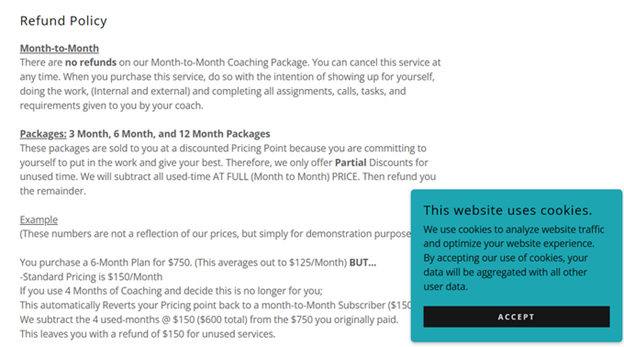
- Payment processing and refund policies
This is where you set the ground rules for how clients pay you and what happens if they want to cancel or request a refund. Most coaches I encountered do not offer refunds. There is a general belief that if you believe your coaching services are satisfactory, you should not promise a refund.
On the other hand, in the discussion forums, clients advise each other not to work with coaches who do not offer refunds. But it depends on your approach.
It should include your pricing, how payments are processed, whether you offer payment plans, and what happens if someone misses a payment. Also, be very clear about your refund policy. Do you offer full refunds? Partial ones? Is there a deadline for requesting one? If someone purchases your coaching package and changes their mind after the second session, will they get any money back?
You can include these points in your policy, as well as the coaching contract.
Here is an example of a refund policy by Coach Rayann LLC.
- Website terms of use
If you have a website or landing page, even a basic one, you should add a terms of use section. This is a legal document that sets the rules for anyone who visits or uses your website. It typically includes things like how your content can be used, what visitors can or cannot do on your site, and limits your liability if something goes wrong.
For example, if someone misuses the information you publish and ends up with poor results, your terms help protect you. You can use tools like Termly, TermsFeed, or GetTerms to generate a custom terms of use document that fits your coaching website.
- Industry-specific disclaimers
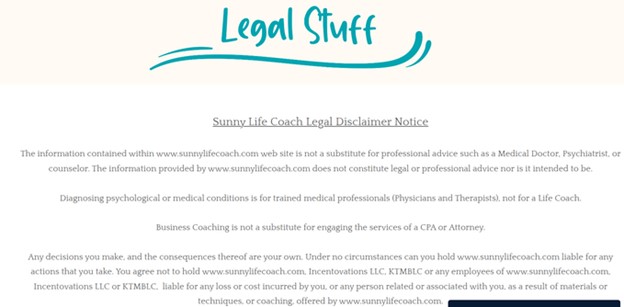
With disclaimers, you clarify that you are not a licensed therapist, doctor, financial advisor, or lawyer. Unless you actually are one.
These disclaimers help you draw the line between coaching and more regulated professional services. Place your disclaimers in visible spots: inside your contracts, under your course materials, and in your website footer.
For example, Sunny Life Coach introduces a disclaimer notice on their page. She mentions that she does not claim to be a doctor, psychiatrist, or counselor.
Life coaching contract
A coaching contract is the agreement between you and your client that lays out how your work together will run. It protects both sides, keeps expectations clear, and prevents misunderstandings.
At the very least, it should include:
- Who is involved, and when the agreement starts
- What the coaching includes
- Your pricing, payment terms, and refund or cancellation rules
- How sessions are scheduled and how clients can contact you
- A confidentiality clause to keep things private and professional
- A section on ending the agreement if either of you chooses to stop
- The responsibilities of both parties
- A liability disclaimer
Related: How to Create a Coaching Contract | Template
Business insurance
Business insurance is what helps protect you financially if something goes wrong. Even if your coaching business is small, insurance gives you a safety net in case a client claims harm, data is leaked, or someone sues you over results.
“If you own a business, it is imperative that you set it up with proper insurance to protect your business, your people, and the customers from the unforeseen issues that can arise. While it might seem a luxury, business insurance is incredibly important not only for protecting your business from lawsuits, but also, if you are a sole proprietor, for protecting your personal assets”.
Ginny Silver
Business coach
There are many types of business insurances, but the common ones you can consider include:
- Professional liability insurance (also called errors and omissions insurance). It covers you if a client says your advice caused them harm or that you did not deliver what they expected. Whether or not the claim is true, this protects you from legal and financial fallout.
- General liability insurance. This covers basic accidents, like someone slipping and falling in your office (if you meet in person), or property damage related to your business. Even if you coach online, it is worth checking what your provider includes.
- Cyber liability insurance. If you store client data online or take payments through your website, this helps protect you in case of data breaches, hacks, or online fraud.
Marketing and advertising laws
When you promote your coaching business, whether through your website, social media, or emails, you need to follow a few basic legal rules to keep things clean and compliant.
- Honest messaging
Do not guarantee results like “You will make $10k in 30 days” or claim to “cure” something unless you can back it up with real, provable evidence. You can talk about outcomes, but be careful with your wording and always include disclaimers if needed.
If you share client feedback or success stories, make it clear that those results are not guaranteed for everyone.
- Use of personal data
If you collect names, emails, or other personal information through your website, even for a freebie, you are responsible for keeping that data safe. You also need a privacy policy that explains what you collect, why, and how people can ask to be removed.
If you send newsletters or sales emails, you need to comply with laws like the CAN-SPAM Act in the U.S. or GDPR in the EU. That means:
- Get clear permission (no auto-subscribes)
- Give people a way to unsubscribe easily
- Include your business name and physical address in every email
Are you ready to make life coaching official?
Starting your coaching business means getting your legal and operational basics in place. You need to choose the right business structure, register your business name, set up clear terms and policies (like payments, refunds, and disclaimers), and create a coaching contract that protects both you and your clients.
Do not forget the essentials, like business insurance and making sure your marketing follows the rules. It may sound like a lot, but once these are in place, you’ll run your business with more confidence and less stress.
If you are looking for a coaching platform to help you launch and scale, consider Uteach. It is built to automate your coaching business. Book a free demo with one of our experts and start your business on the right foot.



![How to Start Online Coaching Business [Proven Strategies]](https://d35v9chtr4gec.cloudfront.net/uteach/articles/LXoil0HbCqKEO2lAdpzG-1693384984/start-online-coaching-business.jpg)