
The following guide covers:
What is scenario-based learning?
How is SBL different from traditional learning?
How effective is scenario-based learning?
Have you ever had employees skip through training or never complete it? One big reason is that they cannot see how it connects to their daily work.
Scenario-based learning closes this gap by placing employees in realistic situations where they practice decision-making. It is a hands-on method that builds confidence and sharpens problem-solving skills.
In this article, we will look at what sets scenario-based learning apart from traditional training and explore examples of activities you can use to make employee learning more engaging and practical.
What is scenario-based learning?
Scenario-based learning (SBL) is a training method that places learners inside realistic situations and asks them to make decisions that mirror actual workplace challenges.
The learners do not just receive information but, as the name suggests, face scenarios that resemble the problems they will need to solve on the job. So to speak, scenario-based learning has an approach that uses relevant narratives and decision points to guide learning toward specific outcomes.
But the idea is not new. The SBL approach shares lots of similarities with Jean Lave and Etienne Wenger’s situated learning theory. According to it, learning is most effective when it takes place in the same environment where it will later be applied. The office floor, the sales call, or the customer service desk becomes the natural classroom.
Similarly, Brown, Collins, and Duguid’s situated cognition framework argues that knowledge is inseparable from the culture and context in which it develops.
When you bring scenario-based learning into the workplace, there are a few common methods used to deliver this type of training. For example,
- Role-playing exercises. Employees step into specific roles, practicing conversations or negotiations that mirror real interactions.
- Simulations. Learners work through a staged version of an incident, system breakdown, or project scenario, experimenting with solutions without real-world risks.
- Gamification. Progress tracking, challenges, and feedback transform routine learning into a more engaging and motivating experience.
We will discuss the example that use the methods mentioned above with specific roles further in this article.
How is SBL different from traditional learning?
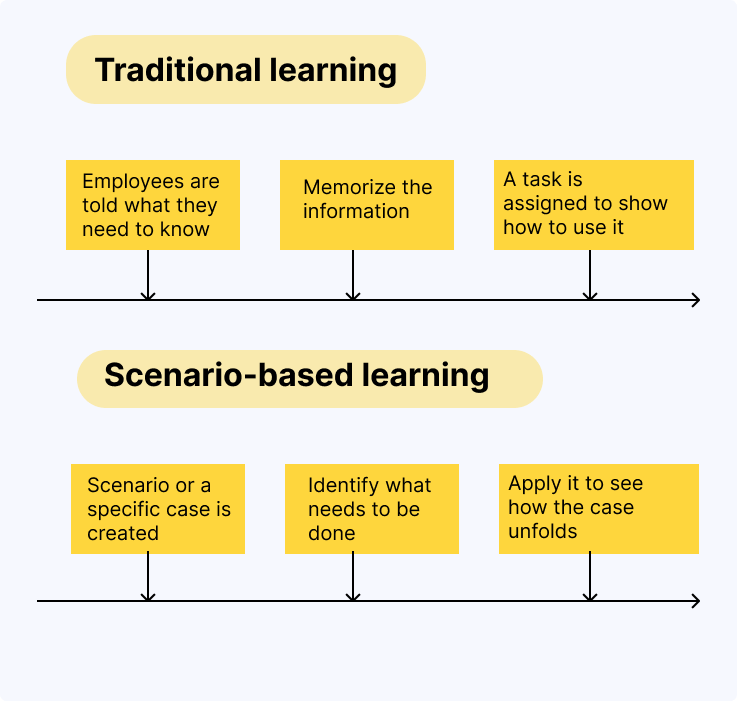
What makes this approach distinctive is its foundation in context. You have perhaps heard that in traditional training practice and theory are often separated. In this case, information is much harder for learners to retain and transfer. As the saying goes, it goes in one ear and out the other.
In this regard, SBL is more impactful. Yes, it still includes traditional learning components. But what makes both different?
Traditional learning | Scenario-Based Learning | |
| Learning context | Knowledge delivered in isolation | Knowledge embedded in realistic, job-related scenarios that mirror daily challenges |
| Role of the learner | Passive recipient of information, focused on memorization | Active participant, making decisions, solving problems, and seeing consequences |
| Application of knowledge | Applied after training, often requiring learners to figure out transfer on their own | Applied during training within authentic scenarios, reducing the gap between theory and practice |
| Engagement level | Often lecture-based, limited interaction | Interactive, immersive, often using role-play, simulations, or gamified elements |
| Feedback | Typically delayed and general | Immediate, context-specific feedback tied to actions and decisions |
The differences also depend on whether we compare them in synchronous or asynchronous environments.
With synchronous learning, scenario-based learning is delivered in a way that the learners physically participate in the role plays, games, or discussions. Then they receive immediate feedback from facilitators or peers.
In asynchronous environments, learners engage with scenarios at their own pace through digital modules, branching simulations, or gamified case studies. They can explore different decision paths, receive automated feedback, and repeat exercises until they master the skill.
How effective is scenario-based learning?
One simple reason why scenario-based learning is one of the most popular approaches in the workplace is that employees learn the skill based on realistic scenarios. In this case, they do not complete the course just for the sake of it.
SBL is especially effective for training, like compliance, which is believed to be much less engaging. However, with scenarios and gamification, employees see the practical application of what they usually get in theory. This approach helps them better grasp the importance of the topic and makes it easily applicable in everyday situations.
The other benefits of scenario-based learning include the following:
- Facilitates decision-making
At the heart of workplace training is the ability to make the right call when it matters, right? But what we see most of the time with employee training is that it involves reading through manuals or listening to lectures. Yes, they are important and build awareness, but they do not teach people how to weigh options in the heat of the moment. Scenario-based learning fills this gap.
- Creates a safe learning environment
There are high-risk industries where it is not quite possible to provide training in real work conditions. Besides, the mistakes could cost the company money and also its reputation. In this regard, SBL is a safe option for employees to sharpen their practical skills in real-life situations.
A case study from InfoproLearning, for example, reported a 15 percent reduction in compliance incidents after introducing scenario-based compliance modules.
- Builds employee confidence
It is one thing to know the theory, and another to feel confident enough to act on it. Many employees hesitate when faced with real-world challenges simply because they have not had the chance to practice. Scenario-based learning bridges this gap by creating repeated opportunities for rehearsal.
- Improves learning ROI
Every L&D team looks at the return on investment, and this is where scenario-based learning helps. Because it is interactive and reusable, it delivers more value over time than traditional classroom methods. The Brandon Hall Group found that scenario-based learning helped employees reach competency 41 percent faster, which translates directly into saved time and higher productivity.
Examples of scenario-based learning
There are multiple ways to introduce scenario-based learning activities, depending on the skills you want to build and the context in which employees will use them. Each activity puts learners in the middle of a situation where they must think, decide, and act. Here are some of the most effective approaches.
#1 What would you do in this scenario?
This activity presents learners with a realistic situation and asks them to decide on the best course of action. It is simple, but powerful, because it requires active thinking instead of passive listening.
For example, a retail employee is facing a customer who wants to return a damaged product without a receipt. The learner must choose how to handle it. Whether to offer store credit, escalate to a manager, or refuse politely. Each option shows the likely outcome, reinforcing the consequences of different decisions.
#2 What would you recommend?
Here, the focus shifts from action to advice. Learners are given a customer’s problem and asked to provide guidance. This builds product knowledge and communication skills in a way that feels practical.
In a financial services setting, an employee might be asked to recommend a savings plan for a client who wants short-term liquidity but also long-term growth. By evaluating options, the learner practices balancing customer needs with company offerings.
#3 Branching scenarios
Branching scenarios take learners through a story where each decision leads to different outcomes. This method mirrors real decision-making, where one choice often changes the direction of the entire situation.
For example, a sales representative begins a call with a potential client. If they ask the wrong opening question, the conversation may stall. If they show genuine interest, the scenario branches into a productive dialogue. Learners can explore multiple paths, experiencing both successful and unsuccessful outcomes in a single session.
#4 Audio role plays
Not every situation is visual. Sometimes hearing and responding to a voice is the most effective way to practice. Audio role plays allow learners to sharpen listening, empathy, and verbal response skills.
For example, a customer service agent listens to an irate caller explaining their issue. The learner records their response and receives feedback on tone, empathy, and clarity. This prepares them for the emotional intensity of live calls.
#5 Video stimulations
In this case, employees see a scenario on screen and must choose how to respond. This format works especially well for soft skills training.
#6 Gamified challenges
Gamification brings in elements such as points, leaderboards, and timed challenges. It keeps learners engaged while reinforcing knowledge through repetition.
For example, in a compliance training game, employees navigate a “day in the office,” earning points for spotting potential violations such as mishandling data or skipping safety checks. This repetition builds awareness while keeping motivation high.
#7 Collaborative scenarios
Not all workplace decisions are made alone. Collaborative scenarios put groups of learners together to solve a problem, encouraging discussion and teamwork.
As an example, a project team is asked to respond to a major client requesting last-minute changes. The group must negotiate deadlines, resources, and priorities to come up with a shared solution. This not only builds decision-making skills but also strengthens collaboration.
Conclusion
As you can see, scenario-based learning works because it turns training into a lived experience. Employees have the opportunity to practice decisions, face outcomes, and build confidence in a safe environment. That is why it is so effective for everything from compliance to leadership development. It makes training stick, and it makes learning matter.
To bring this approach into your workplace, you need an LMS that supports interactive, engaging, and measurable training. Uteach gives you that. You can build and deliver sessions live or on demand, and track employee progress in one system.
If you want to see how Uteach can transform the way your teams learn, book a demo with our specialist today.