
While in different contexts we use the terms training and development as synonyms, they are not exactly the same. Employee training usually focuses on helping someone perform their current role more effectively. Employee development focuses on helping someone grow beyond the current role and prepare for future responsibilities.
If you work in HR, L&D, or manage teams, this distinction matters. It helps you choose the right programs, set the right expectations, and measure success correctly.
In this article, you will learn what employee training means, what employee development means, and how they differ in practice. You will also see examples of each, their benefits, and when organizations typically invest in training versus development.
What is employee training?
Employee training is a structured, short-term educational process designed to provide workers with specific knowledge or skills to perform their current roles. It focuses on immediate functional improvements and operational efficiency within an organization.
The Academy of Management Journal defines it as follows:
“Training refers to a planned effort to facilitate the learning of job-related knowledge, skills, and behaviors”.
Why is this necessary? Effective training ensures your workforce remains compliant with safety laws and reduces errors in daily operations.
To get more specific, here are a few examples of employee training.
- Onboarding training for new hires to learn internal software and company-specific protocols.
- Technical skills training for engineers to learn a new coding framework or manufacturing machinery.
- Compliance training for medical staff to follow HIPAA regulations or updated safety standards.
- Product knowledge training for sales teams to understand the features of a newly launched service.
Statistics from the Association for Talent Development show that companies with comprehensive training programs have 218% higher income per employee than those without. Investing in training is essential because it directly correlates to higher profitability and lower employee turnover.
What is employee development?
Employee development refers to the long-term, continuous process of improving employees’ knowledge, skills, abilities, and career capabilities so they can take on future responsibilities and grow within the organization. It focuses on preparing people for what comes next in their careers rather than only improving how they perform their current job.
Why does this matter in practice? Because jobs change quickly. The World Economic Forum estimates that around 44% of workers’ core skills will change within five years, which means organizations must continuously help employees build new capabilities to stay productive.
The development is also what helps with employee retention. How so? In one of the podcast episodes of the HR Hub, where Andrea Adams was discussing the difference between employee development and training, James Aird shared the following:
“Development is becoming more in demand across the private sector as a way to increase employee recruiting and retention. The young people entering the workforce now have higher expectations for their own career development.”
James Aird
L&D manager, instructional designer
What does employee development look like in organizations?
- Leadership development programs for high-potential managers preparing to lead teams or departments.
- Mentorship programs where junior employees learn decision-making and industry knowledge from senior leaders.
- Career development plans are created between a manager and employee to prepare the person for a future role, such as product manager, team lead, or director.
The organizations that prioritize continuous development and upskilling also experience higher retention rates as employees feel more engaged. As reported by the Association for Talent Development (ATD), they see significant advantages, including a 24% higher profit margin.
What is the difference between employee training and development?
Now for the million-dollar question. What is the difference between employee training and employee development?
In simple terms, training improves how someone performs their current job. Development prepares that person for future roles and broader responsibilities. To be exact, training focuses on immediate performance, while development focuses on long-term capability and career growth.
In the article “The Impact of Training and Development on Organizational Performance”, the authors explain the difference between training and development in the following way:
“Training helps employees perform their roles efficiently, while development programs nurture growth and prepare individuals for future challenges.”
Let us make this practical with an example of a customer support team.
- Training scenario: You introduce a new helpdesk software. The team must learn how to log tickets, escalate issues, and use the dashboard. You run structured sessions and measure whether employees can perform the tasks correctly.
- Development scenario: You identify a support agent who could become a future team lead. You enroll that employee in a 6-month leadership coaching, conflict management workshops, and decision-making programs.
James Aird, an L&D manager and instructional designer, shared a very clear example of this difference when he was a guest on the HR Hub Podcast. He explained it like this:
“In a biotech company, we were implementing a new solution for our clients, and we needed all of our employees to learn how to use this. On the training side, what we had to do was create custom pathways, coursework, and seminars. We had an evaluation assessment, and we knew what it meant for that training to be successful. On the development side, we had an LMS that allowed employees to decide and take agency over what THEY wanted to learn”.
James Aird
L&D manager, instructional designer
As you can see:
- The training program had a fixed outcome. Employees had to learn a specific system and demonstrate competence. Success was measurable.
- The development environment gave employees freedom. They explored skills they wanted to build for their future careers.
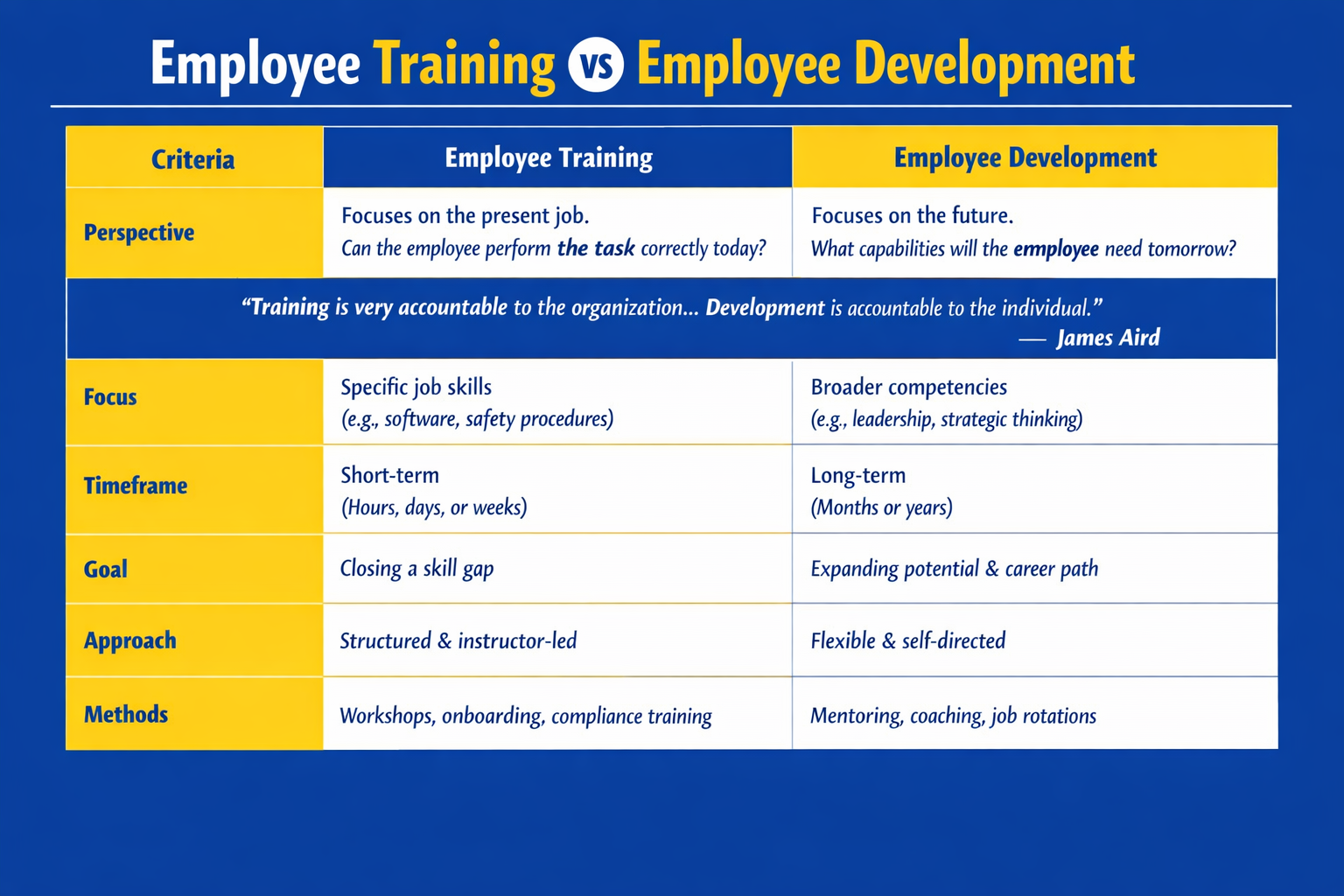
If you step back, the difference becomes clearer when you compare training and development across a few practical aspects.
Perspective
- Training looks at the present job. It asks: can the employee perform the task correctly today?
- Development looks at the future. It asks: what capabilities will this employee need tomorrow?
"Training on one side is very accountable to the organization... On the other side, you have development. Development is accountable to the individual."
James Aird
L&D manager, instructional designer
Focus
- Training focuses on specific job skills such as operating software, following safety procedures, or selling a product.
- Development focuses on broader competencies such as leadership, strategic thinking, or communication.
Timeframe
- Training is short-term. It often lasts a few hours, days, or weeks.
- Development is continuous. It can span months or even years.
Goal
- Training aims to close a specific skill gap.
- Development aims to expand a person’s potential and career path.
Approach
- Training is structured and instructor-led. You define the curriculum and expected outcome.
- Development is flexible. Employees often choose learning paths based on career goals.
Methods
- Training uses workshops, onboarding sessions, compliance courses, or technical instruction.
- Development uses mentoring, coaching, job rotations, leadership programs, and long-term learning plans.
FAQ
Let’s summarize the key differences between employee training and development with a few frequently asked questions.
- Are employee learning and development the same thing?
No. Employee learning and development are related but not the same thing.
Employee learning refers to the process through which employees acquire knowledge, skills, and behaviors. This can happen through training courses, mentoring, self-learning, or on-the-job experience. Employee development, on the other hand, is broader. It refers to structured initiatives organizations use to help employees grow their capabilities and prepare for future roles.
I would say that learning is the mechanism, and development is the objective. Learning activities feed development programs.
- What are the benefits of employee training?
Employee training improves job performance, reduces operational errors, and so much more. To look at the key benefits, let’s check the statistics.
- 90% of employees report better job performance after training programs
- IBM found that regular training can increase productivity by 10% and performance by 14%.
- Organizations with strong learning cultures experience 30–50% lower employee turnover compared with companies that invest less in training.
The same source claims that 61% of employees say training helps them keep up with industry changes, and 72% report greater loyalty to their employer when training opportunities exist
- What are the benefits of employee development?
First, development improves retention. Research shows that 94% of employees say they would stay longer at a company that invests in their career development.
Employee development programs also increase engagement and motivation. Employees who see growth opportunities are significantly more likely to remain engaged and committed to the organization.
Most importantly, development improves organizational performance. Around 75% of companies report that development initiatives help them achieve business goals more effectively.
- When to invest in employee training and when in development?
You can invest in employee training when a specific skill gap affects current job performance. For example,
- New software implementation
- Compliance or safety requirements
- Product knowledge for sales teams
- Technical skills needed for a current role
- Training solves immediate operational problems.
You invest in employee development when you are preparing employees for future roles or expanding organizational capabilities. For example,
- Leadership development for high-potential managers
- Career path programs
- Mentoring and coaching initiatives
- Cross-department job rotations
Development supports long-term workforce strategy.
What is the best platform for offering employee training and development programs?
To manage both effectively, you need a platform that can support structured training programs and long-term learning paths. With Uteach, you can automate employee onboarding and training, saving more than 70% of your time.
There are opportunities for structured courses, onboarding programs, live programs, coaching sessions, etc. Everything is easily accessible with mobile learning.
If you are planning employee training or development initiatives, the next step is simple. Book a demo with Uteach and discuss how the platform fits your workflow and training strategy.