
The following guide covers:
Best practices for a structured employee onboarding training
Employee onboarding checklist based on timelines
Checklist to create course content that’s engaging and educationals
Employee onboarding is one of those processes that looks simple on the surface. But it also determines whether a new hire succeeds. I have reviewed how established companies approach employee onboarding training, studied their internal practices, and analyzed where onboarding breaks down in real business settings.
One pattern is consistent. When onboarding is treated as a checklist task, employees disengage early. When it is treated as a structured learning experience, performance improves.
In this guide, I break down employee onboarding training using proven practices from companies like Google, Zappos, Buffer, Salesforce, Microsoft, and Netflix. You will learn what actually works, find practical best practices, a timeline-based onboarding checklist, and guidance on how learning management systems support onboarding at scale.
Best practices for a structured employee onboarding training
When we hear “employee onboarding training,” we instantly imagine the first few weeks when new hires receive all the information they need to start working. Yes, that is important.
However, onboarding training shall not neglect the preboarding and after-boarding experiences. During all the onboarding stages, you do much more than familiarize your new hires with their key responsibilities and training programs.
Let’s see what onboarding training looks like in practice, starting with preboarding, then moving into culture training, clear onboarding goals, personalization, learning through connection, and constant feedback.
Related: Onboarding vs Training. Differences, Definitions, and Examples
#1 Take preboarding seriously
Preboarding is the structured set of actions and communications that happen after offer acceptance and before the employee’s first official working day.
Glassdoor reports that organizations with a strong onboarding process improve new hire retention by 82% and productivity by over 70%. At the same time, Gallup has found that only 12% of employees strongly agree their organization does a great job onboarding new hires. That gap tells us how underestimated preboarding is.
During the preboarding stage of employee onboarding training, you should focus on reducing uncertainty and building early confidence. In practical terms, that means you should:
- Share essential documentation early, including contracts, compliance materials, and policies, so the first week is not consumed by paperwork
- Clarify what will happen on day one and week one, including schedules, expectations, and who the new hire will interact with
- Set up accounts, tools, and access in advance to avoid technical friction on the first working day
- Introduce key people, such as managers, buddies, or team leads
- Communicate consistently but intentionally, so information is spaced out and easy to absorb
Example
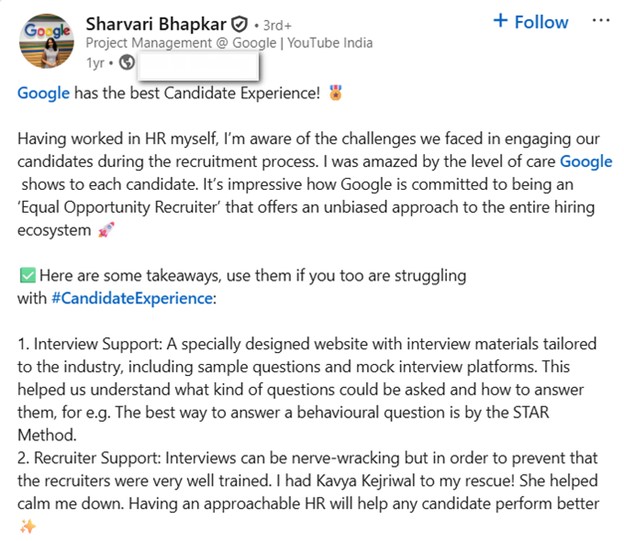
Google is a strong example of how to do this well. They use a dedicated website that serves as a portal where new hires can access what they need before officially joining. As described by Sharvari Bhapkar, Project Manager at Google, on her LinkedIn page:
“Next step after the offer acceptance is crucial. A separate website that helped us with the to-dos before we officially join as contract go-through, documentations, account creation, understanding the compliance policies, benefits, and other Google culture benefits”.
Sharvari Bhapkar
Project Manager at Google
This is not an easy task at all, because you do not want to dump all the resources and training guidance materials on employees. Just sharing all those resources will overwhelm the employees, which you want to avoid at any cost.
Google actively counters this by sending structured engagement emails before the start date. These emails build excitement, introduce the team, and outline what to expect during the first days and weeks, which keeps anxiety low.
Buffer sends the key onboarding information in an email sequence of 5 emails:
- a warm welcome,
- moving through the practical setup and collecting the necessary information
- team introductions,
- Introduction to the tools the team’s using
- clear expectations for day one
You should pace information like a good conversation.
#2 Make training on company culture as part of your employee onboarding
You have probably already learned that you should introduce company values and beliefs as soon as possible. But in most cases, it is just reading company values from a slide deck or listening to a short presentation about mission and vision.
You would agree that such an approach rarely sticks. Employees may understand the words, but they do not understand the behavior behind your vision. Culture is not what you say during onboarding. It is what people do when they make decisions, handle customers, and work with each other.
A better approach is to make your company culture and vision a part of the employee onboarding training program. Such training shapes how employees communicate, how they solve problems, and how they represent your brand externally.
To introduce your company values:
- Translate values into real behaviors and decisions employees are expected to make in their roles
- Use real internal examples and scenarios that show how values are applied at work
- Involve managers and team leads so culture is reinforced through leadership, not just training materials
- Give new hires opportunities to experience the culture instead of only hearing about it
Example
A great example of all of those points in practice is Zappos. New hires go through an intensive four-week training program that immerses them in Zappos’ culture, customer service mindset, and company values, regardless of the role they were hired for. This applies equally to marketers, engineers, and operational roles.
Speaking about the onboarding process at Zappos, Christina Colligan mentioned
“I don’t know another business that has every employee go through such an involved orientation process. It costs Zappos a great deal when it comes to productivity and salaries, but it is worth it in terms of grounding all of us on the importance of the Zappos values.
The process really is an immersion in culture. Everyone at Zappos gets the same rich introduction to values and customer service. We are all in orientation together, and we are all Zappos together”.
Christina Colligan,
CLT Manager at Zappos
To go one step deeper, Zappos involves all new hires directly in customer service work. Every employee spends time on the customer service floor to understand the company’s service-first approach.
#3 Have clearly defined onboarding training goals
Onboarding goals should be specific, role-related, and time-bound. By goals, I do not mean ideas like “get familiar with the role”. Examples of onboarding training goals include
- understanding core tools by the end of week one,
- completing required compliance training within the first ten days,
- shadowing key workflows during the first month,
- reaching a defined level of autonomy in daily tasks by day 60, etc.
To track these goals effectively, you should rely on constant check-ins with new hires. These check-ins are not about control, but about alignment.
During them, you should discuss progress against expectations, clarify open questions, and adjust pace where needed. Be explicit about performance-related goals from the start. For example, if you expect customer service representatives to attend a certain number of calls per week or sales representatives to make a specific number of client calls, state those expectations clearly and revisit them during check-ins.
Example
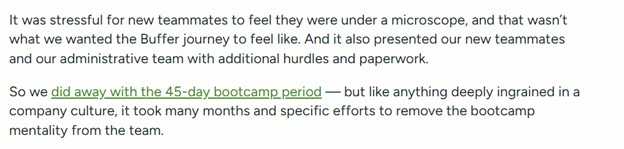
Let’s discuss this on Buffer’s 45-day onboarding plan that they used to implement. They used a 45-day onboarding plan that includes clear weekly goals and checkpoints, the assignment of an onboarding buddy for day-to-day guidance, regular manager check-ins, detailed documentation on tools and processes, and asynchronous video introductions that allow remote hires to learn at their own pace.
But you shall also be very cautious when introducing a similar program that has specific goals and constant check-ins. Buffer has shared in their blog that some employees felt under a microscope, which is why they stopped the bootcamp program.
#4 Personalize the onboarding training
Not all employees start from the same place, and treating them as if they do slows some down.
When onboarding is personalized, new hires focus on what is relevant to their role, experience level, and responsibilities. This shortens the time to productivity and helps employees feel seen as individuals, not as headcount.
From a business perspective, it also prevents wasted training time on content that does not add value.
You can personalize employee onboarding training in practical and manageable ways. For example, you can:
- Adjust training depth based on prior experience and seniority
- Customize learning paths by role, department, or function
- Use one-on-one sessions to address role-specific tools, workflows, or challenges
Example
At the beginning of onboarding, everyone at Salesforce goes through the same core bootcamp to build a shared understanding of Salesforce. It is a 30-hour program on Salesforce’s products, values and its operating model. This creates consistency and a common language across the organization.
At the same time, Salesforce personalizes onboarding through targeted one-on-one sessions and role-specific training.
As they share on their website, onboarding is tailored for different functions. For instance, Business Development Representatives receive focused training on how to pitch Salesforce products in their region. Sales leaders go through onboarding designed around Salesforce’s approach to people leadership.
“Your first day of onboarding is the first impression of the rest of your Salesforce career. It’s critical that we create an experience that makes everyone feel welcomed, engaged, and prepared.”
Jenny Simmons,
Salesforce’s VP of Onboarding and Employee Learning
#5 Combine professional training with networking opportunities
Onboarding training alone does provide engagement. In fact, only 21% of employees worldwide are engaged during the onboarding stage.
When new hires do not build relationships early, however greatly they understand their role, they still feel disconnected from the organization.
Employee onboarding training should help people learn how to do their job and help them feel part of the company.
You can intentionally combine training with networking during onboarding by doing a few simple things:
- Pair new hires with onboarding buddies or mentors who are outside their direct team
- Schedule informal meet-and-greet sessions alongside formal training sessions
- Create small group activities where new hires solve problems or learn together
- Encourage participation in internal communities, interest groups, or discussion channels
- Design onboarding tasks that require collaboration
Example
Microsoft approaches this practice with a strong focus on real relationships, especially in hybrid and remote environments.
Microsoft Viva Engage plays a key role in onboarding and engagement. It connects employees with leaders and peers through two-way dialogue, helping align people around vision and culture. Employees can share experiences, participate in discussions, ask questions, and build communities that feel meaningful
#6 Collect and give constant feedback
You should collect and give feedback at defined milestones during onboarding, most commonly after 30, 45, and 90 days, so expectations, progress, and concerns are addressed before they turn into problems.
When collecting feedback from new hires, keep questions practical and focused. For example, you can ask:
- What part of the onboarding process has been most helpful so far
- What has felt unclear or overwhelming
- Do you understand what success looks like in your role at this stage
- Do you feel supported by your manager and team
Example
At Netflix, feedback is not treated as a corrective action but as part of everyday work. The employees are encouraged to give and receive honest input from the start.
“You get better outcomes when employees have the information and freedom to make decisions for themselves. We hire unusually responsible people who thrive on this openness and freedom.”
Netflix
In the Netflix culture memo, co-CEO Reed Hastings and Ted Sarandos emphasize this clearly: “We value candor, transparency, and freedom with responsibility.”
Employee onboarding checklist based on timelines
Now that you know how to run an employee onboarding training to make it efficient, let’s get into the plan. The checklist below presents a simple plan on what you need to do for the first day, first week, first month, and first three months of onboarding.
First day of onboarding
- Welcome the employee and confirm access to all required tools, systems, and accounts
- Walk through the agenda for the day and the week so expectations are clear
- Introduce the manager, onboarding buddy, and immediate team members
- Review role basics, responsibilities, and short-term priorities
- Share where documentation, policies, and learning resources live
First week of onboarding
- Complete mandatory compliance, security, and HR training
- Provide role-specific training on core tools and workflows
- Set clear short-term goals and explain how progress will be measured
- Schedule regular check-ins with the manager and onboarding buddy
- Introduce the employee to cross-functional teams they will work with
First month
- Gradually transition from training to real, supervised work
- Review progress against onboarding goals and adjust where needed
- Provide structured feedback on performance and learning pace
- Encourage participation in team meetings and internal communities
- Clarify expectations for autonomy and decision-making
First three months
- Evaluate overall onboarding success against initial goals
- Discuss long-term role expectations and employee development opportunities
- Confirm full ownership of core responsibilities
- Collect feedback on the onboarding experience and training quality
- Align on next steps, priorities, and performance goals moving forward
Best LMS for employee onboarding training
An LMS supports employee onboarding training by acting as a centralized hub where learning content, communication, and progress tracking live in one place.
Uteach approaches employee onboarding as a flexible learning system.
More than 6,000 academies and organizations already use Uteach to train, onboard, and upskill their teams.
- Mobile learning and on-the-go access
Uteach offers a mobile app that allows employees to access training content anytime, from any device. Mobile access reduces friction and makes learning part of the workday, not a separate task.
- Microlearning for faster absorption
You can break onboarding training into small modules that cover tools, processes, or policies one at a time. This helps reduce information overload and makes it easier for new hires to retain what they learn.
You can deliver microlearning training in any format you like, such as:
- live training sessions
- pre-recorded courses
- coaching sessions
- Social learning through communities
Uteach includes community features where new hires can interact, ask questions, and learn from peers. These communities support discussion, collaboration, and shared learning, which helps employees feel part of the organization early on.
- Progress tracking and visibility
With Uteach, you can track course completion, participation in live sessions, and overall engagement. This gives you clear insight into how onboarding is progressing and where support may be needed. For managers, it removes guesswork and replaces it with data.
Book your demo to learn more about how Uteach can support your onboarding and training goals.
Related: How to Choose The Best LMS | Checklist, Must-Ask Questions
FAQ
What are the benefits of employee onboarding training?
Employee onboarding training improves retention, accelerates time to productivity, and reduces early-stage turnover. When new hires understand their role, expectations, and tools early on, they contribute faster and make fewer costly mistakes.
It also creates consistency across teams. Structured onboarding ensures every employee receives the same core knowledge about company culture, processes, and standards, regardless of manager or department. This alignment directly impacts performance and collaboration.
From an employee experience perspective, onboarding training builds confidence and engagement. Employees who feel supported during their first months are more likely to stay, perform well, and advocate for the company.
What are the 5 stages of the onboarding process?
The onboarding process typically consists of five stages: preboarding, orientation, role training, integration, and performance alignment. Each stage serves a different purpose and builds on the previous one.
Preboarding prepares employees before day one by handling documentation, access, and expectations. Orientation introduces the company, culture, and people. Role training focuses on skills, tools, and workflows required for the job. Integration helps employees build relationships and operate independently within the team. Performance alignment ensures expectations, goals, and feedback are clearly established.
Treating onboarding as a staged process helps organizations move new hires from introduction to contribution in a structured and measurable way.
What does an effective employee onboarding training imply?
Effective employee onboarding training implies clarity, structure, and continuous support rather than a one-time orientation. It means employees know what is expected of them, how success is measured, and where to go for help.
It also implies personalization and pacing. Training content is relevant to the role, delivered in manageable formats, and reinforced through feedback and real work. Effective onboarding combines learning, connection, and accountability.
Most importantly, effective onboarding training is measurable. Organizations track progress, engagement, and outcomes, then improve the process based on feedback and performance data.