
The following guide covers:
#1 Run a training needs analysis (TNA)
#2 Implement trainee-centered methods in employee training and development
#3 Provide and ask for feedback constantly
#4 Use frameworks like ADDIE and WIIFM to improve training content
#5 Measure learning by behavior and business impact
Have you been looking at the training performance lately and seeing that there is room for improvement? Maybe you even thought you needed to use gamification, make training sessions shorter, or bring engaging elements.
But let’s step into the employee’s perspective for a second. If I do not understand why I am in this training and how it connects to my daily work, I will not engage. Neither will a fancy learning experience motivate me.
That is why in this guide, I will not prompt you to implement blended learning, gamification, microlearning, or anything of that sort. Because if the foundation is weak, those will not fix the problem.
Instead, I will walk you through a few ways to improve employee training from the ground up. We will look at
- how to make sure the right people receive the right training,
- how to structure it around actual learner needs,
- how to keep the content practical and relevant, how to treat training as an ongoing process instead of a one-time activity,
- how to measure whether it actually drives business results.
#1 Run a training needs analysis (TNA)
The first thing we do in any process when we want to improve it is to start with analysis, right? And to understand how we can improve the training and development in the workplace, we need to start with training need analysis.
I highlight this because when you see poor engagement in any training and activity, the first thing that comes to mind is questioning the quality of the training content delivered.
But the core issue is whether the right employees are receiving that training.
With TNA, you stop guessing what to train and start working with clear gaps, priorities, and expected outcomes. The analysis shows where performance is falling short, which skills are missing, and whether training is even the right fix before you spend budget on it.
“First, it (training needs analysis) defines and prioritizes the greatest areas of need. It allows you to identify the performance and skill gaps that you may know or not know about. It’s also integral to determine the costs and benefits of the training”.
Sean McKesson, Solutions architect at Career Development Solutions
- Define business goals. Clarify what outcomes you expect from training (e.g., reduce onboarding time, improve sales conversion).
- Identify required competencies. Map the skills and knowledge employees need to meet those goals.
- Assess current performance. Use surveys, interviews, and performance data to see where employees stand today.
- Find the gaps. Compare required vs. current skills to pinpoint specific needs.
- Prioritize needs. Focus on gaps that have the highest business impact and urgency.
- Choose solutions. Decide whether training, coaching, or process changes will close the gap.
- Estimate cost vs. impact. Validate that the training effort is worth the expected improvement.
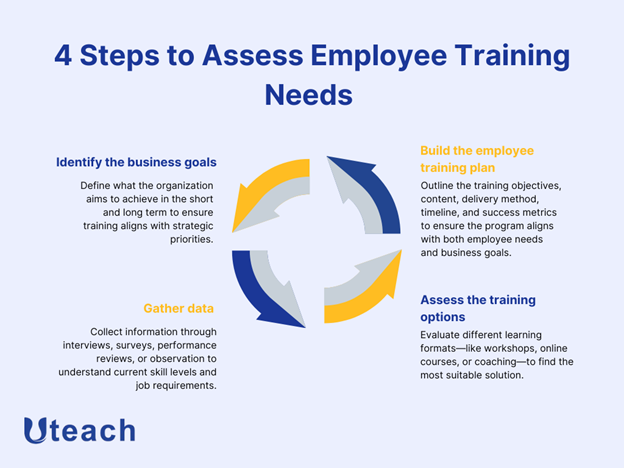
Once you have done this research, you will know exactly which skills need development. But there is another layer: people need to care about those skills. You cannot assign the same training to a group and expect equal engagement or results.
As former VP of People Operations at Google, Lazlo Bock mentions, the effectiveness of employee training depends on intrinsic motivation rather than just extrinsic rewards like salary.
“Find out why people are doing their jobs and what’s meaningful to them, then connect their learning to that sense of purpose.”
Laszlo Bock
Example
Let’s discuss this with a simple example.
Imagine someone in your team is strong in marketing research. But they are the anxious type and struggle to present insights in meetings and host discussions. At first glance, it may seem they do not have the answers, since they hesitate.
But the gap here is presentation skills. The motivation is also clear: they need it to do their job well and feel confident.
In this case, the training will definitely work since the skill is both required and personally relevant.
How will Uteach help?
If you run employee training or onboarding programs on Uteach, you already have forms and a CRM built into your learning management system. You can use them to structure your TNA analysis.
- Create assessment forms on Uteach to collect data on current skills, challenges, and goals.
- Segment and filter responses in the CRM to group employees by role, skill level, or identified gaps.
- Use stored data to prioritize which training to launch first based on real demand and impact.
#2 Implement trainee-centered methods in employee training and development
Now that you know for sure that the right people are receiving the right training, let’s analyze how you could improve the training from this point onward.
A training industry report from 2 years ago presented that 20% to 28% of total employee training hours are delivered through instructor-led classroom approaches. And about 70% of the training occurs on the job.
Looking through other surveys among small, mid, and large organizations, I concluded that instructor-led training continues to be the most popular format that many organizations go with.
Most of them choose instructor-led training as a common solution and approach, but omit one important detail. That is, there are currently five generations in the workforce, each with different learning styles and needs.
So, not only can you not force similar roles to attend training on the same topic, but you cannot expect 5 generations to have the same learning outcomes.
No surprise that one of the well-known training designers, Cathy Moore, suggests using training techniques that work for the learners.
“Best way to respect learners: Use techniques that research has proven to work. Help people reach their goals without wasting their time.”
Cathy Moore
Author of Map It: The Hands-On Guide to Strategic Training Design
And the former VP of People Operations at Google highlighted that learning is personal.
“Learning is personal. Everyone has different learning styles and different levels of challenge within which they can work… We can create the kind of experiences that will help us accelerate”.
Example
Here are a few ways you can make sure the employee training is trainee-centered:
- Learn about what your employees want and need by communicating with them
In the team I work with, it is a common practice to evaluate the training we receive mid-training, not only at the end of it. Even when it is a group training, we share feedback on practicality, improvement recommendations, format effectiveness, etc.
Another great way is to have managers communicate with their employees directly, as Aisrswift suggests.
“Asking questions in a relaxed setting is a great way to do this, as it lets employees express their opinions and communicate openly. Aim to understand and reflect on what your employees are saying”.
Airswift
- Tie training to real tasks, not theory
If someone cannot use what they learned the same week, they will surely forget it. Use real scenarios, current projects, or actual problems they deal with in the training material. Add exercises, simulations, or role-based tasks where employees apply the skill.
For example, “Learning is a process” is the core part of Google’s L&D strategy. It emphasizes pre‑work, practice, and feedback loops embedded in real tasks.
- Personalize learning paths
Even within the same role, gaps are different. Based on your TNA, assign specific training.
Related: 10 Essential Corporate Training Programs for Your Organization
How will Uteach help?
With Uteach, you can track both employee performance and training performance in one place. This gives you a clear view of how people move through the training.
- Measure overall course completion
See how many employees actually finish the training, not just enroll in it. - Spot your most engaged learners
Identify who actively progresses, completes tasks, and interacts with the material. - Track full completion rates
Understand what percentage of employees go through the entire course, not just parts of it.
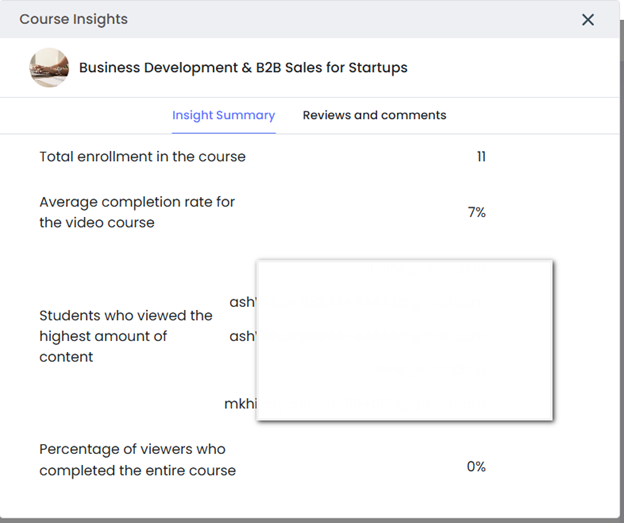
This data tells you what to do next.
For example, if you see that 80% of employees start a course but only 35% complete it, the issue is not participation. It is the structure or relevance of the training. Maybe the modules are too long, or the content is not directly useful.
Or if one group has a much higher completion rate than another, you can go back to your TNA and check if the training actually matches the needs of both groups.
#3 Provide and ask for feedback constantly
Most of the time, we see training as a one-time activity. But employee training is a whole process, and you need to constantly observe, adjust, and reinforce.
Karen May, former VP of People Development at Google, frames learning as a continuous process backed by practice and feedback, not a one‑off event. Here is what she shared in the session on how Googlers teach and learn.
“Learning happens as a process. And our job is to think end-to-end about where the motivation gets created, how we create opportunities to practice, and what the feedback loop is”.
Karen May on how Gogglers teach and learn
As you can see, the strongest tool you can use to improve employee training and development is feedback.
Example
As you go through learner results, the LMS analytics would show exactly how employees progress and where they fall behind. Once you notice a gap in the expected training results vs. actual employee performance, use the SBI method to share feedback with the employee.
It breaks feedback into three parts and keeps feedback specific and actionable.
- Situation = describe what you are sharing the feedback for; in this case, it is their training.
- Behavior = share what you noticed from their training results
- Impact = show what it affected, it might be their performance at the job, or team, etc.
The same method works in reverse when you ask for feedback on training. You can ask employees to describe:
- when they struggled (situation)
- what exactly did not work (behavior/content)
- how it affected their learning (impact)
How will Uteach help?
To keep feedback continuous, you need it built into the training flow, not added later. With Uteach, you can
- Track performance through quizzes and assignments to see where learners struggle
- Review learner progress and responses to identify patterns across teams
- Add feedback forms between training sessions to prompt employees to complete them automatically.
#4 Use frameworks like ADDIE and WIIFM to improve training content
Up to this point, you made sure the right people receive the right training, the content matches their needs, and there is continuous feedback on performance. The next step in this loop is to look at the training content itself.
ADDIE instructional design model
If you notice poor results, do not assume the issue is only with employees. Check how the training is designed and delivered.
A practical way to improve employee training is to reflect on one of the most well-known instructional design models: the ADDIE model. It stands for Analysis, Design, Development, Implementation, and Evaluation.
Here is how to use the ADDIE model in each stage for improving employee training.
- Analysis — Check if the training is solving a real problem. Make sure that the content you offer matches the learner’s skill and knowledge levels.
- Design —At this stage, the instructional designers take care of what materials, tests, and resources the training shall be composed of. Perhaps you can take the employees’ feedback into account and update or restructure the materials based on it. See how the content is actually connected to daily work.
- Development — One of the stages of development is when you have all the necessary materials uploaded on your LMS platform. Test the experience of what it is actually like to pass the training with that LMS. Employee feedback can also prompt you to improve the learning experience inside the LMS.
- Implementation — You can access the LMS reports on the training performance to see where there is a need to tweak something, because employee training implementation is a never-ending process.
- Evaluation — Once you push all the necessary changes into action, you will need to evaluate the effectiveness of the changes, going through the above-mentioned points.
WIFM model
But there are cases where the training content is solid, but you still do not see the results expected. That is why the managers can use the What’s In It For Me model.
The conversations with the employees will help them understand
- What problem will the training solve for them?
- What will become easier in their daily tasks?
- What will they gain?
When employees see the direct benefit, engagement increases, and the chances of applying the skill go up. After all, in companies where employees believe the training is relevant, there is 17% higher productivity and 21% higher profitability.
#5 Measure learning by behavior and business impact
In other cases, you will see no issue with employee motivation.
Yet, you still need to go back to the KPIs you set at the beginning of the training. If those are not met, the problem with your employee training is the impact.
One of the ways to measure the impact is surely ROI.
ROI = (Net benefits / Costs) × 100
This tells you if the training is worth the investment.
You also need to check if the behavior actually changed.
You can measure this through:
- Performance reviews, are employees applying the new skills in their role?
- Self-assessments, do employees feel more confident and capable after training?
- 360-degree feedback, do managers and peers notice improvement in behavior?
“Just as a pole vaulter uses a pole to catapult themselves over a horizontal bar, learning can propel an individual forward and upward."
Emma Weber, Author, Founder of Lever Learning
Example:
You run a sales training focused on handling objections.
- KPI: increase conversion rate by 15%
- After training: course completion is 90%, engagement is high
But conversion only increases by 3%.
Now you check the behavior:
- Performance reviews show reps still rely on old scripts
- 360-degree feedback shows they avoid difficult conversations
- Self-assessments show low confidence in applying new techniques
In this case, the training content is definitely not the issue. It is the lack of behavioral change. So, you need to reflect on the TNA analysis we started with. Maybe you need more practice, role-play, or ongoing coaching instead of a one-time training.
FAQ
- Why is it important to improve employee training?
According to 2025 LinkedIn reports, 49% of L&D professionals report a skills gap in their workforce. And what is the best way to fill that gap if not structured and efficient training?
So many studies and surveys have shown that employee training directly affects performance, retention, and revenue.
- Companies with structured training programs see 218% higher income per employee
- And 94% say they would stay longer in companies that invest in learning
Improving employee training helps you get a skilled and adaptable workforce that is ready to take on new challenges.
- How can Uteach help to improve employee training?
According to Finance Online, 72% of organisations report having a competitive advantage by using an LMS to scale employee training .
With Uteach, you will have an all-in-one platform to create, manage, and deliver training. It streamlines your workflows through automatic scheduling, automated quizzes for assessments, and easy tracking of employee progress and course management.
Uteach partners have already managed to:
- Reduce time spent on onboarding by 65%
- Cut HR and administrative workload by 40%
- Increase learner engagement by 45%
If you want to see how this fits into your current workflow, book a demo, and our specialist will help you map the process and understand your needs.