
The following guide covers:
Google - made learning a core cultural system
Amazon - made upskilling continuous
McDonald’s - structured development for frontline employees
Netflix - high-performance development
Most employee training programs fail for one simple reason. They are designed as events, not systems.
I studied how companies actually develop employee development training programs. What separates companies like Google, Amazon, McDonald’s, and Netflix from everyone else is not budget, perks, or access to elite talent. It is how intentionally they design learning into the way work gets done.
So, in this article, we will not get into trendy learning ideas for employee training and development. We will discuss how some of the giants in different industries run employee development in real life. Read on to find out what you can extract from their systems and employee development training practices without copying them blindly.
Google - made learning a core cultural system
When we say “employee development and corporate training programs”, most people would think about it as a mandatory event that employees have to do just because they are assigned. Yet, the success of most of Google’s development programs is that they view it as a continuous social process.
As stated in Google’s learning and development guide, they have 4 core learning principles that they apply in any employee training program, learning is
- a process, not an event
- happens in real life. The most impactful lessons occur during "moments of need" or transitions.
- personal. Googlers are encouraged to own their own development path.
- social. Knowledge should be shared across the network.
“At Google, we often share advice, support, and information. We intentionally create opportunities for employees to learn from each other and expand their network within the company. As a result, there are more courses taught by Googlers who participate in our employee-to-Google learning network (g2g) than by members of Google's People Operations department”.
Key initiatives for employee development and training programs at Google
Let’s see how Google fosters a culture of curiosity and makes the training highly relevant for the employees.
- Whisper courses
You most likely noticed that traditional day-long workshops often fail because once we return to our desks, we forget the material. With “whisper courses”, Google found a way to make learning "stick". Because they provide reminders at the exact moment a manager might need them.
These whisper courses are essentially a series of bite-sized emails delivered over several weeks. Each email focuses on one specific, actionable suggestion. For example, a whisper might suggest a specific way to show appreciation or a question to ask during a 1:1.
Here is an example email from Google’s re: Work.
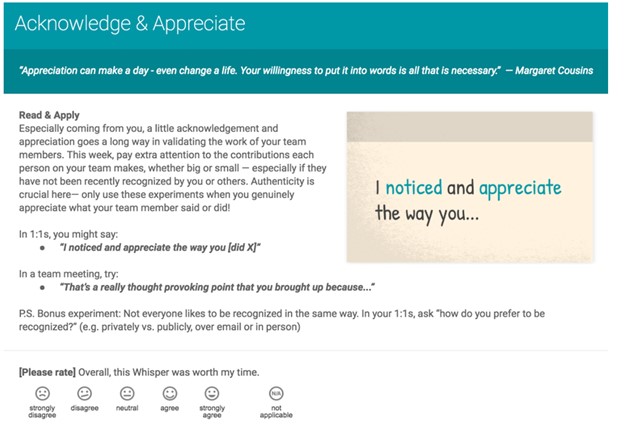
The same Google article mentions that, as a result of the whisper course practice
- the manager’s specific skill was improved by 22-40%
- 95% of Googlers would recommend the whisper course to their colleagues
“I love that it was practice-focused. Oftentimes you leave a course overwhelmed with info, and it's hard to implement a real change. Because you're encouraging stepwise change, it feels like a slow, steady progression of understanding how you can evolve the way you work”.
Google’s feedback on whisper courses
Project Oxygen
Project Oxygen began with a surprising hypothesis: What if managers don't actually matter? But the project proved that managers DID matter. As a result, they identified the "Oxygen 8" (now 10) specific behaviors that make a great manager.
"We were able to have a statistically significant improvement in manager quality for 75% of our worst-performing managers... You don’t actually need to change who the person is. It’s about being really clear about saying: 'O.K., let's talk about results, and this is the goal.'"
Laszlo Bock,
Former Senior VP of People Operations at Google.
20% Time policy
Another famous initiative of Google’s regarding their learning and development efforts is that the employees have the freedom to be creative. The 20% policy allows them to work on projects the employee thinks are beneficial for the company, not just their regular projects.
“We encourage our employees, in addition to their regular projects, to spend 20% of their time working on what they think will most benefit Google. This empowers them to be more creative and innovative. Many of our significant advances have happened in this manner. For example, AdSense for content and Google News were both prototyped in “20% time.” Most risky projects fizzle, often teaching us something. Others succeed and become attractive businesses”.
An Owner’s Manual” for Google’s Shareholders
Key takeaways for your employee development training program
- Create a culture where team members teach one another rather than depending on formal departments. This reduces costs and builds a stronger internal network.
- Design learning around daily decisions, so training materials directly support actions like giving feedback.
- Deliver learning in small, scheduled doses, so employees receive one focused idea at a time that can be applied easily.
- Tie training to specific role moments, so managers, individual contributors, and new hires each receive guidance aligned to what they are currently responsible for. That way, you will also ensure fast-track training.
- Turn internal experience into learning content, so high performers and experienced employees actively teach what works instead of outsourcing all training.
- Use performance data to guide training priorities, so you invest in improving the weakest or most impactful skills instead of offering generic training for every employee.
- Improve managers through targeted coaching.
- Normalize learning through experimentation, so small trials, even when unsuccessful, are treated as valid inputs for improving processes and products.
Related: Employee Training Plan | How to Create One With a Template
Amazon - made upskilling continuous
With Amazon, you will find more than traditional employee training. Employee development and training are treated as part of how the company builds talent pipelines, strengthens internal mobility, and prepares teams for future work.
Amazon believes that leaders are never done learning. Their learning and development is built on the principle that the company has a "broad responsibility" to provide pathways for employees to move from low-wage fulfillment roles to high-wage tech roles.
As Amazon states in their leadership principles:
“Leaders are never done learning and always seek to improve themselves. They are curious about new possibilities and act to explore them.”
Key initiatives for employee development and training programs at Amazon
The idea of success in Amazon’s learning and development programs is a bit different from traditional thinking. We are used to believing it is the participation number that matters.
However, Amazon also defines success by how many employees change job trajectories because of the training they received. Let’s see how.
- Amazon Pathways
Amazon Pathways is a career acceleration program built for future operations leaders. The goal is simple. Take people with strong potential and prepare them to run large teams and complex operations.
Their employees start by managing frontline teams, learning how work actually gets done. Over time, they move into broader roles where they handle supply chain, logistics, and operational planning.
Stories from participants, such as Iris M., show that
“Pathways was a fantastic opportunity, creating a growing path within Amazon Operations and learning, with a lot of grit, to become a leader.”
- Career Choice
Career Choice is one of Amazon’s most practical programs. Amazon pays for employee education upfront, not as reimbursement. Employees can study fields that are in demand, even if the role is not directly tied to their current job.
The goal is workforce mobility. Employees gain skills that open new opportunities, while Amazon builds a more skilled and motivated workforce.
“We know that employees are looking for various ways to continue or start their education and skills training pursuits. The diverse opportunities available through the Career Choice program, and our nine other upskilling programs, are reflective of the needs and potential of our incredible workforce”.
Beth Galetti,
SVP of People, eXperience, and Technology at Amazon
- Amazon Technical Academy
This next program helps employees without traditional computer science backgrounds transition into software engineering roles. As a result of the program, 95% of the graduates already got a role at Amazon.
Amazon Technical Academy reflects Amazon’s belief that internal talent development can be more effective than external hiring for in-demand roles, especially in technical domains.
“There is a huge need for software developers, and not just at Amazon. This program helps fill that gap that exists in the industry right now."
Ashley Rajagopal,
Program manager of Amazon Technical Academy
Beyond these headline programs, Amazon also offers apprenticeships and continuous learning through technical and career skills tracks such as the Amazon Technical Apprenticeship and AWS Training offerings. These programs combine formal instruction with on-the-job experience, which makes the learning directly relevant to both employee goals and business outcomes.
Key takeaways for your employee development training program
- Link upskilling to future roles, so self-paced training prepares employees for positions you expect to need, not just the jobs they hold today.
- Treat employee development as a talent pipeline.
- Invest in potential, not credentials, so you identify high-performing employees early and give them structured exposure to broader responsibilities.
- Remove financial friction from learning, so education support is simple
- Support skill development beyond the current job scope, so employees can learn capabilities that may not be immediately required but strengthen long-term workforce flexibility.
- Prioritize internal reskilling over external hiring.
McDonald’s - structured development for frontline employees
In 2010, Rich Floersch, then-Chief Human Resources Officer for McDonald's, testified before a U.S. Senate Committee that 70% of restaurant managers, 50% of corporate staff, and 40% of their top 50 executives started in entry-level positions.
It is no coincidence that McDonald’s philosophy treats every entry-level position as a seed for future leadership.
Key initiatives for employee development and training programs at McDonald’s
That is how McDonald's operates as a "learning organization" that prioritizes accessibility and immediate application. They follow a strict "See It, Try It, Check It" process, which ensures that no employee moves to a new task until they feel genuinely confident.
Let’s discuss in more detail.
- Hamburger University
Hamburger University is a global training network with a massive campus in Illinois that functions as the company’s internal engine for consistency. The goal is to move managers beyond the day-to-day "flipping burgers" mindset and teach them how to run a multi-million dollar business.
It is so rigorous that the American Council on Education even recommends it for college credit. Apart from that, the investment legend Charlie Munger describes the initiative as marginal.
“McDonald’s hires a lot of people who are quite marginal at the very start of their working career. And they learn to show up on time for work and observe the discipline. A lot of them go on in employment to much higher jobs. And they’ve had an enormous constructive effect on educating people into responsibility, a lot of people who were threatened with not making it”.
This is one of the key employee training practices that ensures that consistent, high-quality operational standards are maintained across over 41,000 locations worldwide.
Archways to Opportunity program
You probably know that McDonald’s is a common employer for high school and college students. Meaning that many employees are just starting their careers.
In this sense, the Archways to Opportunity program serves as a complete career advising program.
One of the most impactful branches of this program is "English Under the Arches." This initiative provides free English language courses to non-native speakers to help them communicate with confidence. The results show that 97% of learners report success in reaching their course objectives, and participation has increased by 107% since 2022.
In one of their articles, McDonald’s shares that:
“The cost of higher education can be intimidating and prohibitive for many, and we’re proud of the over 45,000 restaurant employees who have taken advantage of nearly $125 million in tuition assistance from Archways to Opportunity”
Key takeaways for your employee development training program
- Treat entry-level roles as long-term investments.
- Standardize how new skills are learned, so employees observe a task, practice it themselves, and receive confirmation before moving on.
- Build learning directly into daily operations, so training happens on the job and reinforces how work is actually done.
- Create clear pathways from frontline work to leadership, so employees can see how today’s role connects to future opportunities.
- Teach business thinking early, so employees understand how their work affects costs, quality, and customer experience, not just execution.
- Use training to build employability, so even employees who eventually leave do so with stronger skills and higher career confidence.
Netflix - high-performance development
Netflix does not view development as a series of classes you attend to get better at your job. Instead, they operate on the belief that the best thing you can do for an employee's development is to surround them with "stunning colleagues."
“We develop people by giving them the opportunity to develop themselves, by surrounding them with big challenges to work on. Mediocre colleagues or unchallenging work is what kills progress of a person’s skills”
Patty McCord
Chief Talent Officer at Netflix
They believe that high performers are intrinsically motivated to learn, so the company’s job is simply to remove the obstacles.
- 360-Degree Feedback
Netflix has famously ditched the traditional annual performance review because they find it too ritualistic and slow. Now, you are wondering what they do instead.
Instead, they use a system of Continuous 360-Degree Feedback, but not in a traditional sense of the word. The thing is that they make feedback a "constant" rather than a "scheduled event." They expect employees to give and receive honest, direct input from their peers, superiors, and subordinates at any time.
“I recommend instead focusing first on something much more difficult: getting employees to give candid feedback to the boss. This can be accompanied by boss-to-employee feedback. But it’s when employees begin providing truthful feedback to their leaders that the big benefits of candor really take off”
Reed Hastings
Former CEO of Netflix
The practice is built on the "4A" feedback guidelines:
- the giver must aim to assist and provide actionable data
- the receiver must show appreciation and choose whether to accept or discard the input.
This creates a culture where mistakes are "sunshined" (shared openly) so the whole company can learn from them simultaneously.
Key takeaways for your employee development training program
- Use challenging work as the primary development tool.
- Remove friction that slows high performers, so strong employees are not blocked by unnecessary rules.
- Make feedback part of daily work, so input is shared in real time when context is fresh, not saved for formal review cycles.
- Train people to give actionable feedback.
- Teach employees how to receive feedback productively.
- Surface mistakes openly, so errors are shared as learning signals.
- Replace ritualized reviews with frequent conversations, so performance discussions evolve continuously rather than once or twice a year. That would be an excellent way to improve employee performance.
Conclusion
For your employee training to be systematic, you need an LMS that helps you deliver it effectively.
If you are looking for a platform to automate your employee training and onboarding, consider Uteach. With Uteach, you can build structured training programs, create interactive training modules, track employee progress, and even attach quizzes and certificates to measure learning outcomes. You can host all your learning materials, live sessions, and internal knowledge hubs in one place, saving hours of manual coordination.
Book a demo with our team to see how Uteach automates your training and onboarding and turns them into smooth, measurable, and efficient experiences for both your HR team and employees.