
The following guide covers:
Benefits of self-paced training
Shall you offer self-paced or instructor-led training?
Self-paced training examples in the corporate world
How to create a self-paced training
Employee training can easily become overwhelming when everyone has to keep up with the same schedule. Deadlines, time zones, and packed calendars make it difficult for employees to focus on learning when the timing is not right for them.
While instructor-led sessions or live workshops work just fine, you cannot always set the same schedule for every employee. For more flexibility and higher engagement, you can include a self-paced training format in your corporate learning programs. This approach lets employees learn when they are ready and keeps the training consistent and scalable for the company.
In this article, we will look at how self-paced learning differs from instructor-led training, how it helps companies scale faster, examples of global organizations using it, and how you can start creating your own self-paced employee training.
What is self-paced training?
Self-paced training is a learning approach where employees complete training materials on their own schedule, without having to follow a fixed timeline or attend live sessions.
So to speak, it gives them the flexibility to learn when they have the focus and mental space for it. And there is no need for your employees to squeeze training in between meetings or client calls.
Unlike traditional training sessions, where everyone moves through the content at the same time, self-paced training puts the control in the learner’s hands. It does not depend on an instructor’s availability or a group’s shared progress. Instead, employees can pause, revisit, or skip ahead even.
For example, imagine you are onboarding new hires for the same role. It is obvious that some will grasp the training part in a few sittings. While others need to take their time. By introducing a self-paced onboarding course, every employee gets the same information and quality of training, but in a way that fits their rhythm.
So, what typically defines self-paced training?
- Learners access pre-recorded materials, readings, and quizzes on their own time.
- Progress is tracked automatically through the learning platform.
- Completion depends on the individual’s pace, not on a live schedule.
- The format often includes videos, slides, and short assessments to reinforce knowledge.
Benefits of self-paced training
The key benefit of self-paced training is not only that your employees have more flexibility in terms of organizing their learning. But also that business gets measurable outcomes following.
In a sense, self-paced learning allows your organisation to deliver training that is more precise, cost-efficient, scalable, and better retained. How is that made possible?
- Personalised training aligned with strategic goals
According to a survey, 80% of surveyed employees want personalized learning tailored to their individual needs and goals.
With self-paced training courses, you give employees the opportunity to follow paths that match their current skills. Each group has its own learning path to follow, and you can organize those paths in a way that matches what skill each employee needs to develop.
In this case, if we compare it to instructor-led or offline group training, the training is less generalized. This reduces wasted time and increases relevance, so you get more value out of every training hour.
- Better retention of training material
Research on the eLearning Industry shows that learning via online or digital self-paced methods can improve retention by 25-60% versus traditional classroom or lecture-based training, where retention tends to be much lower (often 8-10%).
That is because self-paced formats allow repetition, review, and space to absorb difficult concepts on their own. Compared to traditional approaches, they can revisit the material as many times as necessary.
Besides, gamification, situation-based learning, conceptual learning, and other learning approaches make self-paced training more memorable and practical.
- Cost savings and higher ROI
Switching from instructor-led or in-person training toward self-paced / online training helps reduce costs in several dimensions: venue, travel, scheduling, instructor time, and, why not, printed materials.
Industry reports suggest that companies can save 30-60% in training costs by using self-paced / online formats instead of live workshops.
Because once content is built and made available on a learning platform, delivering it to additional employees incurs very little extra cost. In this case, you will be able to scale more easily.
On the other hand, other sources claim that eLearning takes 40%-60% less time from employees compared to face-to-face learning. That would mean employees would be able to get their work tasks more quickly. Which is also a win for them and for you as a company.
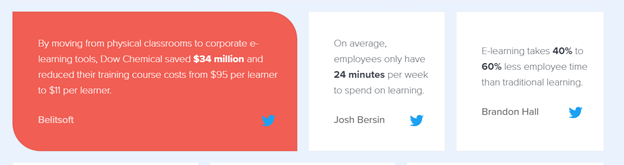
There are dozens of case studies from companies proving how self-paced eLearning courses helped save time and money.
One of them is Dow Chemical. They saved $34 million and reduced their expenses from $95 to $11 per learner/per course.
- Faster deployment and workforce agility
Let’s say you have a tool you want your employees to use or there is a product update that needs to be rolled out. With self-paced training, you can push content instantly to large numbers of employees across locations.
This means that you are able to react faster to change, reduce lag in adoption (like with instructor-led training), and keep everyone more up-to-date.
Also, you have the agility to update content (for example, via an LMS) and have it available immediately, which is one of the reasons self-paced training often has lower time to competency.
- Stronger retention of talent and lower turnover
Companies that invest in structured self-paced or generally digital learning solutions often see improved retention metrics. For example, workplace training reports find that offering development opportunities can make a company 30% more likely to retain top talent.
So, if one of your key goals is to reduce employee turnover, this approach might work for your case, too.
Shall you offer self-paced or instructor-led training?
But all these benefits do not mean you should offer self-paced training for your employees the whole time. Though self-paced training has its own advantages, there are cases when instructor-led training works just fine.
So, which approach should you take? The answer is, you need to adapt a different approach based on the goals of the training and your corporate learning strategy as a whole.
- When to offer self-paced courses?
As you already know, the strength of self-paced learning lies in its flexibility and scalability. It allows you to roll out consistent training to large teams without the logistical headache of scheduling or location coordination. It works best when the goal is knowledge acquisition or skills that employees can master independently.
In this regard, self-paced training is more preferable when:
- You need to train employees across multiple time zones or departments
- You want to provide role-based or personalized learning paths to upskill or reskill the employees.
- The training goal focuses on knowledge consistency and scalability.
- When to offer instructor-led courses?
Instructor-led training, or ILT, is the classic approach where an expert guides employees in real time. The greatest thing about this approach is that it allows immediate feedback, clarification, and discussion, which are sometimes impossible to replicate in a fully self-paced environment.
And if you want employees to work on building interpersonal skills, teamwork, ILT is better. So to speak, there are cases when the “human factor” makes a difference.
Instructor-led training is more preferable when:
- You are training for soft skills such as communication, leadership, or conflict management.
- Real-time feedback and practical group exercises are essential for mastering the skill.
- The content needs to be adapted dynamically based on participants’ understanding.
- The training topic requires collaboration.
But the question is never choosing between either this or that. Because you can and should always offer the mix of both.
So, let’s get a quick side-by-side view to help you decide which one fits your specific case best.
Comparison | Self-paced training | Instructor-led training |
Delivery method | Pre-recorded or digital content accessed anytime | Conducted live by an instructor, either online or in person |
Best for | Knowledge-based or process-oriented training | Interactive, discussion-based, or skill-building sessions |
Pace | Controlled by the learner | Controlled by the instructor and group dynamics |
Scalability | Highly scalable for large teams | Limited by instructor capacity and scheduling |
Feedback | Delayed or automated through quizzes | Immediate and personalized |
Cost-efficiency | More cost-effective over time | More resource-intensive per session |
Engagement | Independent and self-driven | Social and guided through discussion |
Ideal cases | Onboarding, compliance training, and product knowledge | Leadership, communication, and technical workshops |
Self-paced training examples in the corporate world
Self-paced training offers different formats you can follow, such as tutorials, eBooks, recorded webinars, interactive modules, digital resource hubs, etc. Everything depends on how you want to include these formats in your learning programs.
Let’s discuss the examples of some of the best corporate training programs by companies such as Google, Amazon, and Microsoft.
A CNBC report cites a Google spokesperson’s view on their internal course offerings.
“Our internal course offerings have ballooned since we launched them ten years ago, and we’re refreshing Grow to help employees find the most relevant learning opportunities.”
Besides their employees, Google’s Grow program is for people and businesses that want to learn digital skills and advance in their careers. They provide free tools and training resources to improve knowledge in spheres like IT support, data analytics, UX design, project management, etc.
Amazon
Amazon offers digital training via AWS Skill Builder to employees. More than 600 free digital trainings are available through that portal. Or the Surge2IT program helps entry-level IT employees in operations move into higher-paying technical roles.
Since 2019, more than 70,000 Amazon employees have participated in the Upskilling 2025 program. Also, their Career Choice program has delivered education to over 250,000 employees across 14 countries.
Microsoft
Microsoft provides self-paced learning through Viva Learning, which is part of its employee experience platform. Through Viva Learning, employees access internal, third-party, and LMS content, recommended based on their current skills, role, and location.
The idea is to fold learning into the flow of work (for example, via Microsoft Teams). That way, employees see learning content in context, which makes it more likely they engage with it.
Viva Learning reportedly helps embed learning as part of daily workflow, increasing uptake because employees see content in the tools they already use rather than going out of their way.
How to create a self-paced training
If you already know the goal of your self-paced program and the group of employees you want to run it for, you can start your self-paced training program with Uteach LMS.
- Set up the training experience
It is always easier to start with a template, rather than from scratch. So, if you do not have ready-made courses for employees and need to create custom ones, the AI assistant will generate the outline for you. Once you enter the topic (such as sales training, marketing onboarding training, etc.), the tool will suggest an outline you can edit and follow.
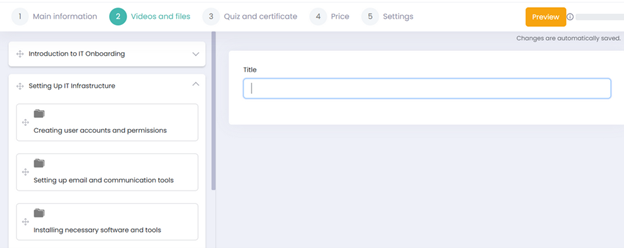
From the main information section, you can control how you want the employees to proceed with the course. For example, if they can fast-forward when watching, meet compliance criteria, track their course duration, etc.
Here, you also have the opportunity to set when you want a specific course, or even an episode, to become available for your employees. This is made possible with the drip-scheduling functionality, based on
- Starting from the day you assigned them the course
- Starting from the date they watch the first episode
- A custom date
This way, you set the whole experience in advance, and the employees are able to learn at their own pace without much administrative interference from your end.
- Add your training files and videos
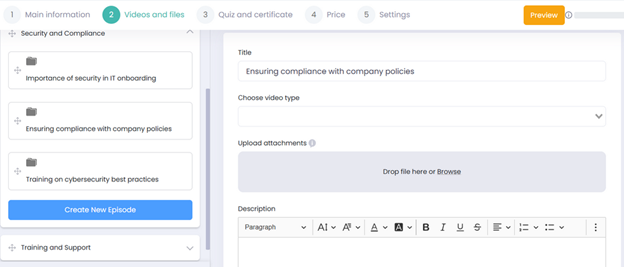
After you edit the training outline the AI suggested, you are ready to start uploading your content and materials. As part of the training curriculum, you have the opportunity to include formats, such as
- Video
- Audio
- File
- Text
- Quiz
- Form
They will be displayed as separate episodes in your training.
- Add the test and attach the certificate
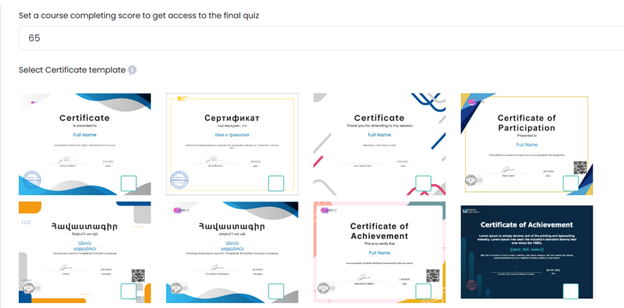
If you also want to include a final quiz, so that upon passing the employees get certified automatically, you can add that.
You need to create a quiz beforehand using Uteach’s quiz builder with 6+ answer types and multimedia options.
As you set the completion score, the learners get their certificate only if they receive the necessary amount of credits.
- Track the course analytics
As learners start progressing through the course, you will get detailed analytics on each employee’s performance based on the self-paced training programs they enrolled in, the quizzes they passed, the amount they completed in percentages, and so much more.
There are separate reports on your training performance, which is a great way to find out how you can improve the content further.
To get a firsthand look at how you can automate your employee training and onboarding, book your free demo with our specialist.