
The following guide covers:
Employee training budget statistics
Skill gap and reskilling in AI statistics
Employee training impact statistics
Employee training delivery statistics
eLearning in corporate statistics
Leadership and management development statistics
What does this all mean for your organization
The decisions you make around learning and development today directly impact employee engagement, retention, productivity, and long-term workforce readiness.
To help you understand where workplace learning is heading, I analyzed the latest employee training trends and statistics from leading industry reports, including LinkedIn Learning, Gartner, Deloitte, Gallup, McKinsey, Coursera, IBM, SHRM, ATD, and more.
In this article, you will discover the latest data on employee training budgets, AI reskilling, leadership development, corporate eLearning, workforce engagement, and training delivery methods. The statistics reveal how organizations are investing in learning, what employees expect from workplace development, and which training priorities are shaping the future of work.
More importantly, these insights will help you evaluate your own learning and development strategy, identify potential gaps, and better understand what leading organizations are prioritizing.
Employee training budget statistics
Organizations are still increasing their investments in learning and development, especially in career-focused learning and AI-related training. At the same time, the number of formal learning hours employees spend in training programs continues to decline. That change suggests that organizations may be shifting toward shorter, more targeted learning experiences.
Another noticeable trend in employee training is the difference in spending between company sizes. While large organizations naturally have the biggest overall budgets, small businesses spend considerably more per employee on training.
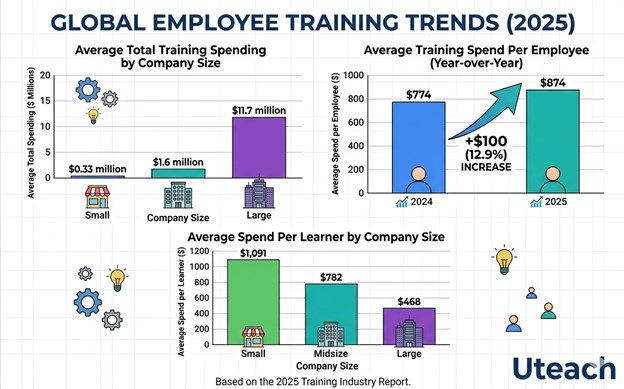
- Large companies spent an average of $11.7 million on employee training in 2025, while midsize companies allocated approximately $1.6 million, and small businesses invested around $333,305. (2025 Training Industry Report).
- Average training spend per employee increased to $874 in 2025, compared to $774 in 2024. Small businesses reported the highest spending per learner at $1,091, followed by midsize companies at $782 and large organizations at $468 per employee. (2025 Training Industry Report).
- 41% of organizations increased their employee training budgets in 2025, slightly lower than the 46% recorded in 2024. 16% of organizations reported budget decreases in 2025, up from 14% the previous year, while 43% kept budgets unchanged (2025 Training Industry Report).
- Employees spent an average of 13.7 hours in formal learning programs during 2024, down from 17.4 hours in 2023, continuing a multi-year decline in formal learning time. (Association of Talent Development Report).
- 83% of career development champion organizations plan to maintain or increase investments in career-focused learning initiatives. (LinkedIn Report: The Rise of Career Champions).
- 25% of organizations said AI training would receive more funding and resources compared to the previous year. (Training Magazine — 2025 Training Industry Report)
While fewer companies increased budgets compared to the previous year, most organizations either maintained or expanded their investments in learning and development.
The data also highlights a growing focus on strategic training areas. Career-driven learning and AI training are receiving additional investment.
Related: What are the Costs of Training a New Employee?
Skill gap and reskilling in AI statistics
The rise of AI is increasing pressure on organizations to close skill gaps and prepare employees for changing job requirements. Many executives already believe employees lack the skills needed to support business goals, while employers across industries are prioritizing upskilling, reskilling, and AI-related learning initiatives.
At the same time, the demand for AI skills is growing much faster than workforce adoption. The data also shows that many employees still feel they are not receiving enough opportunities to develop new skills or enough coaching to improve their current capabilities.
- 49% of learning and talent development professionals say executives are concerned that employees do not have the right skills to execute business strategy successfully(LinkedIn Report: The Rise of Career Champions)
- If the global workforce were represented by a group of 100 people, 59 are projected to require reskilling or upskilling by 2030. (WEF — Future of Jobs Report 2025).
- 85% of employers plan to prioritize workforce upskilling initiatives. 70% of employers expect to hire employees with entirely new skill sets. (The Future of Jobs Report 2025)
- 50% of the workforce has already completed training through employer learning and development initiatives, compared to 41% in 2023. (The Future of Jobs Report 2025)
- AI training became the fastest-growing workplace training topic in 2024.Nearly two-thirds of organizations expect to increase AI training offerings in the future. (ATD — 2025 State of the Industry Report).
- 37% of companies currently use artificial intelligence within their employee training programs, up from 25%. (Training Magazine — 2025 Training Industry Report)
- Jobs requiring AI fluency increased from approximately 1 million in 2023 to around 7 million in 2025, making AI one of the fastest-growing skill requirements in U.S. job postings (McKinsey & Company — Workforce Research)
- Just 46% of employees believe their employers provide enough opportunities to learn skills that support long-term career growth. (Global Workforce Hopes & Fears Survey).
- Employees planning to change employers are nearly twice as likely to strongly consider upskilling opportunities compared to workers intending to stay (PwC — 2024 Global Workforce Hopes & Fears Survey)
- Executives estimate that 40% of their workforce will need to reskill as a result of implementing AI and automation. (IBM Institute for Business Value — Global HR Study)
- Historically only 6% of the workforce has needed reskilling. By 2024, that number rose to a full 35% of the workforce. (IBM Institute for Business Value — Demystifying Skills During Digital Transformation)
- 85% of leaders believe AI and digital transformation will significantly increase the need for workforce skill development. (Gartner — ReimagineHR Conference Survey)
- 60% of employees report not receiving enough on-the-job coaching to support their core job skills. (Gartner — ReimagineHR Conference Research)
Employers are expanding training initiatives, investing in AI learning programs, and preparing for large-scale workforce reskilling.
However, the data also reveals a gap between organizational priorities and employee experience. Many workers still feel they lack adequate learning opportunities and coaching support, even as demand for AI and digital skills continues to grow rapidly.
Employee training impact statistics
Organizations increasingly view employee learning as more than a skills initiative. The statistics show a strong connection between continuous learning, employee engagement, motivation, productivity, and business performance. Employees who feel supported in their development tend to feel more engaged and motivated at work, while organizations that invest in learning report stronger workplace and financial outcomes.
The data also suggests that employers are placing greater importance on learning initiatives that support career growth, employee well-being, and faster workforce readiness.
- 91% of L&D professionals agree that continuous learning is more important than ever for career success. (LinkedIn Learning)
- 84% of employees say learning gives more purpose to their work, highlighting the connection between development opportunities and employee engagement. (LinkedIn Learning)
- Organizations with highly engaged employees experience 51% lower turnover, 68% higher employee well-being, and 23% higher productivity levels.(Gallup).
- Employees who feel strongly supported in upskilling are 73% more motivated than workers who receive the least support. (2025 Global Workforce Hopes & Fears Survey).
- Organizations that successfully increase the capacity of employees to grow and think deeply at work are 1.8 times more likely to report better financial results (Deloitte)
- 59% of HR leaders expect employee well-being and mental health to become a greater workplace priority, while 53% anticipate increased investment in rapid skill development. (SHRM — State of the Workplace Report )
- 94% of employers believe hiring entry-level candidates with micro-credentials shortens their training time. (Coursera)
- 42% of learners who completed a generative AI course reported receiving a salary increase afterward.
As you can see, employers are investing more in rapid skill development, while alternative credentials and AI-related learning are increasingly associated with faster workforce readiness and career advancement.
Employee training delivery statistics
Organizations continue to use a mix of traditional and digital learning formats to deliver employee training. Instructor-led classroom training remains the most widely used format, even as companies continue adopting online learning technologies and virtual delivery methods.
At the same time, learning management systems have become standard infrastructure for workforce training across organizations of all sizes.
- Instructor-led classroom training remains the most commonly used employee training method across organizations. (ATD — 2025 State of the Industry Report)
- 90% of large companies, 97% of midsize companies, and 84% of small companies have incorporated LMSs in training and development. (Training Magazine — 2025 Training Industry Report).
- 34% of organizations use virtual classrooms, webcasting, or video broadcasting for online training delivery. (Training Magazine — 2025 Training Industry Report)
As you can see, the widespread use of LMSs also shows that centralized and scalable learning delivery is now a standard part of corporate training operations, especially as organizations continue supporting hybrid and remote learning environments.
eLearning in corporate statistics
The growing popularity of AI-related online courses also reflects how quickly demand for digital skills is increasing across industries. Companies are not only investing in AI adoption but also preparing employees for changing job requirements through large-scale learning initiatives.
- In 2025, Coursera's 700 GenAI courses averaged 12 enrollments per minute (Coursera — 2025 Global Skills Report)
- 4 in 5 people want to learn how to use AI to improve their effectiveness (LinkedIn Learning )
- Many organizations have already retrained up to 10% of their workforce because of AI-related changes, with significantly more reskilling expected over the next three years. (McKinsey & Company — State of AI: Global Survey)
The data also suggests that AI learning is moving beyond experimentation and becoming a core part of long-term workforce development strategies.
Leadership and management development statistics
Leadership and management development remain a major focus area for organizations, especially as companies prepare managers to lead through workforce changes, digital transformation, and evolving employee expectations. While many organizations continue investing in leadership training, a significant number of HR leaders and managers believe current programs are not fully preparing leaders for modern workplace challenges.
- 90% of companies offered managerial and supervisory training, and 69% provided executive development. (Absorb LMS)
- 36% of managers say they are insufficiently prepared to be people managers. (Deloitte — 2025 Global Human Capital Trends Report)
- 70% of HR leaders stated their current leadership programs are inefficient and unable to equip managers with the necessary skills for today and tomorrow. (Gartner — Top 5 Priorities for HR Leaders)
- Nine out of 10 global executives plan to maintain or increase their investment in L&D in the next six months (LinkedIn Learning)
- 47% of leaders list upskilling existing employees as a top workforce strategy for the next 12–18 months (Microsoft — 2025 Work Trend Index Annual Report)
- When organizations invest in manager development through training focused on coaching and people development, their teams see up to 18% higher engagement levels (Gallup — State of the Global Workplace Report & Manager Development)
The statistics suggest that organizations recognize leadership development as a critical workforce priority, yet many companies still struggle to prepare managers effectively for changing workplace demands.
The data also highlights the connection between strong manager development and employee engagement. Organizations continue investing in leadership training and employee upskilling as part of broader workforce development and retention strategies.
What does this all mean for your organization?
Employees increasingly expect learning opportunities that help them grow, stay relevant, and advance in their careers. Companies that fail to provide those opportunities risk lower engagement, weaker retention, and larger workforce capability gaps in the future.
So what should your organization focus on moving forward? Here are some questions worth evaluating internally.
- Are your training programs aligned with future skill needs?
Instead of focusing only on current operational needs, evaluate whether your learning programs prepare employees for the next three to five years. Which skills are becoming more important in your industry? Which roles are most likely to change because of AI? Identifying these gaps early gives your organization more time to adapt.
Related: How to Conduct a Training Needs Assessment on a Role Level
- Are you investing in AI learning strategically?
Consider whether your teams need foundational AI literacy, role-specific AI workflows, or hands-on practical training. The companies seeing the most value are typically the ones treating AI learning as an ongoing capability-building initiative rather than a one-time workshop.
- Is your learning experience practical and continuous?
Formal learning hours are declining across organizations, while demand for faster skill development continues to increase.
Employees often respond better to shorter, practical, and directly applicable learning experiences. Consider whether your training approach supports continuous learning through coaching, microlearning, hands-on projects, peer collaboration, or learning integrated into daily work.
Related: 5 Ways to Improve Training and Development in the Workplace
- Are your managers equipped to support employee growth?
Managers play a major role in employee engagement, coaching, and skill development. If leadership training is outdated, employees may not receive the support they need to grow. You should evaluate whether managers are trained not only in operations, but also in coaching, communication, feedback, and employee development.
- Are you creating clear career development opportunities?
Employees who feel supported in upskilling report significantly higher motivation, while workers planning to leave are much more likely to prioritize development opportunities.
Training programs become far more effective when employees clearly understand how learning connects to career progression. Consider whether your organization provides visible learning paths, internal mobility opportunities, mentorship, or role-based development plans.
Related: How Big Companies Run Employee Development Training Programs
- Are you balancing traditional and digital training methods effectively?
Instructor-led training remains highly common, but LMS platforms, virtual classrooms, and online learning tools are now standard across most organizations.
Instead of replacing one method with another, many companies are combining formats to improve flexibility and accessibility. Hybrid learning approaches often help organizations scale training while still maintaining engagement and collaboration.
Related: Employee Training Plan | How to Create One With a Template
- Are you measuring training impact beyond completion rates?
The data shows strong links between learning, engagement, productivity, retention, and financial performance.
This means training success should not only be measured by course completion or attendance numbers. You should also look at outcomes such as employee retention, internal mobility, productivity improvements, leadership readiness, engagement levels, and workforce adaptability.
The overall trend across all these statistics is clear: organizations are shifting from occasional training initiatives toward continuous workforce development. Companies that invest early in relevant skills, practical learning experiences, and career growth opportunities are likely to be better positioned to adapt to ongoing workforce and technology changes.
If you are ready to automate your employee training and make the process more efficient, Uteach is here to help. Book a call with our expert today and let us support you in implementing these strategies and growing your business.