
The following guide covers:
19 examples of employee training incentives
How big companies run employee training incentives
Did you know that if you select and run the right incentive program, you can expect employee performance to increase by 22%?
“When offered strategically, aligned with employees’ professional development goals, rewards can work well.”
Lynn Schroeder, VP of Client Relations at CAEL
Monetary rewards are just one way to approach employee training incentives. But if you truly need an incentive that your employees care about, you have to find what motivates them.
In this article, I collected some of the best employee training incentives companies use, such as Amazon, Walmart, Starbucks, Chipotle, and others. We will discuss how each incentive works so that you can find the right ones for your teams.
19 examples of employee training incentives
An employee training incentive is a reward or benefit an employer offers to encourage employees to participate in training, develop new skills, or complete learning programs.
Yet, having an employee incentive program does not necessarily mean better performance in training. I want to note that yes, an incentive will get people to open the training. But so much also depends on what learning experiences you are offering. So, if you have gaps in your employee training program, no fancy incentive is going to change the training completion rates.
Now that you know, let’s discuss some of the most common incentives you can use for your teams, be it monetary or non-monetary.
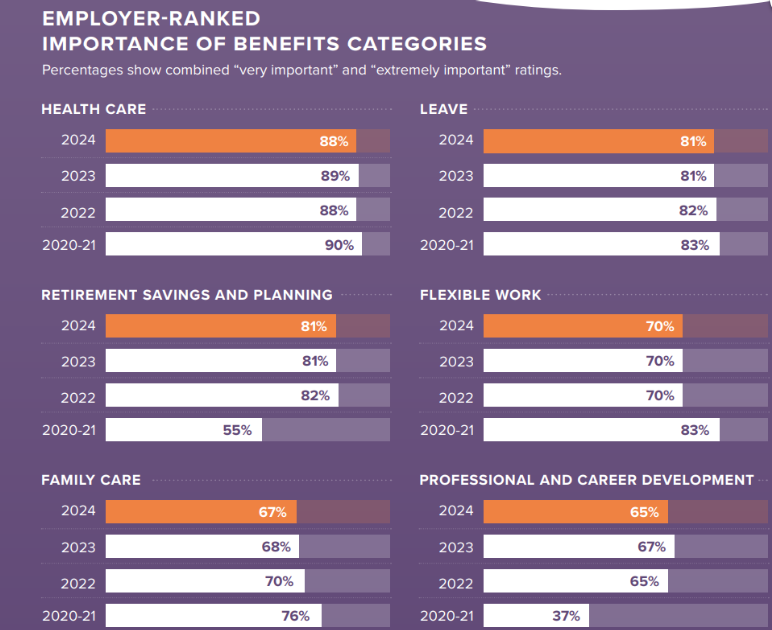
Employer-ranked importance of benefits by categories from SHRM survey 2024.
Monetary employee training incentives
Money is the most direct way to show employees that their development is worth investing in. It is also the most common type. In fact, more than 90% of organizations use monetary incentives like performance bonuses, cash awards, or variable pay programs.
#1 Completion bonus
The employee gets a one-time cash bonus after finishing a training program and passing the final assessment. It works best for programs you really need people to complete on time, like a new system rollout or a product launch. Also works if employees need to put in intense extra effort or overtime over a short, defined period
Example: Every sales rep who completes the new product training and scores 80% or higher on the final quiz gets a $150 bonus in the next paycheck.
Tip: Tie the bonus to passing the assessment and not the lesson progress. Otherwise, you only pay for completions.
#2 Certification bonus
A bigger one-time bonus for earning an industry certification, like AWS, PMP, CompTIA Security+, or SHRM-CP. These certifications take weeks or months of study, usually in the employee's free time, so the reward should reflect the effort.
Example: An IT support specialist passes the CompTIA Security+ exam and receives a $1,000 bonus.
Tip: Make a short list of certifications that matter for your business and publish the bonus amount for each one. Also decide before launch if the bonus must be paid back when someone leaves within 6 or 12 months, not after the first person resigns.
#3 Exam and certification fee coverage
The company pays for the exam, and often the renewal fees too. This one has almost become a baseline and standard for all the companies looking to foster learning and development in the company. SHRM's 2024 Employee Benefits Survey even found that 79% of employers cover certification and recertification fees. So if you do not have it on your list yet, it is high time you considered it.
Example: A project coordinator registers for the PMP exam, and the company pays the fee directly, plus retakes if needed.
Tip: Many exams cost several hundred dollars, and asking employees to cover that first quietly stops the ones who cannot afford it. And agree in advance how many retakes you cover.
#4 Pay raise for new skills
Instead of a one-time bonus, the employee moves to a higher pay rate once they prove a new skill. This is often called skill-based pay. It works well in roles where skills are easy to measure, like operations, manufacturing, IT, marketing, or customer support. And employees do see the results.
Example: A warehouse associate completes forklift and equipment safety certification and moves to the next pay band, earning $1.50 more per hour.
Tip: Write down the skill levels and what each one pays in a simple skills matrix. If managers decide case by case, you will have 10 different rules within a year. And remember that a raise is a permanent cost, unlike a bonus, so plan the budget for it.
#5 Tuition assistance
The company pays for part or all of a degree or a longer course. It is one of the strongest loyalty builders. According to the Bright Horizons 2024 Education Index, 84% of workers said they would be more loyal to a company that invested in their education, and 82% would choose a job with education benefits over a competitor's offer.
Example: The company covers up to $5,250 a year for job-related degrees and courses. (In the U.S., this is also the amount employers can give tax-free under Section 127.)
Tip: Decide if you reimburse after the course or pay upfront. Reimbursement is cheaper to run, but it leaves out frontline employees who cannot spend $2,000 and wait months to get it back. Also decide if the program must be job-related and if you require a minimum grade.
#6 Annual learning budget
Each employee gets a fixed amount every year to spend on learning they choose themselves: online courses, books, workshops or a conference ticket. What I like about this one is the freedom it gives. People already look for learning on their own. Gallup found that 58% of U.S. employees sought at least one learning experience outside what their employer formally offered. A learning budget just brings that effort back into the company.
Example: Every employee gets $1,000 a year for learning. They submit the receipt and a two-line note on what they learned and how they will use it.
Tip: Define what counts and what does not before the first request comes in.
How will Uteach help as your LMS?
- You can use Forms and CRM to collect bonus, tuition, and budget requests in one place
- You can run quizzes and assessments to confirm the skill before you pay a bonus or raise
- You will see analytics to see who completed what, so payouts are based on real data
Non-monetary rewards
While cash incentives are a lot more common, money is not the only motivation driver for employees to complete training. So you can incentivize them with gift cards, extra time off, etc. In fact, 84% of US businesses run non-cash incentive programs.
#7 Gift cards and vouchers
A small, instant reward for completing a training program feels nice, and it is quick to deliver. I believe it works for programs that we, as employees, usually postpone. For example, those security and compliance modules.
Tip: Gift cards are good for short training. But I recommend that you check with your payroll team, as in many countries gift cards are treated as taxable income.
#8 Extra paid time off
Many employees would agree that paid time off is better than any cash incentives. Employees earn an extra day or half day off after finishing a longer program. And do you know why employees love it? Because they get back the time they spent on long training.
Example: Employees who complete the 8-week management program get one extra paid day off, to use within the next 3 months.
Tip: Make sure the team can cover the workload. Otherwise, what we call a "reward" for one employee will turn into stress for colleagues.
#9 Paid learning time as the standard
I believe training should happen during working hours and count as work. Turns out many employers and employees are of the same opinion. Gallup reports that 41% of employees name time away from their responsibilities as their top obstacle to development. And nearly half of employees (46%) feel their company treats training as time away from "real" work.
Example: Every employee gets 2 hours a week blocked in their calendar for learning. Meetings cannot be scheduled in that slot.
Tip: Managers have to protect this time too. Because, according to the same survey, managers do not approve dedicated time for learning. If the learning hour gets canceled for other work tasks, then of course, employees will see training as a chore.
#10 Flexible schedule for learners
Employees who are studying for a degree or certification can adjust their schedule around classes and exams. According to DeVry University's research, 40% of workers say there is not enough time in the day to upskill, and 35% say family and other priorities come first. Flexibility is often what makes training possible at all.
Example: A store associate studying for a business degree can start later on class days and swap shifts during exam weeks.
Tip: Put the rules in writing. If flexibility depends on having a kind manager, some employees will get it and others will not.
#11 Conference and event tickets
The best learners get sponsored to attend an industry conference or event. For many employees, especially early in their careers, this is a real honor.
Example: The top 3 learners of the quarter get sponsored to attend an industry conference, with travel and accommodation covered.
Tip: Ask them to share their key takeaways with the team after the event. That way, one ticket turns into learning for 10 people. And budget for travel, not only the ticket.
#12 Team celebration
A reward the whole team gets when everyone completes a training. It turns a solo task into a shared goal, and colleagues start reminding each other instead of you chasing everyone.
Example: When 100% of the team completes the new compliance course before the deadline, the company pays for a team lunch.
Tip: Be careful it does not turn into pressure on the one person who is struggling or on leave.
How will Uteach help?
- Uteach offers a branded mobile app so employees can use their learning time wherever they are, even between shifts.
- Content scheduling options with drip content. Sometimes, when I look at the length of the program and imagine the whole pressure, it is not motivating to start the training. But with Uteach, you can split longer programs into small lessons that fit the weekly learning slot. That way, you will not dump all the information on the employees at once.
Career growth incentives
If you asked me my biggest motivation to attend all the training I am assigned, that would be career growth opportunities. According to LinkedIn's 2023 Workplace Learning Report, progress toward career goals is the No. 1 reason employees learn. And in the 2024 report, learners who set career goals engaged with learning 4 times more. So, for the incentive program to work you also need to tie it to career growth opportunities.
#13 Promotion eligibility
Completing a program becomes a requirement or a fast track for the next role. This makes the connection between learning and growth very clear.
Example: Completing the team lead program is required to apply for shift manager positions.
Tip: Do not promise a promotion when the employees complete the training. The program shall just make the employee eligible for the new role.
#14 Priority for internal roles
Employees who complete certain programs get first access to internal openings before the role is posted externally. LinkedIn found that employees who made an internal move have a 75% likelihood of staying, compared to 56% for those who did not.
Example: Employees who complete the data analytics track get an interview for internal analyst openings before the job is advertised outside the company.
Tip: If they keep hiring externally anyway, the incentive loses its value.
#15 Mentorship with a senior leader
Employees who complete a program get paired with a senior leader for regular one-on-ones. For many employees, this opportunity is worth more than money, because it opens doors and gives them someone to ask. A 2025 Gallup poll found that 48% of employees who took part in mentorship programs report high job satisfaction, compared to 29% of those who did not.
Example: After completing the leadership fundamentals course, employees get paired with a director for 6 months, meeting once a month for an hour.
Tip: Create agendas for mentorships so that both sides get value from it.
#16 Stretch projects
After training, employees get to use the new skill on a real project, often a bit above their current level. It is where learning actually sticks.
Example: After finishing a project management course, an employee leads the rollout of a new tool within their department.
Tip: Start with a low-risk project and give them a go-to person for support. The goal is to build confidence.
How will Uteach help?
- You can automatically award certificates that serve as proof of readiness for the next role
- You can run quizzes and analytics to check skills objectively and spot ready-now candidates for internal moves
- You can deliver online courses, coaching, webinars, and training in any format.
Recognition and gamification incentives
Recognition is the cheapest incentive on this list, and probably the most underused. Gallup and Workhuman found that well-recognized employees were 45% less likely to have left after two years. Yet only 22% of employees say they get the right amount of recognition for their work.
#17 Certificates and digital badges
Employees get a certificate or a digital badge when they complete a course. They can share it on LinkedIn or add it to their internal profile. It is a small thing, but it makes the effort visible.
Example: After passing the customer service program, employees receive a branded certificate with their name and completion date, ready to share on LinkedIn.
#18 Points, leaderboards and milestone rewards
Employees earn points for completing courses, passing quizzes, or reaching milestones, and they can exchange the points for rewards. This works, and not only because it is fun. A meta-analysis published in Educational Psychology Review found that gamification has positive effects on learning, motivation, and behavior, especially when it combines competition with collaboration.
Example: Employees get 10 points for each completed course and 50 for a certification. 200 points can be exchanged for a $50 voucher or an extra half day off.
Tip: Reward progress and team goals too, not only the first place.
#19 Public recognition from leadership
Public recognition costs nothing, and people remember it for a long time.
Example: At the monthly all-hands meeting, the CEO names everyone who finished the leadership program and shares one result a graduate achieved with what they learned.
How big companies run employee training incentives
Now let's see how this works in real life. I looked for companies that publish their own data on how their programs work and what results they got.
Most of them use education as the main incentive and connect it to career growth. And one thing I noticed across almost all of them: they removed as many barriers as possible. No upfront payment, access from day one, no fine print.
But I have to be honest. Most of these results compare employees who chose to join the program with those who did not. People who sign up for a degree are probably more motivated to begin with.
Amazon - turned tuition into a career path
When most companies think about education benefits, they think about degrees related to the current job. Amazon went further. Through its Career Choice program, it trains employees for in-demand roles, even outside Amazon.
How the incentive works
Amazon prepays tuition for degrees, certificates, high school completion, and English classes, and offers career coaching on top. Employees can join after 90 days. Since August 2025, Amazon covers up to 100% of tuition fees upfront, so employees do not pay anything out of pocket. The focus is on high-demand fields like cybersecurity, software development, logistics, and mechatronics.
Results
- Over 300,000 employees have participated in Career Choice since 2012, including 100,000 in 2024 alone
- More than 700,000 employees have upskilled globally since 2019, seven times more than the original target
- Graduates of the Mechatronics and Robotics apprenticeship can earn up to 58% more per year than typical entry-level wages
- A new $1 billion commitment to train another 500,000 employees
"This success reinforces something we've always believed and embraced: When you remove barriers to education, you create pathways that help people build the careers they want."
Beth Galetti,
Senior Vice President of People Experience and Technology at Amazon
Walmart - removed even the smallest barrier
Walmart's story is one of my favorites, because it shows how much a small barrier can hold people back.
How the incentive works
Walmart launched Live Better U in 2018, and associates paid $1 a day to join. In 2021, Walmart removed even that fee and now pays 100% of tuition and books for eligible programs. Full-time and part-time associates can join on day one, and there is no obligation to stay at Walmart after graduation.
Results
- After removing the $1-a-day fee, enrollment increased by 66% year over year
- 126,000+ associates have participated, with $812M+ in tuition costs covered
- Associates in the program are 3x more likely to receive promotions
- Graduates are 3x more likely to stay with Walmart
A dollar a day is not a lot of money. But it was enough to stop thousands of people from starting.
"We are creating a path of opportunity for our associates to grow their careers at Walmart, so they can continue to build better lives for themselves and their families."
Lorraine Stomski,
SVP of Learning and Leadership at Walmart
Starbucks - made a college degree part of the job
Approximately 70 percent of Starbucks U.S. workforce consists of current students. Starbucks was one of the first big employers to offer fully covered degrees to frontline employees, and the scale today is impressive.
How the incentive works
The Starbucks College Achievement Plan (SCAP) covers 100% of tuition upfront for a first bachelor's degree through Arizona State University's online program, with over 150 degree options. Partners (Starbucks employees) who work an average of 20 or more hours a week are eligible.
Results
- Nearly 20,000 partners have graduated, and 27,000 more are enrolled
- 13% of the U.S. workforce participates
- 80% graduation rate, 16 points higher than the national average
- More than 20% of coffeehouse leadership roles and 13% of early-career corporate roles are filled by SCAP scholars and graduates
- 75% of graduates report career growth
"When partners feel supported with life-changing benefits like these, they bring that same care and connection to every cup they serve."
Sara Kelly,
Chief Partner Officer at Starbucks
Chipotle - connected education to the leadership pipeline
Chipotle is a great example of using training incentives to grow leaders from within. And they do not just say it.
How the incentive works
Through Cultivate Education, Chipotle covers 100% of tuition for selected degree programs and up to $5,250 a year for other education. The company also builds apprenticeship paths and aims to have an apprentice in every restaurant by the end of 2027.
Results
- Nearly 25,000 employees have enrolled, and more than 14,000 have completed a program
- Participants have a 66% lower average annual turnover rate than peers who did not participate
- Graduates are promoted about 1.4 times as often
- More than 85% of restaurant managers started as Crew Members
"Every Crew Member we hire has the potential to become a future restaurant leader. Developing leaders from within allows us to create meaningful careers for our people while ensuring every restaurant is led by someone who understands our culture and our commitment to exceptional guest experiences."
Ilene Eskenazi,
Chief Legal and Human Resources Officer at Chipotle
McDonald's - started with foundational skills
Many McDonald's employees are just starting their careers. So it makes sense that their program does not start at the degree level.
How the incentive works
Through Archways to Opportunity, eligible crew members who have worked for 90 days and at least 15 hours a week get $2,500 a year in tuition assistance, and managers get $3,000. The program also covers high school diplomas, English as a second language classes, and free education advising.
Results
- More than 90,000 crew members have been supported since 2015
- More than $240 million invested by McDonald's and its franchisees
- In the company's participant survey, 64% said the program helped them get promoted more quickly, and 72% said it created new job opportunities
"Seventy years as a brand, and ten years into Archways to Opportunity, we're reminded that one of the greatest impacts we can make is providing access to opportunity."
Michael Gonda,
Senior Vice President and Chief Impact Officer, North America at McDonald's
PwC - rewarded employees for using their new skills
PwC used recognition and real-work results as the incentive.
How the incentive works
As part of its digital upskilling program, PwC offered short courses and digital badges employees could earn. The most engaged employees became "digital ambassadors" who trained their colleagues, and employees could share the automations they built across the firm. So people were recognized not only for learning, but for putting it to work.
Results
- 55,000 employees upskilled
- More than 2,400 bots built by employees
- 160,000 hours saved in fiscal year 2019
- Around $100 million in identified cost savings
These numbers are from 2019 and 2020, but it is still one of the clearest examples of recognition-driven upskilling with measured results.
"We were trying to get to new ways of doing things faster and better, and at a lower cost for us and our clients. And if you can't replicate that across all employees, then it's not going to be a success."
Joe Killian,
US Finance and Shared Services Leader at PwC
Key takeaways for your training incentive program
- Remove the smallest barriers first. Walmart's $1-a-day fee showed that even a tiny cost can stop people from starting.
- Pay upfront when you can. Amazon, Walmart, Starbucks and Chipotle all cover tuition upfront, so employees do not need savings to participate.
- Make the career path visible. Chipotle, Target and Starbucks connect learning to leadership roles and share the promotion numbers.
- Meet people where they are. McDonald's covers high school diplomas and English classes, not only degrees.
- Recognize the use of skills, not only completion. PwC rewarded employees for building real solutions with what they learned.
- Measure the results. Every company here can show turnover, promotion or savings data. Without it, it is very hard to defend the budget next year.
FAQ
- What are employee training incentives?
Employee training incentives are rewards that motivate employees to start and complete training. They can be monetary, like bonuses and tuition assistance, non-monetary, like gift cards and extra time off, career-related, like promotion eligibility and mentorship, or recognition-based, like certificates, badges, and public praise.
- Do training incentives improve employee retention?
The data points that way. Target reports a 76% lower turnover rate among enrolled hourly team members, and Chipotle reports 66% lower turnover among participants. And learning opportunities matter to employees when they decide to stay or leave. In PwC's 2024 Hopes and Fears survey, fewer than half of workers (46%) agreed that their employer gives them enough opportunities to learn new skills.
- Which training incentive works best?
It depends on what stops your employees from learning. If it is cost, choose monetary incentives. If it is workload, give paid learning time. If people do not see the point, connect training to career growth. In most cases, the strongest programs combine two or more, like Chipotle pairing free tuition with a clear path to restaurant management.
Related: How to Conduct a Training Needs Assessment
Conclusion
So, what do Amazon, Walmart, Starbucks, Chipotle, Target, McDonald's and PwC have in common? They removed the cost, made time for learning, showed where it leads, and recognized the people who did it. And then they measured the results.
You do not need a billion-dollar budget to do the same. Look at what stops your employees from completing training today, pick one or two incentives from this list that remove that barrier, and track the results from the first month.
And if you want training your employees actually finish, with quizzes, certificates, a branded mobile app, and analytics that show what is working, book a demo with Uteach. Our specialist will help you map your training process and show you how to reduce time spent on onboarding by 65%.