The following guide covers:
AI skills are now the hardest skills to hire
Skills are expiring faster than training plans can keep up
Training access is shrinking when it is needed most
The skills gap is splitting the workforce in two
Human skills are becoming the scarcest skills of all
Employees are closing the gap on their own
Verified skills and credentials are replacing tenure
Entry-level and manager skills are being rewritten
The skills gap is already costing companies people and ROI
The workplace is changing fast, and the growing demand for AI expertise, adaptability, and critical thinking is making it harder for companies to find and retain the right talent.
To help you understand these changes, we compiled the latest skills gap statistics from leading global research reports, including studies by ManpowerGroup, the World Economic Forum, PwC, and Deloitte.
After analyzing the findings, we gathered the skills gap statistics you need to understand which skills employers struggle to find, how quickly skill requirements are changing, and why current training programs are not always enough to prepare employees for the future.
These statistics will help you identify the biggest workforce skill gaps, understand their impact on hiring and business performance, and discover what organizations can do to close them. The findings cover global trends across industries, countries, and company sizes, giving you a broader picture of the skills challenges businesses face this year.
AI skills are now the hardest skills to hire
For years, engineering and IT topped every list of hard-to-find skills. In 2026, that changed. AI skills have moved to the top of the global shortage ranking, and demand for AI-related roles is growing far faster than the supply of people who can fill them.
The shortage is also not limited to one market or one industry. Employers across countries, sectors, and company sizes report similar difficulty, although large organizations and certain countries feel it more than others.
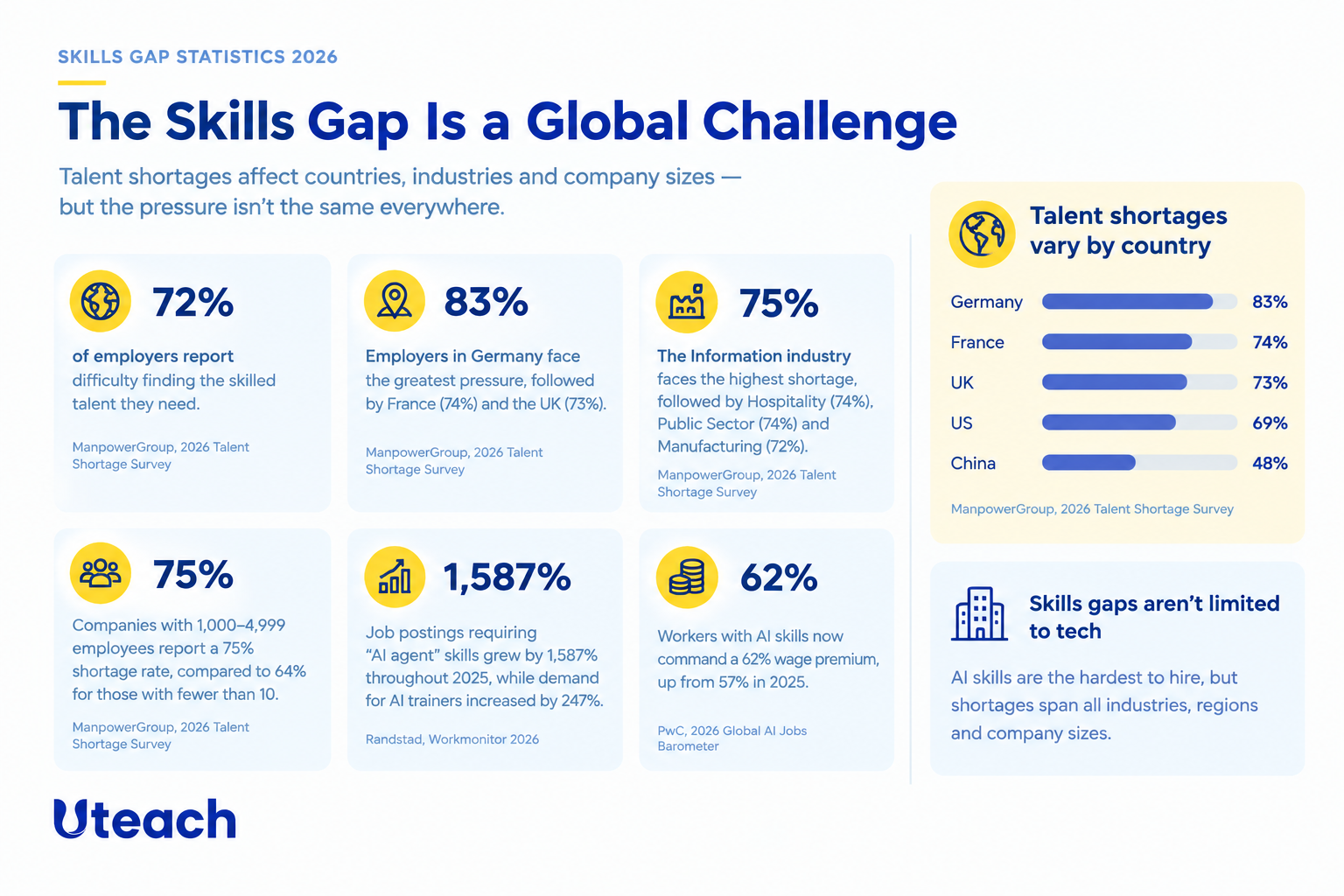
- For the first time, AI skills are the hardest skills for employers to find globally. AI model and application development leads at 20%, with AI literacy at 19%, alongside engineering (19%). (ManpowerGroup — 2026 Talent Shortage Survey)
- Traditional IT and data skills fell to seventh place (17%), pushed down the list by AI capabilities. (ManpowerGroup — 2026 Talent Shortage Survey)
- 72% of employers report difficulty finding the skilled talent they need, a slight improvement from 74% the previous year. Even with this modest relief, more than seven in ten employers are still struggling to hire. (ManpowerGroup — 2026 Talent Shortage Survey)
- Talent shortages vary sharply by country. Employers in Germany (83%), France (74%), and the UK (73%) face the greatest pressure, while the US (69%) sits slightly below the global average and China (48%) is the least constrained major market. (ManpowerGroup — 2026 Talent Shortage Survey)
- The Information industry faces the highest shortage (75%), followed closely by Hospitality (74%), Public Sector, Health and Social Services (74%), and Manufacturing (72%). (ManpowerGroup — 2026 Talent Shortage Survey)
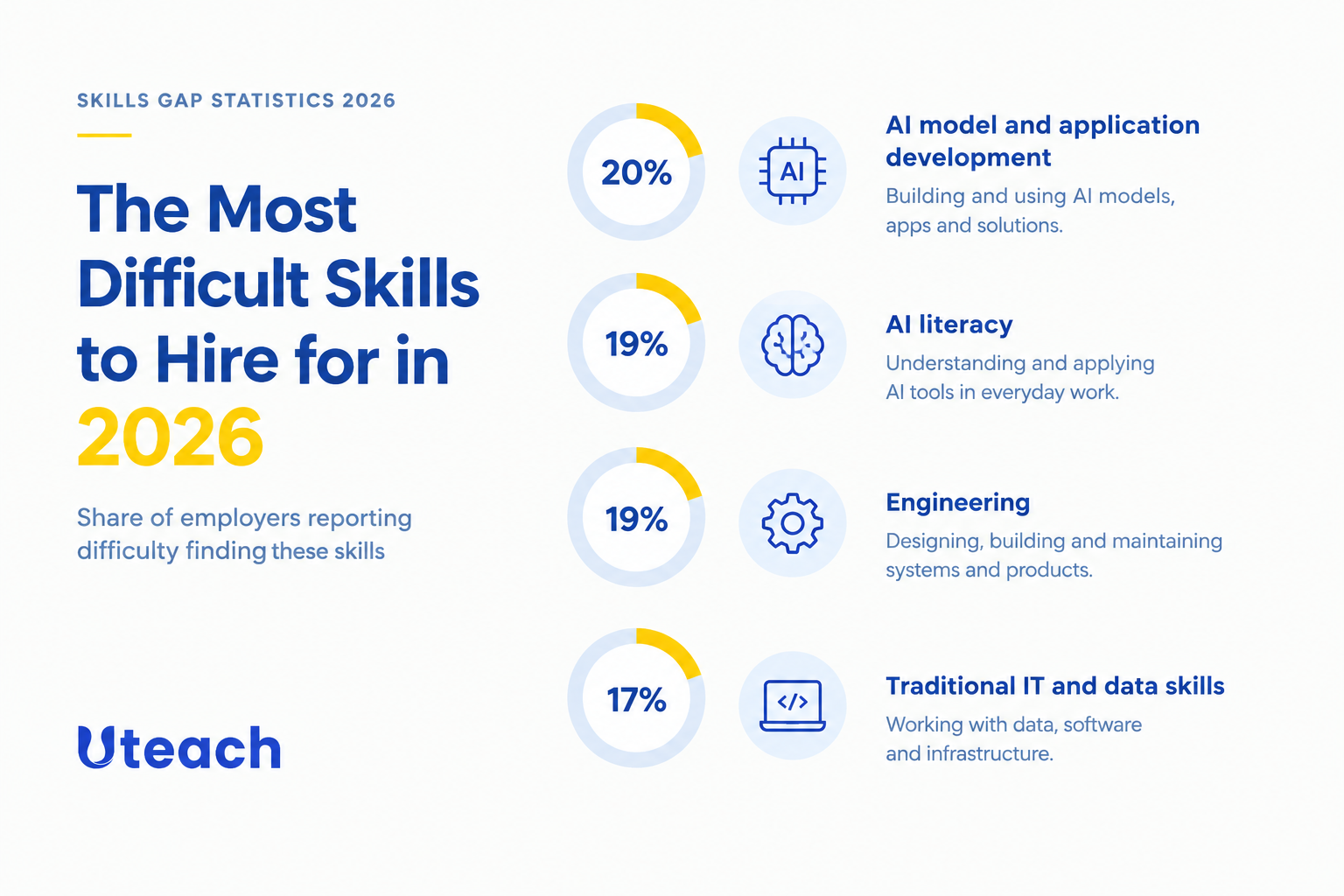
- Companies with 1,000–4,999 employees report a 75% shortage rate, 11 points higher than businesses with fewer than 10 employees (64%). (ManpowerGroup — 2026 Talent Shortage Survey)
- Job postings requiring "AI agent" skills grew by 1,587% throughout 2025, while demand for AI trainers increased by 247%. (Randstad — Workmonitor 2026)
- Demand for prompt engineering as a core skill across all job functions grew by 403%, showing that AI skills are no longer limited to technical roles. (Randstad — Workmonitor 2026)
- Global demand for AI Solutions Leads grew 226% over the past year, making it one of the hardest integration roles to fill. Senior AI leadership roles face vacancy rates above 25% in key markets. (Randstad — The New Career Currency, 2026)
- 86% of employers expect AI and information processing to transform their business by 2030, and two-thirds plan to hire talent with specific AI skills. (WEF — Future of Jobs Report 2025)
- Workers with AI skills now command a 62% wage premium, up from 57% in 2025. (PwC — 2026 Global AI Jobs Barometer)
As you can see, AI skills have moved from a niche technical need to the single biggest hiring challenge globally. The rise of AI literacy to the top of the list is especially telling. Employers are not only struggling to find people who can build AI, but also people who can simply use it well in everyday work.
The growing wage premium adds another layer of pressure. When AI-skilled workers cost more each year, hiring your way out of the gap becomes more expensive, which makes developing these skills internally a more realistic option for most organizations.
Related: What are the Costs of Training a New Employee?
Skills are expiring faster than training plans can keep up
A large share of the skills employees use today will look different within a few years. The pace is slightly slower than during the pandemic years, but it is still significant, and in jobs most exposed to AI, skill requirements are changing faster every year.
Employees are already feeling this in their daily work. Most of them have applied new skills or learned new tools over the past year, and many have experienced more change than ever before. At the same time, employers see skill gaps as the main thing holding their transformation plans back.
- Employers expect 39% of workers' existing skill sets to be transformed or become outdated between 2025 and 2030. This "skill instability" has slowed from 44% in 2023 and 57% in 2020, which WEF links to more workers completing training. (WEF — Future of Jobs Report 2025)
- The skills needed for the most AI-exposed jobs are changing more than twice as fast as those for the least exposed jobs. That gap is 75% wider than it was a year earlier. (PwC — 2026 Global AI Jobs Barometer)
- 63% of employers identify skill gaps as the biggest barrier to business transformation over the 2025–2030 period. (WEF — Future of Jobs Report 2025)
- 88% of workers applied new skills in their job over the past year, and 40% did so to a large or very large extent. (PwC — Global Workforce Hopes and Fears Survey 2026)
- 64% of workers had to learn new tools and technology for their job over the past year, with 36% saying this happened to a large or very large extent. (PwC — Global Workforce Hopes and Fears Survey 2026)
- Among workers affected by change, 34% say they experienced more change in the last year than in previous years. (PwC — Global Workforce Hopes and Fears Survey 2026)
- One-third of workers experienced 15 major changes in the past year alone. The most frequently cited changes involve the work itself and the skills required to do it, followed by AI and other technology disruptions. (Deloitte — 2026 Global Human Capital Trends)
- 85% of leaders say it is critical to build the ability of their organization and workforce to adapt at today's speed. Yet only 74% report making any progress, and just 7% say they are leading in this area. (Deloitte — 2026 Global Human Capital Trends)
- AI and big data top the list of fastest-growing skills, followed by networks and cybersecurity and technological literacy. (WEF — Future of Jobs Report 2025)
- Environmental stewardship entered the top 10 fastest-growing skills for the first time. (WEF — Future of Jobs Report 2025)
- 24% of employers expect manual dexterity, endurance, and precision to decline in importance, the most notable drop among all skills. (WEF — Future of Jobs Report 2025)
The data suggests that the pace of skill change is not slowing down in the places where it matters most. While overall skill instability has eased since 2020, the gap between AI-exposed and less exposed jobs is widening year over year.
There is also a clear gap between ambition and execution. Almost every leader agrees that adaptability is critical, but only a small fraction feel they are actually good at it. That difference is where most skills gaps start.
Training access is shrinking when it is needed most
You would expect training access to grow as skill requirements change faster. The data shows the opposite. Fewer workers say they have access to learning resources than a year ago, and fewer than half of employees have received any AI training, even though most of them already use AI.
Organizations are aware of the problem. Many have invested in AI training, but employees, especially frontline workers and technical professionals, say it is still not enough. Very few organizations consider themselves effective at continuous learning.
- Only 51% of workers say they have access to learning and development resources, down from 59% the previous year. That is an 8-point drop in a single year, at a time when skill demands are rising. (PwC — Global Workforce Hopes and Fears Survey 2026)
- Workers rate their understanding of the future skills they need (49%) lower than their own capacity to develop skills (61%). In other words, employees are willing to learn, but many do not know what to learn. (PwC — Global Workforce Hopes and Fears Survey 2026)
- Only 47% of employees say they have received AI training, and only 40% say their workplace has a policy or guidance on generative AI use. (KPMG and the University of Melbourne — Trust, Attitudes and Use of AI: A Global Study 2025)
- Across all respondents, not only employees, just two in five people (39%) report having some form of AI training. (KPMG — Trust, Attitudes and Use of AI: A Global Study 2025)
- 66% of people already use AI intentionally on a regular basis, but less than half (46%) are willing to trust it. Usage is clearly running ahead of understanding. (KPMG and the University of Melbourne — Trust, Attitudes and Use of AI: A Global Study 2025)
- Only 36% of employees feel adequately trained to use AI. (BCG — AI at Work 2025)
- Just 25% of frontline workers say their leaders provide enough guidance on AI. (BCG — AI at Work 2025)
- Only 8% of organizations believe they are highly effective at meeting the continuous, "always-on" learning needs of their workforce. (Deloitte — 2026 Global Human Capital Trends)
- Only 27% of respondents believe their organizations manage change effectively. (Deloitte — 2026 Global Human Capital Trends)
- 63% of enterprises invested in AI training over the past year, yet 27% of tech talent say their organizations are still not doing enough to develop their skills. (Randstad Digital — The AI Capability Gap, 2026)
- 74% of technology professionals say they must upgrade their skills to remain relevant. (Randstad Digital — The AI Capability Gap, 2026)
- If the world's workforce were 100 people, employers foresee that 29 could be upskilled in their current roles and 19 could be upskilled and redeployed elsewhere in the organization. However, 11 would be unlikely to receive the reskilling they need, leaving their employment prospects at risk. (WEF — Future of Jobs Report 2025)
As you can see, there is a growing gap between how fast skills are changing and how much training employees actually receive. Workers are adopting AI on their own, often without guidance or a clear policy, which creates both a skills risk and a governance risk.
The data also shows that investment alone is not the answer. Many organizations are spending on AI training, but employees still feel unprepared. That points to a problem with how training is designed and delivered, not only how much of it there is.
The skills gap is splitting the workforce in two
The skills gap is not only a gap between companies. It is increasingly a gap inside them. A small group of AI-skilled employees is moving ahead quickly, with more access to learning, more use of AI, and more rewards for building new skills. The majority of the workforce is falling behind.
The same pattern shows up across several global studies. Leaders and managers adopt AI faster than frontline employees, and many skilled workers say their organizations are not set up to let them use what they know.
- PwC identifies a small group of AI-enabled "front-runners" making up 14% of the workforce, while the core workforce, which PwC calls the "engine room," makes up 56%. (PwC — Global Workforce Hopes and Fears Survey 2026)
- Less than 40% of the core workforce say they have access to learning and development resources, compared to nearly 80% of front-runners. That means the employees who need upskilling most are half as likely to get it. (PwC — Global Workforce Hopes and Fears Survey 2026)
- Only a quarter of core workers learned new skills, applied new tools, or experienced increased change in the past year. (PwC — Global Workforce Hopes and Fears Survey 2026)
- 51% of front-runners use generative AI daily, compared to just 11% of the core workforce. The majority of the core workforce say they have never used AI. (PwC — Global Workforce Hopes and Fears Survey 2026)
- Overall, 64% of workers used AI at work in the past 12 months, a ten-point increase year over year. Daily generative AI use grew from 14% to 22% in the same period. (PwC — Global Workforce Hopes and Fears Survey 2026)
- Front-runners are 1.2 times more likely than the global average to work in organizations that reward learning new skills. (PwC — Global Workforce Hopes and Fears Survey 2026)
- Only 19% of AI users are in the "Frontier" zone, where individual AI capability and organizational readiness reinforce each other. 10% have strong skills but lack the systems to apply them, and 16% are stalled, with low capability and limited organizational support. (Microsoft — 2026 Work Trend Index)
- 72% of employees use AI regularly, but frontline adoption has stagnated at 51%. (BCG — AI at Work 2025)
- One in five workers (21%) believe their tasks will not be affected by AI at all, and nearly half (47%) fear AI benefits the company more than themselves. (Randstad — Workmonitor 2026)
The statistics suggest that AI adoption is deepening an existing divide. The employees who already have access to learning and AI tools keep building skills, while the majority stay where they are. Over time, that turns into a two-speed workforce.
For L&D teams, this is an important shift. The question is no longer only "how much training do we offer," but "who is actually receiving it." A program that reaches only the most motivated employees can widen the gap instead of closing it.
Human skills are becoming the scarcest skills of all
As AI takes over more routine tasks, the skills that only people can bring are becoming more valuable, not less. Employers are looking for communication, adaptability, emotional intelligence, and critical thinking, and demand for these skills in job postings is rising sharply.
There is also a new type of human skill emerging: the ability to judge and validate AI output. Employees who work with AI daily increasingly see quality control and critical thinking as the skills that matter most.
- The most sought-after human attributes are communication, collaboration, and teamwork (39%), followed by professionalism and work ethic (36%) and adaptability and willingness to learn (34%). (ManpowerGroup — 2026 Talent Shortage Survey)
- Over the past year, demand for emotional intelligence in job postings increased by 173% and demand for creativity by 168%. Demand for problem solving grew 35%, critical thinking 17%, and ethical judgment 11%. (Randstad — The New Career Currency, 2026)
- New tasks added to AI-exposed roles are 2.5 times more likely to rely on skills like empathy, judgment, and creativity. (PwC — 2026 Global AI Jobs Barometer)
- Analytical thinking remains the most sought-after core skill, with seven out of ten companies considering it essential. (WEF — Future of Jobs Report 2025)
- When asked which human skills become more important as AI takes on more work, AI users ranked quality control of AI output (50%) and critical thinking (46%) at the top. (Microsoft — 2026 Work Trend Index)
- 86% of AI users say they treat AI output as a starting point, not a final answer, and stay responsible for the thinking. (Microsoft — 2026 Work Trend Index)
- The most advanced AI users are more likely than others to intentionally do some work without AI to keep their skills sharp (43% vs. 30%). (Microsoft — 2026 Work Trend Index)
- Enrollments in critical thinking courses grew 168% year over year among data learners, 101% among software and product learners, 91% among IT learners, and 185% among generative AI learners. (Coursera — Job Skills Report 2026)
- Validation skills are also growing fast. Among data learners, enrollments in Data Quality grew 108% and Data Cleansing 103% year over year. (Coursera — Job Skills Report 2026)
- Learning is flowing in both directions across generations. 78% of workers say they learn soft skills from older colleagues, while 72% learn tech and AI skills from Gen Z and Millennials. (Randstad — Workmonitor 2026)
As you can see, the rise of AI is not making human skills less important. It is changing which human skills matter. Communication and adaptability remain in high demand, while judgment, validation, and critical thinking are becoming core skills for anyone who works with AI.
The intergenerational data is also worth noting. Employees already learn different skills from different colleagues. Peer learning and mentoring can be a practical, low-cost way to close both soft skill and AI skill gaps at the same time.
Employees are closing the gap on their own
While many organizations are still figuring out their skills strategy, employees are not waiting. Most of them recognize they need to upskill, and more than half are already looking for learning opportunities on their own, often outside their employer's programs.
Online learning data confirms this. Enrollments in generative AI courses keep breaking records, and more women are joining technical and AI training than a year ago.
- 65% of workers recognize the need to upskill, and more than half (52%) are actively seeking opportunities to future-proof their skills independently. (Randstad — Workmonitor 2026)
- Among technology professionals, 52% are seeking training independently because employer-provided learning cannot keep pace with the rate of technological change. (Randstad Digital — The AI Capability Gap, 2026)
- With 14 enrollments per minute, generative AI remains the most in-demand skill in Coursera's history. Among enterprise learners, generative AI enrollments grew by 234% year over year. (Coursera — Job Skills Report 2026)
- Demand for AI skills reaches far beyond engineering. Among learners focused on generative AI, the number one fastest-growing skill is Content Creation. (Coursera — Job Skills Report 2026)
- The gender gap in AI training is narrowing. Women made up 41% of generative AI enrollments among enterprise learners in 2025, up from 36% in 2024. Women's share also grew in Data (32% to 35%), IT (29% to 32%), and Software and Product Development (30% to 33%). (Coursera — Job Skills Report 2026)
- 65% of AI users fear falling behind if they do not use AI to adapt quickly, yet 45% say it feels safer to focus on current goals than to redesign their work with AI. (Microsoft — 2026 Work Trend Index)
- 66% of AI users say AI has allowed them to spend more time on high-value work, and 58% say they are producing work they could not have a year ago. (Microsoft — 2026 Work Trend Index)
- 80% of respondents say AI has improved their individual productivity, and about half say it has helped them develop new skills. (McKinsey — The State of AI in 2026)
- Only 13% of respondents say AI makes them anxious about their career prospects. (McKinsey — The State of AI in 2026)
The data shows a motivated workforce. Employees want to learn, they see AI helping them build new skills, and most are not paralyzed by fear of it. Yet nearly half still feel safer sticking to their current goals than changing how they work.
That tension is an opportunity for employers. When people are already learning on their own, a structured program that connects their learning to real roles and career paths can turn scattered self-study into skills the organization can actually use.
Verified skills and credentials are replacing tenure
In a fast-changing skills market, years of experience are no longer the only signal employers trust. Verified skills, certifications, and micro-credentials are becoming a faster route to promotion and higher pay, especially when they cover AI.
Employers and employees both see the traditional career ladder as outdated, and the demand for professional certificates shows that people are actively looking for proof of their skills.
- Professionals who acquire verified AI certifications are securing promotions up to 3.5 times faster, using them to leapfrog standard seniority structures. (Randstad — The New Career Currency, 2026)
- Content and customer support professionals with advanced AI certifications are driving salary premiums of 40% or more. (Randstad — The New Career Currency, 2026)
- Enrollments in Professional Certificates increased by an average of 91% across all career areas Coursera analyzed. (Coursera — Job Skills Report 2026)
- 94% of employers are willing to offer higher starting salaries to graduates with micro-credentials. (Coursera — Micro-Credentials Impact Report 2026, a survey of more than 3,500 learners, employers, and higher education leaders)
- 95% of employers believe micro-credentials help differentiate candidates. (Coursera — Micro-Credentials Impact Report 2026)
- 72% of employers say the traditional, linear career ladder is outdated. Only 41% of workers still want to follow a traditional career path. (Randstad — Workmonitor 2026)
- Roles focused on governing AI systems are among the fastest-growing professional positions, with demand for Process Automation Specialists up 196% over the past year. (Randstad — The New Career Currency, 2026)
As you can see, credentials are becoming a practical bridge between learning and career growth. Employers value them in hiring, and employees use them to move up faster than tenure alone would allow.
For organizations, this means internal training becomes more valuable when it ends with something verifiable. Assessments and certificates make new skills visible to managers, which helps with internal mobility and gives employees a clear reason to finish what they start.
Entry-level and manager skills are being rewritten
Two groups are feeling the skills shift in a very particular way: junior employees and managers. Entry-level roles exposed to AI now ask for skills that used to belong to senior positions, such as leadership and strategic thinking. At the same time, managers are expected to guide their teams through change while struggling with it themselves.
The data also shows how much influence managers have. When they model AI use and create space for experimentation, their teams build skills and confidence much faster.
- The most AI-exposed junior roles are seven times more likely than the least exposed junior roles to demand traditionally senior skills, such as leadership and strategic thinking. (PwC — 2026 Global AI Jobs Barometer)
- While overall early-career job postings have flatlined in highly AI-exposed sectors, "seniorized" entry-level roles have grown 35% since 2019. (PwC — 2026 Global AI Jobs Barometer)
- 31% of senior executives and 24% of managers find it difficult to manage change. Managers' confidence in their job security also fell six points year over year, while it barely changed in more junior roles. (PwC — Global Workforce Hopes and Fears Survey 2026)
- Mid-level managers and individual contributors are more likely to report AI-related strains than executives. 47% of them say they have experienced at least one negative effect, compared to 31% of executives and senior managers. (McKinsey — The State of AI in 2026)
- A separate Microsoft study of 1,800 workers found that when managers actively modeled AI use, employees reported a 17-point lift in AI value, a 22-point lift in critical thinking about their AI use, and a 30-point lift in trust in agentic AI. (Microsoft — 2026 Work Trend Index)
- Among the most advanced AI users, 85% say their manager openly uses AI, compared to 64% of other users. They are also more likely to say their manager creates space for experimentation (84% vs. 61%). (Microsoft — 2026 Work Trend Index)
- Only one in four AI users (26%) say their leadership is clearly and consistently aligned on AI. (Microsoft — 2026 Work Trend Index)
- Leaders are more likely than employees to feel safe suggesting new ways of working with AI (81% vs. 67%). (Microsoft — 2026 Work Trend Index)
- Trust in management fell by seven percentage points year over year, and less than half of the global workforce now trusts top management. (PwC — Global Workforce Hopes and Fears Survey 2026)
- Trust in leadership dipped from 77% to 72%, and to 67% among Gen Z. At the same time, 72% of workers say they have a strong relationship with their manager, up from 64% in 2024, and 60% look to their manager for reassurance. (Randstad — Workmonitor 2026)
The statistics suggest that the traditional career ladder is being compressed from both ends. Junior employees need senior-level skills earlier, and managers need new skills to lead teams through constant change.
The data also highlights the manager as the key point of influence. As trust in top leadership declines, employees rely more on their direct managers, and teams whose managers model new behaviors build skills faster. Investing in manager development may be one of the most effective ways to close skills gaps across the whole team.
The skills gap is already costing companies people and ROI
The skills gap has a price, and organizations are already paying it in two ways. First, skilled employees leave when they do not get development opportunities. Second, AI investments are not delivering the returns companies expected, because the workforce is not ready to use the technology well.
Constant change without enough support also affects the people who stay, through lower well-being, heavier workloads, and the feeling of being left behind.
- Nearly one in four technology professionals globally have quit a job specifically because their employer failed to provide structured upskilling opportunities. (Randstad Digital — The AI Capability Gap, 2026)
- The share of tech professionals who left roles over a lack of development varies by region: 30% in North-Western Europe, 27% in Eastern Europe, 26% in Asia Pacific, and 24% in North America. (Randstad Digital — The AI Capability Gap, 2026)
- 29% of AI-enabled front-runners say they are very or extremely likely to change employers in the next 12 months. The most skilled employees are also the most mobile. (PwC — Global Workforce Hopes and Fears Survey 2026)
- The steady pace of organizational change has led to decreased well-being (68%), increased workload (60%), and employees feeling less relevant or left behind (58%). (Deloitte — 2026 Global Human Capital Trends)
- 37% of respondents attribute at least some EBIT impact to AI, essentially unchanged from last year, even though more organizations are scaling AI. (McKinsey — The State of AI in 2026)
- AI high performers, organizations attributing 5% or more of EBIT to AI, still make up only about 6% of respondents, the same share as in 2025. (McKinsey — The State of AI in 2026)
- Just 20% of companies capture 74% of AI-driven returns. (PwC — AI Performance Study, cited in the Global Workforce Hopes and Fears Survey 2026)
- In separate Deloitte research with 100 C-suite leaders, 59% said their organizations take a tech-focused approach to AI. Those organizations are 1.6 times more likely to miss AI returns that exceed expectations than those taking a human-centric approach. (Deloitte — 2026 Global Human Capital Trends)
- 39% of respondents expect AI to reduce their organization's headcount in the coming year, up from 32% last year. Yet only 14% report that AI actually contributed to a workforce decline over the past year, less than half of what was expected. (McKinsey — The State of AI in 2026)
- 40% of employers plan to reduce staff as their skills become less relevant. (WEF — Future of Jobs Report 2025)
- Only 13% of AI users say they are rewarded for reinventing their work with AI, even when results are not met. (Microsoft — 2026 Work Trend Index)
As you can see, the cost of the skills gap shows up in both retention and returns. Skilled employees are the most likely to leave, and organizations that treat AI as a technology project rather than a people project are less likely to see results.
The McKinsey data is especially interesting. Last year, companies expected far bigger workforce reductions than what actually happened. Instead of replacing people, most organizations still need their current employees, with new skills, to make AI work.
What actually closes the skills gap
The good news is that the research also shows what works. Upskilling is now employers' first response to talent shortages, ahead of raising wages. And the organizations seeing the best results share a few common habits: they build learning into daily work, make it role-specific, and create an environment where people are encouraged to experiment.
The data also makes one thing clear. The environment around employees matters more than individual effort alone.
- Faced with structural talent scarcity, 91% of employers are using a mix of strategies. Upskilling and reskilling (27%) is the leading approach, ahead of schedule flexibility (20%), increasing wages (19%), and location flexibility (18%). (ManpowerGroup — 2026 Talent Shortage Survey)
- 50% of employers plan to transition staff from declining to growing roles. Funding for, and provision of, reskilling are seen as the two most welcome public policies to boost talent availability. (WEF — Future of Jobs Report 2025)
- Organizational factors such as culture, manager support, and talent practices account for more than twice the reported AI impact of individual mindset and behavior (67% vs. 32%). (Microsoft — 2026 Work Trend Index)
- Organizations that successfully build an adaptive approach, with learning and change embedded in daily work, are 2.4 times more likely to report better financial results and provide more meaningful work. (Deloitte — 2026 Global Human Capital Trends)
- AI leaders are 1.7 times more likely than other companies to provide ongoing, role-based AI learning, and 2.2 times more likely to redesign workflows around AI rather than simply adding AI tools. (PwC — AI Performance Study, cited in the Global Workforce Hopes and Fears Survey 2026)
- Nearly three-quarters of AI high performers report fundamentally redesigning workflows because of AI, up from 55% last year. Only one-quarter of other organizations do the same. (McKinsey — The State of AI in 2026)
- Employees who receive five or more hours of AI training, especially in person and with coaching, are significantly more likely to become regular AI users. (BCG — AI at Work 2025)
- Digital training solutions, such as custom digital academies, boost workforce readiness by 56%. (Randstad Digital — The AI Capability Gap, 2026)
- 87% of workers say safe digital spaces to practice and learn new things would help them adapt to change better. (Deloitte — 2026 Global Human Capital Trends)
- The top barrier to adapting, cited by 44% of leaders and managers, is that change does not seem relevant or personalized to the individual. Among workers, 30% do not understand how the change relates to them, and 21% lack personal motivation. (Deloitte — 2026 Global Human Capital Trends)
- Workers are twice as likely to feel negatively about an employer-imposed change as about a change they chose themselves. (Deloitte — 2026 Global Human Capital Trends)
- The most advanced AI users are far more likely to work in teams that share AI tips, new agents, learnings, and mistakes (61% vs. 36%). (Microsoft — 2026 Work Trend Index)
- 7 in 10 business leaders say their primary competitive strategy for the next three years is to be fast and nimble. (Deloitte — 2026 Global Human Capital Trends)
- Productivity growth is 40% higher at companies most exposed to AI compared to the least exposed. (PwC — 2026 Global AI Jobs Barometer)
The statistics suggest that closing the skills gap is less about running more courses and more about how learning is set up. Role-specific content, enough training time, practice spaces, and peer sharing consistently show up in the organizations getting results.
Personalization also stands out. When employees do not see how a change or a training program relates to their own work, they disengage. Learning that is tailored to the role, and that employees have a say in, is far more likely to stick.
What does this all mean for your organization?
The skills gap in 2026 is not one gap, but several at once. AI skills are the hardest to hire, existing skills are expiring faster, training access is shrinking, and the employees who need development most are the least likely to receive it. At the same time, the organizations that build learning into daily work are seeing better financial results and keeping their best people.
So where should your organization start? Here are some questions worth evaluating internally.
- Do you know which skills your teams are actually missing?
Most employees are willing to learn, but fewer than half understand which skills they will need in the future. Before launching new programs, map the skills each role requires today and in the next two to three years, and compare them to what your people can already do. Skill assessments make the gap visible, both for you and for your employees.
Related: How to Conduct a Training Needs Assessment on a Role Level
- Are you building AI skills internally, or relying on hiring?
AI skills top the global shortage list, and the wage premium for AI-skilled workers keeps growing. Hiring alone will be expensive and slow. Consider which roles need foundational AI literacy, which need role-specific AI workflows, and how you can develop those skills within your current workforce.
- Is training reaching your whole workforce, or only the most motivated?
The data shows a two-speed workforce, where the employees with the most access keep moving ahead. Look at who is actually completing your training programs. Frontline and core employees often need easier access, such as mobile learning, shorter formats, and protected time to learn.
- Are you investing in human skills alongside technical ones?
Communication, adaptability, emotional intelligence, and critical thinking are in growing demand. As AI takes on more routine work, judgment and the ability to validate AI output become core skills for every role, not only technical ones.
Related: 5 Ways to Improve Training and Development in the Workplace
- Are your managers equipped to lead the change?
Managers are under pressure, but they also have the biggest influence on how their teams learn. When managers model new skills and create space for experimentation, their teams build confidence and capability faster. Manager development may be one of your most effective investments.
- Can employees prove the skills they gain?
Verified skills and credentials are speeding up promotions and raising salaries. Adding assessments and certificates to your internal training makes new skills visible, supports internal mobility, and gives employees a reason to complete their learning paths.
- Is learning part of daily work, or a separate event?
Only a small share of organizations feel effective at continuous learning, yet those that embed learning into work are far more likely to see better results. Short, role-specific learning, practice opportunities, and peer sharing tend to work better than occasional workshops.
Related: How Big Companies Run Employee Development Training Programs
The overall trend across all these statistics is clear: the organizations that close the skills gap are not necessarily the ones spending the most on technology. They are the ones that treat skills development as an ongoing part of work, make it accessible to everyone, and connect it to real career growth.
If you are ready to build your own training academy and close the skills gaps in your teams, Uteach is here to help. Book a call with our expert today and let us support you in assessing your employees' skills and creating the learning programs your teams need.