
The following guide covers:
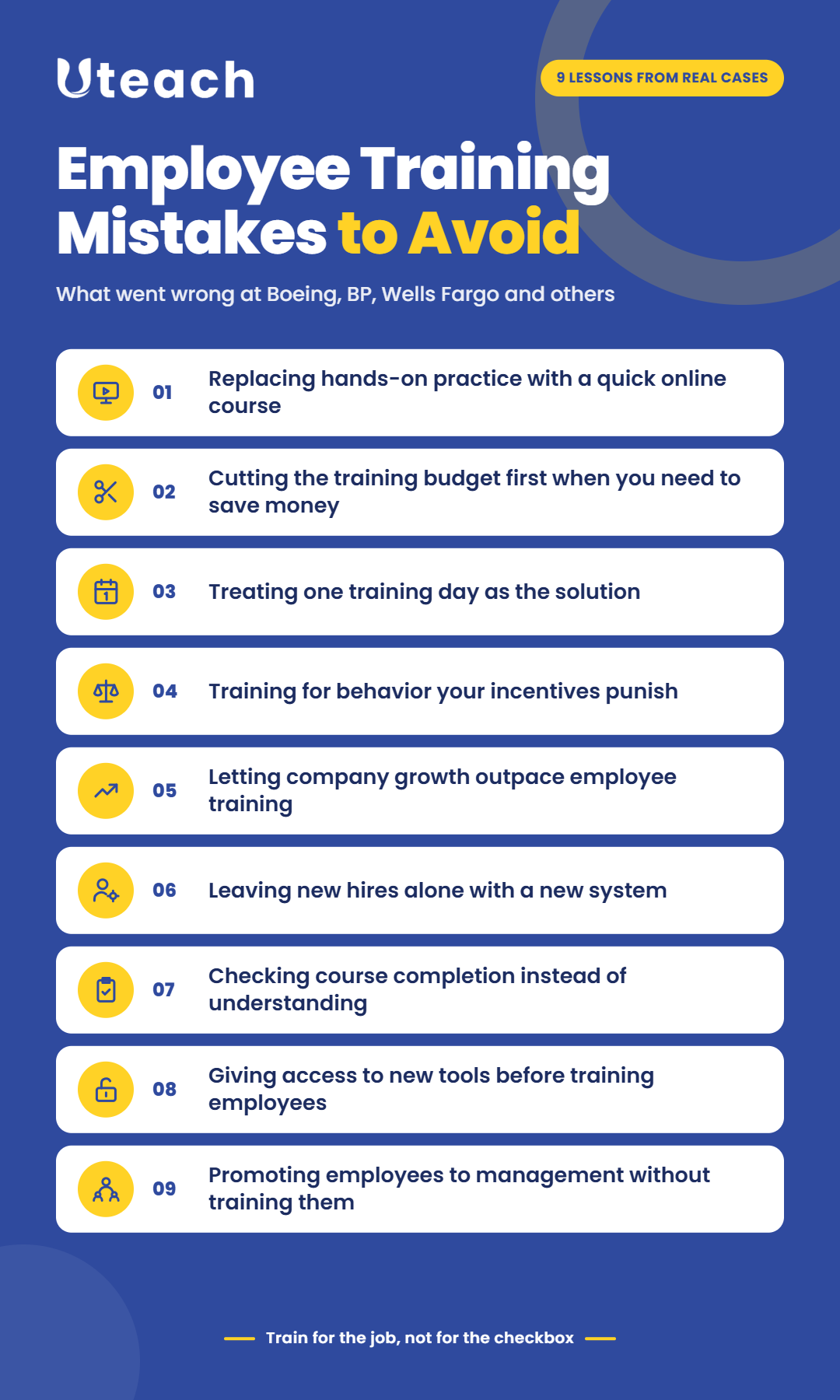
#1: Do Not Replace Hands-On Practice With a Quick Online Course
#2: Do Not Cut the Training Budget First When You Need to Save Money
#3: Stop Treating One Training Day as the Solution
#4: Do Not Train for Behavior Your Incentives Punish
#5: Do Not Let Company Growth Outpace Employee Training
#6: Do Not Leave New Hires Alone With a New System
#7: Check Understanding, Not Just Course Completion
#8: Train Employees on New Tools Before You Give Them Access
#9: Do Not Promote Employees to Management Without Training Them
How Do You Know Whether Your Employee Training Is Actually Working?
Frequently Asked Questions About Employee Training Mistakes
Ready to Avoid These Mistakes in Your Training Program?
Some of the most common employee training mistakes are setting no clear goals, assuming that a one-size-fits-all approach will work, not following up, and not measuring the results. And to be fair, these are really costly mistakes. But I am sure you have already considered them all.
So I wanted to look at something more specific: what actually went wrong at big companies when they were training their employees?
I checked investigation reports, testimonies, company statements, and documented cases to find training decisions that contributed to costly failures at companies like Boeing, BP, Toyota, and Wells Fargo. Some of these incidents cost millions of dollars, damaged reputations, and, in the most serious cases, involved the loss of human lives.
What I found interesting is that none of these companies had simply forgotten about training. They had training budgets, courses, workshops, and even ethics programs.
The problem was how they trained, when they trained, and what they expected the training to fix.
And although training was not the only cause of these incidents, the cases reveal important lessons about how companies prepare their employees.
In this guide, we will look at 9 employee training mistakes, what exactly happened, and what you can do so your training program does not repeat them.
#1: Do Not Replace Hands-On Practice With a Quick Online Course
When e-learning started to gain traction, many people thought it would eventually replace traditional training. And I can understand why. Online courses are cheaper to deliver, easier to update, and employees can complete them without leaving their workplace. But choosing the cheapest or most convenient training format is where companies can get things wrong.
Imagine you are a pilot who has flown the Boeing 737 for years. The company releases a new version of the plane, the 737 MAX, and tells you that a short online course is enough to understand the differences.
That is essentially what happened.
Pilots transitioning from older Boeing 737 models to the MAX received self-paced training. At American Airlines, the course lasted approximately 56 minutes and could be completed on an iPad, according to CNN's reporting and the pilots' union.
The course did not explain MCAS, a new flight-control system that later became central to investigations into two fatal crashes.
Why so little additional training?
Because minimizing the differences between the MAX and earlier 737 models, including the need for expensive simulator training, was part of the aircraft's commercial appeal. Airlines would not have to take pilots off flights for additional simulator sessions.
After the two crashes, Boeing changed its position.
In January 2020, the company's interim CEO, Greg Smith, announced:
"Boeing has decided to recommend MAX simulator training combined with computer-based training for all pilots."
— Greg Smith, interim CEO of Boeing, Boeing's official statement
Of course, the accidents involved much more than training. Investigations identified serious problems with aircraft design, certification, and safety oversight. But the training decision still teaches us something important. The mistake was not using e-learning. It was relying on a limited training approach for changes that could require pilots to respond correctly in critical situations.
I see similar logic in companies on a much smaller scale.
A customer support team watches a 10-minute video about a new product, and the next morning, everyone is expected to handle angry customers asking complicated questions. But knowing how something works and actually being able to use that knowledge under pressure are two different skills.
How to avoid this employee training mistake
- Match the format to the risk. If an employee's mistake could be expensive, dangerous, or difficult to reverse, do not rely only on theory. Add supervised practice.
- Train on what is different, not only what is similar. When introducing a new product or system, identify what has changed in the employee's work and focus the training on those differences.
- Add practice before employees start working independently. Role-playing, simulations, shadowing, and supervised first tasks are still useful. AI-based simulations can also help employees rehearse difficult customer conversations.
- Test the skill in action. A quiz can check knowledge, but it cannot always show how someone will perform under pressure. Include practical assessments where the job requires them.
#2: Do Not Cut the Training Budget First When You Need to Save Money
When management does not see the direct results employee training brings, the immediate thought is often to cut the costs and budget allocated to training. And I can see why this happens. If you cut the training budget today, employees will not suddenly forget how to do their jobs tomorrow. Work continues, the company saves money, and it may look like nothing has changed.
The damage, however, can take years to become visible.
BP's Texas City refinery is probably the most painful example.
In March 2005, an explosion at the refinery killed 15 workers and injured approximately 180 others. The US Chemical Safety Board (CSB) investigated the disaster and found serious problems with training, supervision, equipment, maintenance, and the refinery's wider safety culture.
And the numbers behind the training cuts are difficult to ignore.
According to the CSB investigation:
- The refinery's central training staff went from 30 people in 1997 to just 8 in 2004.
- The training department's budget was cut in half between 1998 and 2004.
- Trainers were assigned additional responsibilities, leaving less time for actual training.
- The training coordinator for the unit involved in the explosion reportedly spent only about 5% of his time on training.
And there was another important decision.
As training resources were reduced, computer-based learning replaced some instructor-led activities. Operators also lacked simulator training for unusual situations, including the kind of abnormal startup conditions involved in the incident.
In its final investigation report, the CSB warned:
"Simply targeting the mistakes of BP's operators and supervisors misses the underlying and significant cultural, human factors, and organizational causes of the disaster."
— US Chemical Safety Board, final investigation report
What I find most important in this case is that last point. When something goes wrong, it is easy to blame the employee who made the final mistake. But that employee may be the last link in a chain of decisions made years earlier, sometimes in a budget meeting.
Training cuts did not cause the BP disaster on their own. But the investigation shows how reducing training resources contributed to an already dangerous working environment. And this is exactly why I think training budgets should not be treated as an easy source of short-term savings.
How to avoid this employee training mistake
- Protect critical training from across-the-board cuts. Identify which skills employees must maintain for safety, compliance, customer service, and business continuity before approving reductions.
- Track how much time trainers actually spend training. If your trainers also have other responsibilities, check whether they have enough time to do their actual training work. Five percent is hardly a functioning training role.
- Train for rare situations, not only daily routines. The most expensive mistakes often happen in situations employees rarely encounter. Include refresher training, simulations, and drills.
- Save money on delivery, not on essential practice. Reuse existing learning content, move suitable theory online, and use an LMS to reduce administrative work. But keep the hands-on activities employees need.
- Measure the cost of not training. Look at errors, rework, incidents, customer complaints, and the time managers spend correcting avoidable mistakes.
#3: Stop Treating One Training Day as the Solution
You probably know the situation. Something goes wrong at a company, and leadership wants to show that they are taking action. Or they find something trendy, like AI, and suddenly everyone is enrolled in a training session.
And most of the time, the topic is closed. But does attending one session mean employees will change how they work? Let's look at the Starbucks example. In April 2018, two Black men were arrested at a Starbucks store in Philadelphia while waiting for a business meeting.
The incident went viral, and Starbucks responded with one of the most high-profile corporate training decisions of the time.
On May 29, the company closed more than 8,000 US stores for approximately four hours so that around 175,000 employees could participate in racial-bias education.
To be fair to Starbucks, the company itself did not call it a complete fix.
Its CEO, Kevin Johnson, said:
"Closing our stores for racial-bias training is just one step in a journey."
— Kevin Johnson, then CEO of Starbucks, company announcement
And Starbucks did take further steps, including integrating this education into employee onboarding and reviewing company policies. So I am not using Starbucks as an example of a company that stopped after one session.
What makes the case interesting is that even Starbucks, with its ability to close thousands of stores and organize training for so many employees, recognized that one afternoon could not solve a complex problem.
Research on diversity training also suggests that results depend on how programs are designed and reinforced. For example, a meta-analysis of diversity training studies found that training effects varied across outcomes and that some effects were more durable than others.
Now think about your annual compliance training or a cybersecurity webinar. An employee watches a presentation about recognizing phishing emails. They answer five questions, pass the quiz, and receive a certificate.
Three months later, they receive a convincing phishing message. Can they recognize it? We do not really know unless we check.
How to avoid this employee training mistake
- Plan the follow-up before the first session. Decide what employees should do in week two, month one, and month three before launching the training.
- Turn the topic into a learning path. Instead of delivering everything in one session, spread lessons, quizzes, and practice activities over several weeks.
- Set measurable benchmarks. Decide which changes you expect to see in behavior, complaints, errors, or customer feedback.
- Make managers part of the training program. Managers should reinforce what employees learned through team meetings, coaching, and one-on-one conversations.
- Check whether the behavior lasts. Repeat practical assessments after a few weeks or months instead of measuring only immediate knowledge.
In an LMS like Uteach, you can use drip content to release lessons gradually, combine them with quizzes, and track employees' progress.
The important part is that the learning does not end when the first session does.
#4: Do Not Train for Behavior Your Incentives Punish
You can probably guess what happens when a training program tells employees one thing, but their bonus tells them the opposite. The bonus usually wins.
Wells Fargo learned this the expensive way. For years, bank employees faced aggressive sales targets and pressure to cross-sell products. The company promoted an ambitious goal of selling eight financial products to each customer. To meet targets, some employees opened bank and credit card accounts without customers' permission.
By 2016, the scandal involved approximately 2 million potentially unauthorized accounts identified in the bank's earlier reviews. The bank did not completely ignore ethics training.
According to reporting on the scandal, Wells Fargo held a two-day ethics workshop in 2014, emphasizing that opening unauthorized accounts was unacceptable.
Yet the misconduct continued.
Why? Because telling employees to behave ethically did not remove the pressure to achieve unrealistic sales numbers.
In September 2016, regulators announced a combined $185 million in penalties, and Wells Fargo reported that approximately 5,300 employees had been dismissed in connection with improper sales practices over several years.
Richard Cordray, then director of the Consumer Financial Protection Bureau, described the problem this way:
"Wells Fargo built an incentive-compensation program that made it possible for its employees to pursue underhanded sales practices."
— Richard Cordray, CFPB enforcement remarks
This is the mistake I find the hardest to spot from inside a company. Because the training itself might look perfectly fine. The content is correct. The employees attended. Everyone knows the company's policies.
But employees also know what gets rewarded. Imagine a support team that is trained to solve customer problems thoroughly but measured almost entirely by how many tickets they close per hour. Which behavior do you think will show up?
How to avoid this employee training mistake
- Review incentives before designing training. Ask what employees are measured, paid, and promoted for. If those expectations contradict what you teach, the training will struggle.
- Train managers along with employees. If managers continue pushing the old targets, employees have little reason to apply the new training.
- Listen to what employees report after training. Give people a safe way to explain when company expectations make it difficult to follow procedures.
- Use balanced performance metrics. Track quality, customer satisfaction, compliance, or other relevant outcomes alongside productivity.
- Do not stop at firing employees. When thousands of people engage in similar misconduct, you need to investigate the organizational conditions that allowed it to happen.
#5: Do Not Let Company Growth Outpace Employee Training
Growth feels like the best problem a company can have. New markets, new locations, new hires, more customers. But every new employee needs to learn how the work is done. Every new manager needs to understand how to lead the team. And every new location needs people who can maintain the company's standards.
The problem is that businesses do not always plan enough training capacity for that growth. Toyota is an interesting example because the company's president acknowledged the problem himself.
In 2009 and 2010, Toyota recalled millions of vehicles amid concerns about unintended acceleration.
When Akio Toyoda testified before the US Congress in February 2010, he discussed how rapid growth had affected the company's ability to develop its people and organization.
He said:
"We pursued growth over the speed at which we were able to develop our people and our organization."
— Akio Toyoda, President of Toyota, testimony to the US Congress
Now, this does not mean insufficient employee training directly caused the vehicle defects. Those problems involved technical, operational, and safety issues. But Toyoda's statement tells us something important about what happens when a company expands faster than it can develop its people.
Starbucks went through a different kind of training challenge in 2008. After years of rapid expansion, the company was trying to restore consistency and improve the quality of its coffee.
When Howard Schultz returned as CEO, Starbucks decided to close approximately 7,100 US stores for several hours to retrain about 135,000 employees on espresso preparation. According to contemporary reporting, the training was part of a wider effort to improve product quality and restore the customer experience.
Think about what that means.
A company had grown so large that it decided to temporarily close thousands of stores to bring employees back to the standards it wanted them to follow.
What I find interesting about both examples is that employee development became part of a much larger business discussion. Companies can hire and expand quickly. But they cannot assume the people and skills needed to support that growth will develop automatically.
How to avoid this employee training mistake
- Make training capacity part of growth planning. Before opening a new location or doubling a team, ask who will train the new employees and how much time they will need.
- Turn your best employees' knowledge into training content. Record how experienced employees handle common tasks and build reusable onboarding materials.
- Standardize onboarding across teams and locations. Employees should not receive completely different training depending on who happens to be available.
- Watch quality metrics during growth. Rising errors, customer complaints, and rework can indicate that employee development is falling behind hiring.
- Measure time to proficiency. Track how long new employees need before they can perform their jobs independently and correctly.
#6: Do Not Leave New Hires Alone With a New System
You were a new employee once, and you probably remember how much there was to learn during your first week. The company, your colleagues, the processes, the expectations.
Now imagine adding a brand-new software system that nobody in the company has used before. And a deadline. This is close to what happened during Target's expansion into Canada.
In 2013, Target opened more than 100 Canadian stores in less than a year while introducing new systems to manage inventory and supply-chain operations.
Employees had to enter information for more than 75,000 products into the company's inventory system. The work involved details such as product descriptions, dimensions, weights, and identification codes.
Many employees assigned to the task were inexperienced with the software and had limited preparation for the complexity of the work. One former employee told Canadian Business:
"You had these people we hired, straight out of school, pressured to do this insane amount of data entry."
— Former Target Canada employee, as quoted in reporting on the investigation
And the consequences were serious.
According to the investigation, only about 30% of the initially entered product data was accurate. Incorrect product dimensions, missing information, and other errors affected inventory planning and replenishment.
Some stores had empty shelves while distribution centers struggled with excess inventory. Of course, inadequate training was not the only problem. The company also had serious software implementation, data validation, supply-chain, and operational issues. But that is exactly why the training mattered.
Employees were expected to perform critical tasks in unfamiliar systems without enough preparation, while the systems themselves lacked adequate safeguards to catch mistakes.
In January 2015, less than two years after opening its first Canadian stores, Target announced that it would close all 133 locations, affecting approximately 17,600 employees.
The failed expansion cost the company billions of dollars. I think this case matters for almost every company introducing new software. It could be a CRM, an HR platform, an inventory system, or a new AI tool.
If employees do not understand how to use the system, the problems may spread far beyond the person who made the original mistake.
How to avoid this employee training mistake
- Make system training part of onboarding. Do not assume new hires will figure out important software while working with real data.
- Build a structured onboarding path. Introduce the system, demonstrate common tasks, give employees opportunities to practice, and check their understanding before assigning critical work.
- Explain why the task matters. Show employees how the information they enter affects colleagues, customers, and other departments.
- Use practice environments. Let employees make mistakes with sample information rather than real business data.
- Add safeguards to the system. Training reduces errors, but it does not eliminate them. Validation rules, templates, and review procedures are still necessary.
With Uteach, you can build step-by-step onboarding courses, add quizzes and assignments, and track employees' progress before they move on to more advanced responsibilities.
#7: Check Understanding, Not Just Course Completion
I have a feeling that many companies measure training success using one number: completion rate. Everyone finished the course. Everyone passed the quiz.
So everyone knows what to do, right? Well, not necessarily.
Citibank's accidental payment in 2020 is an interesting example of why knowing a procedure does not always mean being able to apply it correctly.In August 2020, Citibank was supposed to process approximately $7.8 million in interest payments to lenders of cosmetics company Revlon. Instead, the bank accidentally transferred almost $900 million, including its own money.
And the interesting part is that Citibank had a review procedure designed to prevent errors. It was called the six-eye process. Three people—a maker, a checker, and an approver—were involved in reviewing the transaction.
The software also had training materials explaining how to complete the relevant payment process.
Yet the employees misunderstood how the system would process the transaction, and the multiple reviews did not catch the mistake. Some lenders refused to return the money. Citibank initially lost a major part of the dispute in 2021 but successfully appealed in 2022.
You can read the details in the US Court of Appeals decision.
Now, I would not say this proves that Citibank employees simply needed another training course. The system was complicated, and the incident exposed problems with software design and operational controls as well.
But it does show something I think training managers should pay more attention to.
An employee can know the steps of a procedure and still misunderstand what those steps will do in an unusual situation. Imagine you train a new finance employee on payment approvals. You ask, "How many people need to approve a transfer?" They answer correctly.
But if you show them a complicated transaction and ask what will happen after they click Approve, will they still get it right?
That is what I mean by checking understanding.
How to avoid this employee training mistake
- Test with realistic scenarios, not only memory questions. Instead of asking employees to repeat procedures, show them actual workplace situations and ask what they would do.
- Use assignments alongside quizzes. Ask employees to demonstrate how they would complete a task and review their work.
- Train reviewers separately when necessary. People approving other employees' work need enough understanding to identify mistakes, not simply follow the same steps.
- Include unusual cases in training. Employees should practice situations where the standard process becomes complicated.
- Check performance after training. Look at errors, supervisor observations, and practical assessments rather than relying entirely on completion percentages.
In Uteach, you can use quizzes and assignments to assess employees' understanding and review their results.
But for skills that require practical execution, I would also recommend supervised tasks or simulations outside the course itself.
#8: Train Employees on New Tools Before You Give Them Access
Have you noticed how companies introduce new AI tools? Employees get access, everyone starts experimenting, and the training and usage rules often come later.
The problem is that employees may start experimenting with real company information before they understand the risks.
Samsung is one of the best-known examples. In 2023, Samsung's semiconductor division began allowing employees to use ChatGPT for work-related tasks. Soon afterward, incidents emerged involving employees submitting confidential information to the AI chatbot. Reported cases included employees using ChatGPT to troubleshoot sensitive source code and work with internal meeting information.
The employees were trying to make their jobs easier. And that is what makes the situation interesting. They were using a tool that was supposed to help them work faster, but their actions also created risks for confidential company information.
In May 2023, Samsung introduced restrictions on external generative AI tools on company-owned devices and internal networks while working on additional security measures.
The public reports do not establish that Samsung had no policies or that employees had received no guidance. But the incidents make one thing very clear: allowing employees to use a new tool is not the same as preparing them to use it safely.
I think this mistake will become even more common as companies introduce AI into everyday workflows. Employees are not going to wait until the company has developed a perfect training program.
They will use the tools available to them. And if they do not know what they should or should not share, they may learn through mistakes involving real customer or company information.
How to avoid this employee training mistake
- Make basic tool training a condition for access. Before employees start using a new system, explain what it does, what information it can access, and what risks are involved.
- Use examples from actual work. "Do not share confidential information" is too abstract. Show examples such as customer lists, contracts, source code, and internal meeting recordings.
- Provide safe ways to experiment. Create sample tasks and practice environments so employees can test AI tools without exposing real information.
- Teach employees to check AI-generated results. Training should cover inaccurate outputs and the need for human review, not only data confidentiality.
- Update training as tools change. Review training whenever important features, risks, or internal policies change.
And, of course, training should be supported by approved tools, access restrictions, and appropriate data protection measures.
#9: Do Not Promote Employees to Management Without Training Them
The best engineer becomes the engineering manager. The best salesperson becomes the sales manager. The best customer support representative becomes the team leader.It sounds logical. But being good at the work and being good at leading people who do the work are two very different skills.
Google learned something interesting about this.
Back in 2002, Google's founders believed that engineers could work effectively without traditional management, so the company experimented with eliminating engineering managers.
The experiment did not last long. Years later, in 2008, Google launched Project Oxygen, a research initiative that initially explored whether managers really made a difference.
The findings challenged the assumption that managers were unnecessary.
Project co-lead Neal Patel described the outcome in one short line:
"Luckily, we failed."
— Neal Patel, Project Oxygen co-lead, Harvard Business Review
The research found that effective managers were associated with better team outcomes. But what I find more interesting is what Google did next.
Instead of simply telling managers to do a better job, the company studied the behaviors of its most effective managers and turned those findings into management development programs.In its initial research, coaching, communication, and supporting employees were among the most important behaviors.
Technical expertise mattered, but it was not enough by itself. Now, Google did not publish this research as proof that its managers had been promoted without training.
Still, the findings support an important lesson about employee development. Being a great individual contributor does not automatically prepare someone to become a great manager. Someone might be excellent at solving customer problems but have no experience giving difficult feedback. These skills need training, too.
How to avoid this employee training mistake
- Start manager training before promotion. Give potential managers opportunities to learn about feedback, delegation, performance reviews, and difficult conversations.
- Use your own data to define good management. Ask employees what their best managers do differently and identify which behaviors you want to develop.
- Let new managers practice difficult conversations. Role-playing with colleagues or an AI partner can help them prepare before handling sensitive situations.
- Pair new managers with experienced leaders. Coaching and mentoring can support the transition from individual contributor to manager.
- Continue training managers after promotion. Leadership skills need regular feedback and development, just like technical skills.
How Do You Know Whether Your Employee Training Is Actually Working?
After looking at these nine cases, I think there is one question every company should ask:
Are we measuring how much training employees complete, or whether the training helps them do their jobs better? Because these are not the same thing.A 100% completion rate sounds impressive. But it tells you only that everyone finished the required learning activities.
To understand whether your employee training is working, I would look at a few additional things.
| What to measure | What it tells you |
| Course completion | Whether employees finished the assigned training |
| Knowledge assessments | Whether employees understood the material |
| Practical assessments | Whether employees can apply their knowledge |
| Time to proficiency | How quickly new employees become capable of working independently |
| Error rates and rework | Whether mistakes decrease after training |
| Employee and manager feedback | Whether the training helps with actual work |
| Business outcomes | Whether relevant performance indicators improve |
For example, if you train a customer support team on handling difficult conversations, do not stop at checking whether everyone completed the course. Look at the quality of their conversations afterward.Are customers complaining less? Are employees escalating fewer cases unnecessarily? Can they resolve difficult situations without constantly asking their managers for help?
Of course, training is not the only thing that affects those results. Changes in processes, staffing, and technology can also make a difference.
But measuring outcomes gives you a much better idea of whether the training is useful.
Frequently Asked Questions About Employee Training Mistakes
What is the biggest mistake companies make in employee training?
One of the biggest mistakes is treating training completion as proof of competence. Employees may finish courses and pass quizzes without being fully prepared to perform their jobs. Practical assessments, follow-up training, and performance monitoring help companies understand whether employees can apply what they learned.
Why do employee training programs fail?
Employee training programs can fail because they are poorly timed, too generic, lack practical exercises, or are not reinforced after completion. Training can also become ineffective when company incentives, management expectations, or workplace systems contradict what employees are taught.
How can companies avoid costly employee training mistakes?
Companies can avoid many training mistakes by identifying job-specific skill gaps, choosing suitable training methods, including practical exercises, preparing managers, reinforcing learning, and measuring performance after training.
Is online training enough for employees?
Online training can work well for teaching concepts, product knowledge, policies, and procedures. However, roles involving complex decisions, high-risk situations, or interpersonal skills may also require simulations, supervised practice, or hands-on assessments.
How often should employees receive training?
There is no single schedule that works for every company. Training frequency depends on the job, the risks involved, and how often processes or tools change. Critical skills may require regular refreshers, while other topics can be reinforced through shorter lessons and periodic assessments.
Ready to Avoid These Mistakes in Your Training Program?
As you can see, none of these companies failed simply because they had no training.
Boeing had online courses. BP had a training department. Wells Fargo had ethics workshops. Citibank had training materials and a three-person review process. And yet, training did not always prepare employees for what happened next.
In some cases, the format was wrong. In others, the training was insufficient, not reinforced, or introduced without enough practical support.
Of course, training cannot fix unsafe systems, unrealistic targets, or poor management decisions on its own. But that is exactly why companies need to stop treating employee training as just another box to check.
The good news is that you do not need a Boeing-sized budget to avoid many of these mistakes.
You need a clear structure, regular practice, and a way to see whether employees actually understand what they learned.
And that is where a learning management system can help.
With Uteach, you can create structured onboarding and employee training programs, organize lessons and learning materials, drip content over time, assess knowledge with quizzes and assignments, run live training sessions, and track learning progress.
Whether you are onboarding new hires, introducing a new system, training managers, or organizing ongoing professional development, you can manage the learning process in one place.
Book a demo to see how Uteach fits into your employee training workflow.