

The following guide covers:
What is the Learning Management System really for?
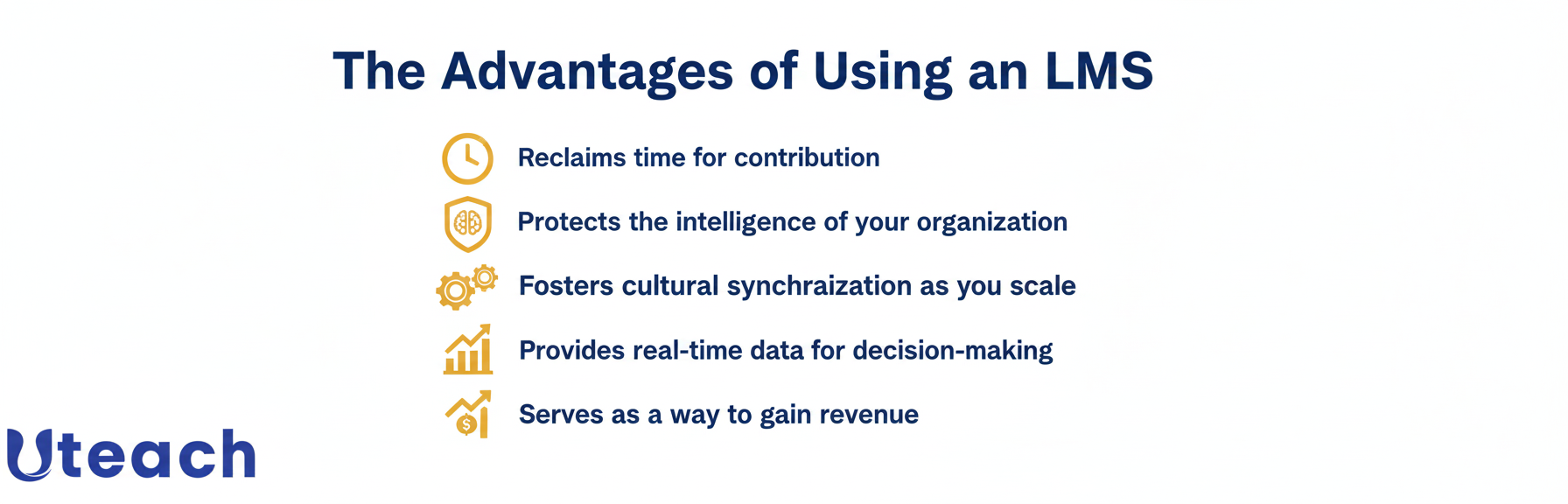
LMS benefit #1: Reclaims time for contribution
LMS benefit #2: Protects the intelligence of your organization
LMS benefit #3: Fosters cultural synchronization as you scale
LMS benefit #4: Provides real-time data for decision-making
LMS benefit #5: Serves as a way to gain revenue
If you search for LMS benefits, you will see the same claims repeated everywhere. An LMS centralizes eLearning. It makes training more efficient. It improves onboarding. It supports skill development. All of that is true, but these are operational conveniences, not business arguments. They explain what the system does, not why it matters to the financial and strategic health of your organization.
The real question is what advantages an LMS offers in terms of return on investment. How does it protect revenue, accelerate contribution, reduce operational leakage, and support scalable growth? The strategic pillars of any growing organization are time to productivity, knowledge retention, execution consistency, compliance readiness, and the ability to extend expertise into new value streams.
An LMS becomes vital when viewed through these lenses because it directly strengthens each of them in measurable ways. Let us examine the benefits of a modern and functional LMS solution from a business perspective.
What is the Learning Management System really for?
A Learning Management System is used to organize, deliver, and control how training and operational knowledge are assigned, completed, and tracked. Companies use it to centralize onboarding programs, role-based training, compliance certifications, and process education so that every employee follows the same requirements without manual coordination. Instead of managing training through spreadsheets, email reminders, and disconnected tools, the LMS automates enrollment, monitors completion, stores records, and provides visibility into who is qualified to perform specific tasks.
Common use cases include
- onboarding new hires with structured learning paths,
- managing mandatory compliance training and audit documentation,
- enabling continuous professional development, training distributed teams using standardized materials,
- certifying partners or training customers on products and services, and maintaining a searchable knowledge base tied to real job functions.
LMS is not just about automating the training process and onboarding. It directly affects your organization revenue.
- 42% of companies see an increase in revenue after implementing e-learning. Employees deliver $30 of increased productivity for every $1 invested in e-learning.
- LMS drives up to 92% higher employee engagement, performance, and retention.
How can an LMS solution help your organization increase revenue and employee engagement? Let’s discuss the benefits LMS offers in more detail.
Also see: 15 Best Employee Training Software Reviewed
LMS benefit #1: Reclaims time for contribution
A common misconception is that the use of LMS helps to better train and onboard employees. But in reality, the key benefit is that you are buying back productive time that you are currently paying for but not receiving.
Most organizations underestimate how long it takes for a new hire to become useful, not just employed. Many companies report 8 to 12 months before a new hire reaches full productivity under conventional onboarding structures. The reason is that for them, onboarding means scheduled sessions, shadowing, and fragmented knowledge access in the company wikis, if there are.
During those early weeks, new employees spend most of their time just searching for the information they need to do their jobs. Meanwhile, the Value of Enterprise Intelligence report mentions that effectively managing employee knowledge assets directly impacts 22% of annual revenues.
All that means that operational inefficiency costs your company money. You are paying salary, benefits, and management time while the employee is still assembling context manually.
Now multiply that by every hire.
How does the LMS contribute to faster onboarding and training?
An LMS compresses time-to-contribution because it removes three structural bottlenecks that exist in traditional onboarding:
- Waiting for the training to happen
Onboarding with a modern LMS solution allows knowledge transfer before day one through preboarding content and structured learning paths.
- Manager-dependent knowledge delivery
The learning environments that LMS provides eliminate repeated explanations and coordination work that previously consumed HR.
- Fragmented information discovery
Centralized, searchable knowledge access saves new hires measurable weekly time. You are able to deliver a structured and effective onboarding program. And the organizations who are able to do so reach 50% increase in employee productivity.
Related: Checklist For Training New Employees
Let me translate that into financial logic.
If an employee needs 6.5 months to become productive and you reduce that by even 30%, you are effectively gaining back nearly two months of contribution per hire.
This is why LMS adoption is often tied directly to measurable labor efficiency outcomes:
- Mid-sized enterprises report LMS adoption reducing training workload by up to 10,000 hours annually.
- Many see a positive return within the first year, with reported average ROI exceeding 200 percent over three years.
Another benefit for implementing and LMS solution is that traditional onboarding consumes experienced employees. According to a LinkedIn study, HR teams could reduced administrative onboarding effort from 20 hours per hire to 6 hours after implementing structured digital workflows.
In short
An LMS industrializes onboarding so contribution begins earlier, scales consistently, and stops relying on tribal knowledge. That is why the first real benefit is not learning improvement. It is recovered time, converted into output.
We have seen that first-hand at Uteach. With Uteach LMS businesses and organizations were able to reduce onboarding time by 65%. At the same time, HR worklodas was cut by 40%.
LMS benefit #2: Protects the intelligence of your organization
Let us imagine you do not have an LMS solution yet.
When a key employee leaves, you are not just replacing a role. You are rebuilding knowledge you already paid to create.
Most organizations assume their processes are documented because they have files, slide decks, or scattered SOPs. Yet, different research sources point out there is a huge gap real know-how and the documentation your teams are supposed to have.
- Companies lose $31.5 billion annually due to poor knowledge sharing, according to an IDC study.
- Another study highlighted in Forbes found that 42 percent of institutional knowledge resides solely within individual employees. When those employees leave, organizations lose access to nearly half of what they know.
That means your organization ends up paying three times:
- You paid to develop that expertise.
- You paid again while it walked out the door.
- You pay a third time to rediscover it.
How an LMS solution stops tribal knowledge
An LMS changes the model from person-dependent knowledge to system-embedded knowledge. Here is what that looks like in practice:
- Knowledge becomes part of the workflow
Processes are translated into repeatable learning paths, simulations, and recorded expertise while employees are still performing the work. As a result, the employee performance improves.
- Version control
Instead of static documents living in folders, LMS content evolves alongside process changes. Updates propagate automatically to everyone, so knowledge does not fragment across teams.
- Onboarding uses proven knowledge
When someone new steps in, they inherit a structured representation of the role as it was successfully executed, not a guess based on partial handovers. Because let’s be honest, every senior employee develops their own processes of doing things, which is different from the standard.
Let’s review this from the ROI perspective. The advantage of implementing an LMS solution is that
- Transition time between employees shortens because learning is based on preserved expertise, not rediscovery.
- Fewer operational mistakes occur during role changes because tacit knowledge has already been translated into guidance.
- Senior employees spend less time reteaching foundational information and more time advancing work.
In short
Organizations lose billions each year because knowledge lives inside people instead of systems, with 42 percent of critical expertise often undocumented. An LMS prevents this loss by structurally capturing, maintaining, and redistributing employee know how, turning individual experience into a permanent organizational asset that continues generating value even after employees move on.
LMS benefit #3: Fosters cultural synchronization as you scale
Growth does not break companies because of the workload. It breaks them because of the inconsistency.
When you move from 10 people in one room to 100 people across locations, you lose something that was previously automatic. Shared understanding. At a small size, culture spreads through proximity. People observe how decisions are made, how quality is judged, and how customers are treated. No formal system is needed because alignment happens organically.
Once you scale, that mechanism disappears.
Without a structured learning system, cultural transmission becomes manager-dependent. Each new team lead explains the company in their own way. Each office interprets standards slightly differently. Training becomes localized storytelling.
The cost is not visible in training hours. It shows up in rework, brand inconsistency, slower execution, and internal friction.
In other words, you are scaling headcount faster than you are scaling clarity.
Without an LMS solution, you rely on instructor-led onboarding or shadowing models. But traditional models fail when:
- Hiring happens continuously rather than in batches.
- Teams operate in different time zones.
- Managers prioritize operational delivery over cultural explanation.
How an LMS operationalizes your company culture
An LMS allows you to codify not just what employees do, but how and why they do it.
- Use cases, case-based exercises, and operational simulations ensure that someone in London and someone in Washington are trained to resolve situations using the same logic and standards, not a translated version filtered through management layers.
- When priorities shift or processes evolve, you change the source once. The LMS redistributes the updated guidance everywhere.
- You can see whether teams actually understand strategic priorities through assessments and engagement data. Alignment stops being anecdotal and becomes observable.
As a result:
- Expansion does not require re-explaining the company every time you hire.
- Brand consistency holds even as organizational complexity increases.
In short
Organizations that scale without a system for transmitting intent often discover they have built multiple versions of themselves. An LMS prevents that divergence by acting as a central distribution layer for how the organization thinks and operates.
LMS benefit #4: Provides real-time data for decision-making
In some organizations, Learning and Development still operates as a checkbox activity.
- You bring in an expert.
- You run workshops.
- You host training days.
- You collect attendance sheets and maybe a feedback form.
Then everything disappears into folders, spreadsheets, or emails that no one revisits.
From a business perspective, that is an unmeasured expense that you cannot later justify to the leadership.
This fragmentation becomes especially risky in regulated industries where proof of training is not optional. You need defensible records, version control, and traceability.
The result is that you can spend money on development, but cannot prove readiness, effectiveness, or compliance.
How an LMS turns training into measurable infrastructure
- Every learning activity becomes automatically logged
Completion records, assessment results, timestamps, and certifications are recorded without administrative effort. You no longer chase documentation. The system generates it.
- Audit readiness is continuous
For regulated environments, LMS platforms maintain verifiable training histories, ensuring you can demonstrate compliance at any moment rather than reconstructing evidence under pressure.
- Recertification is automated
Instead of relying on managers to remember renewal timelines, the LMS assigns retraining, sends reminders, and prevents lapses in required knowledge.
- Leadership gets visibility into capability gaps
Dashboards show where teams struggle, where adoption is low, and where additional enablement is required. Training stops being based on intuition and starts being guided by actual performance signals.
In short
With real-time visibility, training is no longer a sunk cost. It becomes an accountable function tied to risk reduction, operational readiness, and workforce capability.
LMS benefit #5: Serves as a way to gain revenue
Some organizations evaluate an LMS purely as an internal tool.
They see it as a place to train employees, manage onboarding, or host compliance materials. What they miss is that the same infrastructure can be used externally to generate revenue.
Your expertise already exists. The LMS allows you to package, distribute, and monetize it.
Companies routinely train:
- Customers on how to use their products.
- Partners on how to sell or implement solutions.
- Vendors on standards and processes.
- Industry professionals through informal workshops.
How an LMS enables monetization of knowledge
An LMS provides the mechanisms required to transform internal expertise into external offerings:
- Structured external academies
You can build certification programs for customers and partners that standardize adoption while creating paid learning pathways.
- Scalable course delivery
Training is no longer limited by instructor availability. Once created, content can be sold repeatedly without incremental delivery cost.
- Integrated commerce capabilities
Modern LMS platforms like Uteach, allow organizations to price courses, bundle programs, and manage access like any other digital product.
- Brand authority through education
Offering structured training positions your company as the source of expertise in its domain, strengthening both customer loyalty and market positioning.
Unlike enterprise-heavy LMS, Uteach is designed in a way that you can monetize your organization’s knowledge. Apart from building internal training academies, our partners:
- Create branded academies to train customers, partners, or external learners.
- Sell courses, memberships, or certification tracks directly through the platform.
- Manage payments, access control, and learner experience without needing a separate ecommerce infrastructure.
- Scale educational offerings as a parallel revenue stream while using the same system for internal training.
Uteach becomes both an enablement platform and a distribution channel.
FAQ
- What is an LMS?
A Learning Management System is a software platform used to deliver, manage, track, and document training and knowledge within an organization. It allows companies to assign structured learning paths, monitor completion, assess understanding, and maintain a record of employee qualifications. Instead of relying on manual coordination, emails, or scattered documents, the LMS creates a centralized environment where all training activities are standardized and measurable.
Organizations use an LMS to control how knowledge is distributed and applied at scale. It ensures that onboarding, compliance education, operational training, and professional development happen consistently across teams, locations, and roles while providing leadership with visibility into workforce readiness and capability gaps.
- What are the disadvantages of LMS?
An LMS requires upfront investment in setup, content structuring, and process alignment. Companies that implement it without clearly defined learning workflows may find the system underused, as simply purchasing software does not automatically create effective training. Adoption depends on integrating the LMS into daily operations rather than treating it as a separate HR tool.
- What are the advantages of LMS for the employees?
For employees, an LMS removes uncertainty about how to perform their roles by providing structured, role-specific learning they can access on demand. Instead of relying on verbal instructions or searching across multiple sources, employees receive clear expectations, guided development paths, and resources tied directly to their responsibilities, which reduces time spent figuring things out.
It also gives employees visibility into their own growth. They can track completed training, certifications, and skill progression, making professional development more transparent and self-directed. This creates a more predictable learning environment where individuals know what is required to succeed and how to advance.
- What is the best LMS for small businesses?
The best LMS for small businesses is one that balances structure with simplicity. Smaller organizations need a platform that can manage onboarding, compliance, and knowledge sharing without requiring a dedicated technical team. Ease of setup, automation of administrative tasks, and the ability to scale as the company grows are typically more important than complex enterprise features.
Platforms such as Uteach are designed with this balance in mind, allowing small businesses to build internal training, manage learners, and even offer external courses without needing separate systems. The right choice is one that supports both immediate operational needs and future growth.
Book a demo with our team to learn more about how Uteach supports your organizational growth and eases onboarding and training. We will hep you choose the best LMS for your goals.